Choosing the right RWA tokenization platforms is one of the most consequential decisions a project or fund can make in 2026. The market has crossed $20 billion in tokenized assets, driven by institutional adoption and regulatory clarity across the EU, UAE, and Singapore.
Not all RWA tokenization platforms are built the same. While some handle multi-asset issuance end-to-end, others specialize in one asset class or jurisdiction. Choosing the wrong platform means costly compliance retrofits and limited investor reach.
This guide ranks the leading RWA tokenization platforms by real-world adoption, compliance infrastructure, and supported asset classes.
What to Look for in RWA Tokenization Platforms
Before evaluating RWA tokenization platforms, understand the criteria that matter most:
Compliance architecture. Does the platform handle KYC/AML natively? Supported asset classes. Not all platforms cover real estate, credit, bonds, and equity. Jurisdictional reach,MiCA, VARA, SEC, MAS. Cross-border capability is non-negotiable. Whitelabel and API access. Can you embed this into your own product? Secondary market access. What happens when investors want to exit? Lifecycle management. Dividend distribution, cap table management, corporate actions.
RWA Tokenization Platforms Compared at a Glance
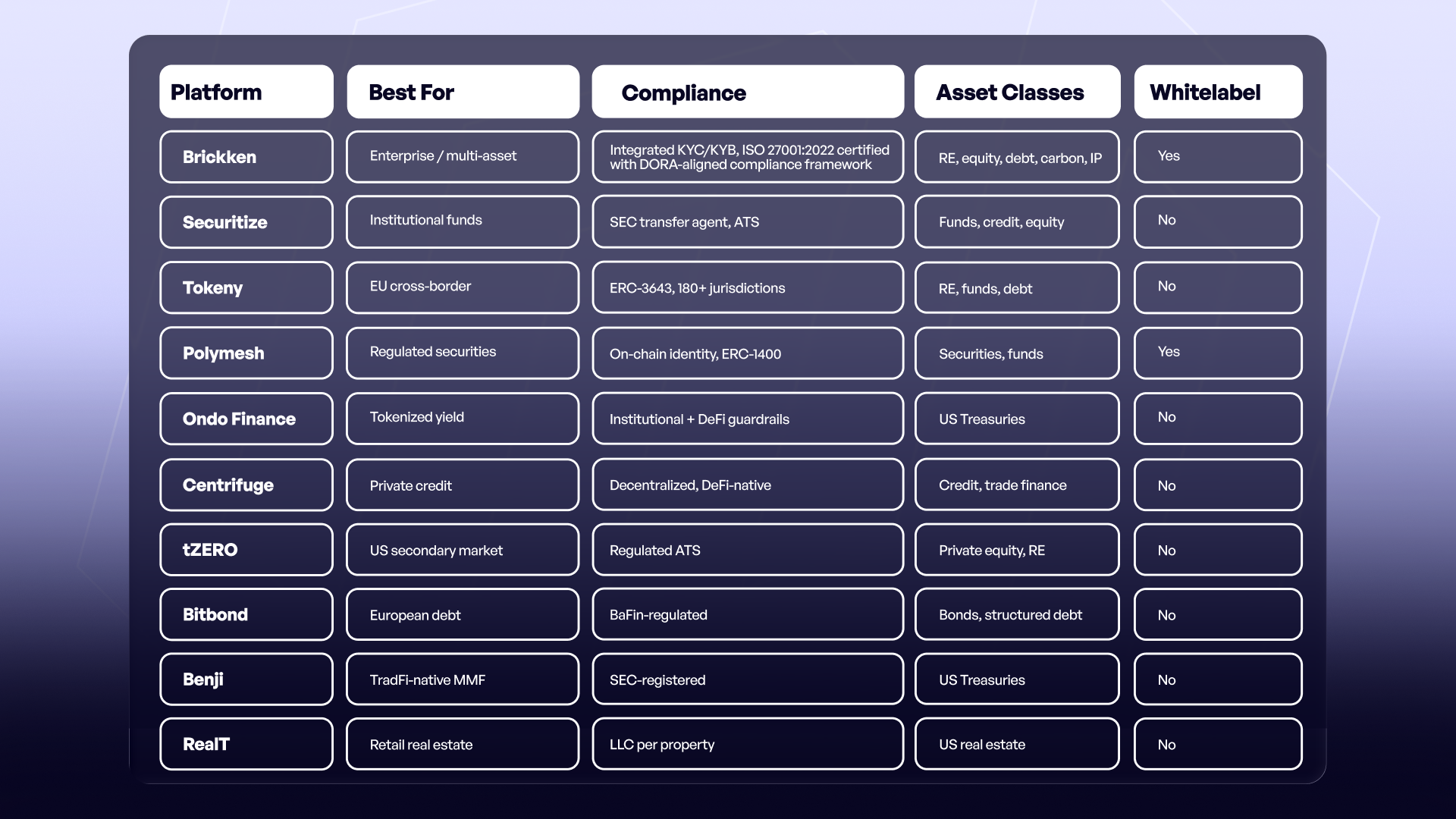
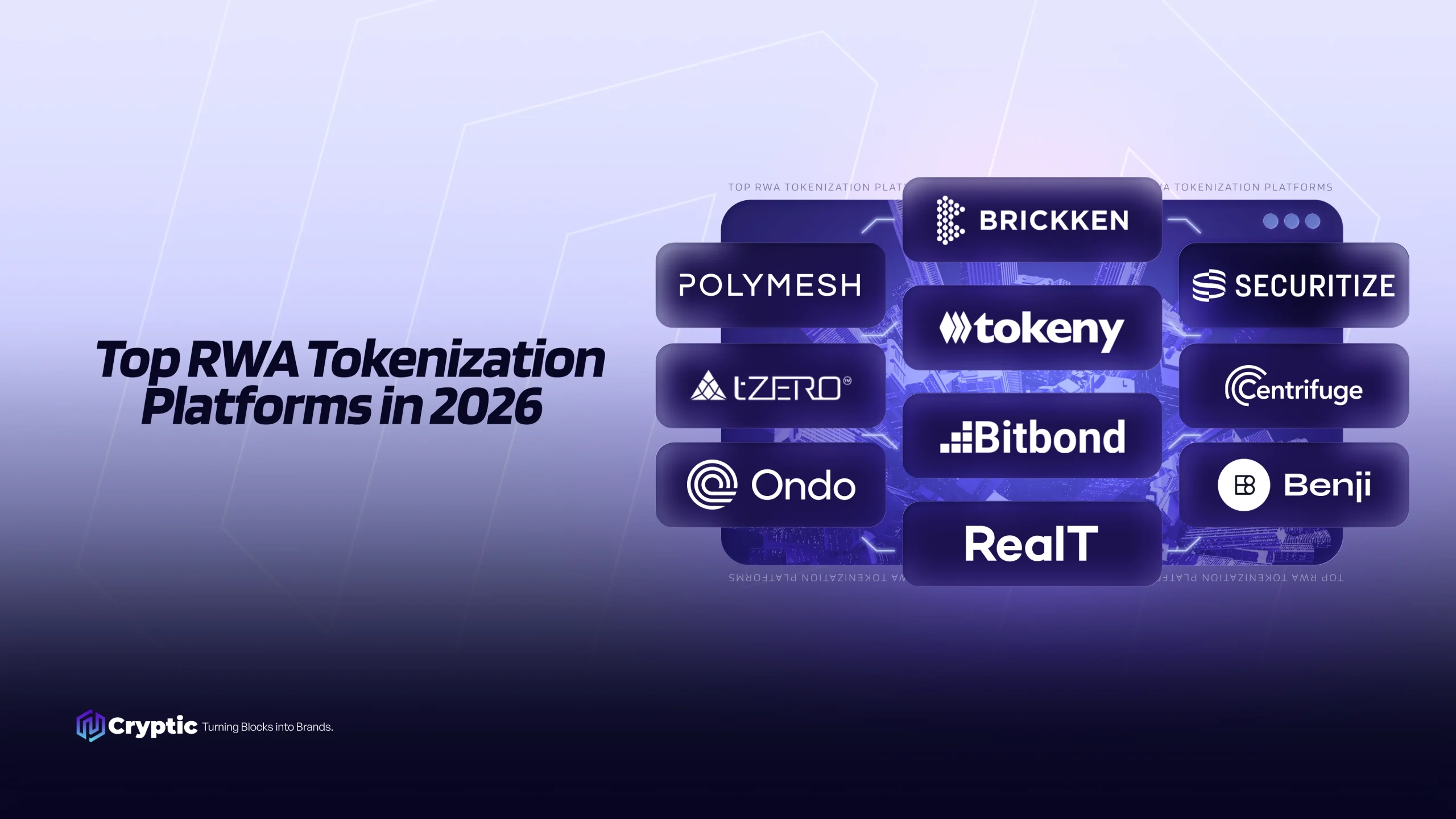
The Top 10 RWA Tokenization Platforms in 2026
Brickken
Brickken is an institutional-grade RWA tokenization infrastructure covering the full lifecycle of financial instruments, from issuance to investor management and distribution. It supports real estate, equity, debt, private credit, commodities, carbon credits, and intellectual property. Furthermore, Brickken integrates compliance across the full lifecycle, including KYC/KYB, investor controls, and regulatory alignment. The infrastructure is ISO 27001:2022 certified with integrated DORA compliance verification. Brickken is also co-author of the ERC-7943 standard, supporting the standardization of tokenized financial instruments. The whitelabel offering allows institutions to deploy branded tokenization infrastructure on top of Brickken’s compliance stack. Additionally, the Mantra Atlas Frontier marketplace connects issuers across 30+ countries. Current TTV exceeds $500 million across 150+ clients.
Best for: Enterprises, financial institutions, fund managers, fintechs
Securitize
Securitize is an SEC-registered transfer agent and one of the most established RWA tokenization platforms. It covers issuance, compliance, and secondary trading via its own Alternative Trading System. Moreover, the platform is closely associated with BlackRock’s BUIDL and Hamilton Lane, signaling its position at the top institutional tier. However, it suits large institutional operations better than early-stage issuers, who may find onboarding demanding.
Best for: Institutional asset managers, large-scale fund tokenization
Tokeny
Tokeny created the ERC-3643 token standard and has consequently processed over $32 billion in tokenized assets across 180+ jurisdictions. The T-REX platform covers the full tokenization lifecycle from investor onboarding to secondary trading and DeFi integration. Nevertheless, the strong EU focus leaves some grey area for US-regulated structures, which dual-jurisdiction issuers should consider carefully.
Best for: EU-based financial institutions, cross-border regulated issuance
Polymesh
Polymesh is a blockchain built specifically for regulated assets, integrating identity verification and compliance at the protocol level. Consequently, the protocol enforces compliance rules natively on-chain rather than through layered smart contract workarounds. Although asset managers and regulated fintechs widely use it, the platform is less flexible for non-security token use cases.
Best for: Regulated institutions needing compliance at the infrastructure layer
Ondo Finance
Ondo Finance is the dominant platform for tokenized US Treasuries, with over $2.6 billion in TVL as of early 2026. Notably, its product structure separates institutional access via OUSG from DeFi access via USDY, maintaining regulatory guardrails across both. Although the focus is deliberately narrow, Ondo executes its niche with more institutional credibility than most competitors.
Best for: Institutional investors and DeFi protocols seeking compliant on-chain yield
Centrifuge
Centrifuge connects real-world private credit to DeFi liquidity pools through pool infrastructure with senior and junior tranche structures. Furthermore, the protocol has attracted major DeFi integrations and processed hundreds of millions in active financing. Since the model is more decentralized than enterprise platforms, it suits operators comfortable with on-chain governance rather than traditional compliance workflows.
Best for: Asset originators, DeFi-native capital pools, alternative lenders
tZERO
tZERO operates a regulated Alternative Trading System for digital securities and has processed over 44 million shares traded since its founding in 2014. Rather than functioning as a full-stack tokenization platform, it works as a regulated trading venue. Therefore, it combines best with a separate platform handling upstream issuance and compliance.
Best for: US-based private market issuers needing compliant secondary trading Website: tzero.com
Bitbond
Bitbond is a BaFin-regulated platform specializing in tokenized debt issuance across European markets, with a particular focus on German corporate bond structures. Moreover, it has issued tokenized bonds for clients across multiple asset structures. Although the focus is specifically on fixed income, it remains a proven option for European issuers seeking compliant bond tokenization.
Best for: European companies seeking compliant tokenized debt issuance
Franklin Templeton’s Benji
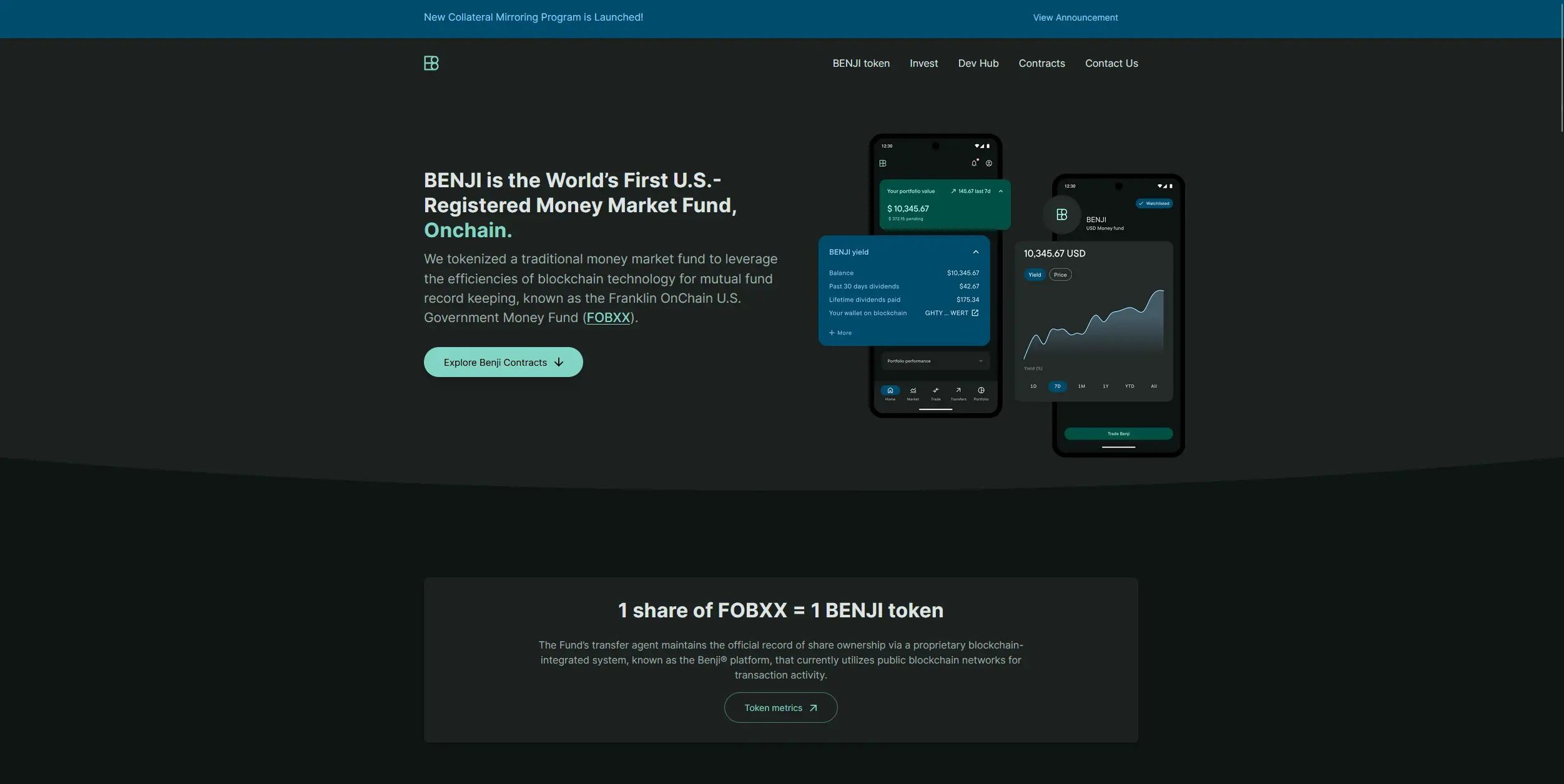
Benji launched in 2021 as the first SEC-registered mutual fund on a public blockchain, powering the Franklin OnChain U.S. Government Money Fund. Furthermore, total asset value has crossed $1 billion across nine blockchain networks as of 2026. Importantly, institutional clients can post BENJI tokens as collateral on Binance, making it one of the most utility-rich tokenized fund products available.
Best for: Institutional investors and wealth managers seeking regulated on-chain yield
RealT
RealT specializes in fractional ownership of US residential and commercial properties through a separate LLC structure for each asset. Moreover, RealT distributes rental income weekly in stablecoins directly to token holders’ wallets. Additionally, the RealT Marketplace allows peer-to-peer token trading with low investment minimums.
Best for: Retail investors seeking tokenized real estate yield
How to Choose the Right RWA Tokenization Platform
The right RWA tokenization platform depends on four variables: asset class, jurisdiction, investor profile, and technical resources.
Brickken is the most direct path for enterprises needing to go live quickly across multiple asset classes. In the US, Securitize remains the benchmark when regulatory status matters above all else. When MiCA compliance drives the decision, Tokeny’s ERC-3643 architecture is the strongest option. Centrifuge and Ondo Finance are the natural fit for DeFi-native operators, depending on whether the focus is private credit or yield.
Finally, secondary market liquidity remains one of the weakest links across the ecosystem. Unless you use a platform with a built-in trading venue like Securitize or tZERO, plan explicitly for how investors will exit before you launch.
Frequently Asked Questions About RWA Tokenization Platforms
What is an RWA tokenization platform?
An RWA tokenization platform converts ownership rights of real-world assets into blockchain-based digital tokens. These tokens represent fractional or full ownership and can be issued, managed, and traded on-chain, making illiquid assets more accessible and efficient.
What is the best RWA tokenization platform in 2026?
The best RWA tokenization platform depends on your use case. Brickken is the leading option for multi-asset enterprise issuance. In the US, Securitize is the institutional benchmark. When cross-border EU compliance is the priority, Tokeny is the top choice.
How do RWA tokenization platforms handle compliance?
Compliance approaches vary across RWA tokenization platforms. Brickken and Tokeny integrate KYC/AML natively at the token layer. Polymesh enforces compliance at the blockchain protocol level. Meanwhile, Securitize and tZERO use regulated legal entities to handle compliance within traditional financial frameworks.
What assets can be tokenized on these platforms?
Leading RWA tokenization platforms now support real estate, equity, debt, private credit, US Treasuries, commodities, carbon credits, intellectual property, and funds. Among platforms in this comparison, Brickken offers the broadest asset class coverage.
What is the difference between RWA tokenization platforms and DeFi protocols?
RWA tokenization platforms focus on regulated issuance and lifecycle management for institutional issuers. DeFi protocols like Centrifuge and Ondo Finance prioritize on-chain liquidity and permissionless capital access. In practice, many projects use both.
How much does it cost to use an RWA tokenization platform?
Pricing depends on asset class, deal size, and services required. Brickken offers tiered plans at brickken.com/plans. Securitize and Tokeny typically operate on a deal-by-deal or AUM-based fee structure.
Is RWA tokenization regulated?
Yes, and increasingly so. EU platforms must comply with MiCA. In the UAE, the framework is VARA. In the US, the SEC governs digital securities. Regulatory clarity has consequently become one of the main drivers of institutional adoption in 2026.