Picking the wrong KOL is expensive in ways that go beyond wasted budget. A misaligned placement reaches an audience that was never going to convert. A creator with inflated metrics generates impressions with no downstream action. A KOL with a history of undisclosed promotions transfers reputational risk to your project the moment they post. None of these outcomes show up in the follower count that looked impressive in the initial search.
This guide is built around one question: how do you identify a KOL whose audience will actually respond to your project? The answer is a repeatable five-step vetting process, from campaign objective through to controlled testing, that filters out the wrong choices before the budget is committed.
The 5-Step KOL Vetting Framework
The most common KOL selection mistake is starting with the creator and working backward to justification. The correct sequence is the opposite: start with your campaign objective, define the audience characteristics that would respond to it, and then find the creators who reach that audience with genuine authority.
STEP 1: Start With Campaign Objective, Not Creator Profile
Before evaluating any creator, define what a successful campaign actually looks like. The metric that matters will determine everything about which KOL type is the right fit, and the answers are not interchangeable.
Awareness at scale: You need reach above everything else. Mid-tier to macro KOLs with broad crypto audiences are appropriate. Engagement depth matters less than impression volume and brand familiarity.
Targeted education for a technical audience: You need a creator whose audience already understands the category, DeFi, infrastructure, RWA, and whose format supports deep explanation: threads, long-form YouTube, podcasts. Reach matters less than audience sophistication.
Wallet connects and on-chain conversions: You need micro and mid-tier KOLs with high engagement rates in your specific user category. The audience must be active market participants. Follower count is largely irrelevant; conversion history per post is everything.
Investor credibility and ecosystem signaling: You need KOLs whose audience includes builders, investors, and ecosystem participants, not just retail traders. Platform matters here: X and podcasts outperform TikTok for this objective.
Once the objective is defined, every subsequent vetting criterion has a clear filter to apply against it.
STEP 2: Evaluate Audience Quality
Audience quality is the variable that determines whether a KOL partnership delivers real outcomes or just impressive dashboard numbers. There are four specific signals to check, all of which can be evaluated manually before any analytics tool is needed.
Comment depth: Read the last 20–30 comments on recent posts. Real engagement includes substantive replies, disagreements, questions that reference specific content, and follow-up threads. Short generic phrases repeated by accounts with no profile history are the clearest indicator of purchased or incentivized engagement.
Engagement rate relative to follower count: For X, a healthy engagement rate is above 1% for accounts above 100K followers; higher is expected for smaller accounts. For YouTube, watch time per video relative to subscriber count is more meaningful than like count. For TikTok, completion rate and share count signal real audience interest.
Audience geography: Confirm that the creator’s audience matches your target market. High follower counts concentrated in low-relevance geographies inflate reach metrics without delivering conversions in your actual market. Most legitimate creators will share audience analytics on request.
Audience consistency with the creator’s niche: A DeFi analyst whose follower base suddenly includes large numbers of accounts following general entertainment content has likely had a viral moment that inflated numbers outside their core audience. The core audience is what matters for a crypto project partnership.
Cryptic perspective: Audience geography is the most frequently overlooked quality check. We have reviewed KOL proposals where 40–60% of the audience was located in markets irrelevant to the client’s launch geography. The reach numbers looked strong. The conversion potential was close to zero.
STEP 3: Audit Content Credibility and Consistency
A KOL’s content history is their track record. Review at least 3 months of posts before reaching a decision. You are looking for three specific qualities.
Category consistency: Does the creator regularly cover topics genuinely relevant to your project? A crypto analyst who has spent months discussing DeFi yield mechanics is a credible partner for a DeFi protocol. The same creator who pivoted to NFT gaming last month and memecoin analysis this week is chasing narrative rather than building expertise, and their audience’s trust follows the expertise, not the creator.
Intellectual honesty: The most trustworthy KOLs push back on projects they do not believe in, ask hard questions in interviews, and distinguish clearly between their personal views and sponsored content. Creators who are uniformly positive about everything they cover are either not being honest with their audience or are covering everything with equal conviction, which means your placement competes with 50 others for the same credibility.
Format and depth matched to your message: Some projects require explanation to convert. If your project has a complex value proposition, a KOL whose format is 60-second takes will not give you the depth the audience needs to understand what you are building. Match the content format to the information density your campaign requires.
STEP 4: Check Reputation and Disclosure History
Reputational risk is a transfer problem in crypto. A KOL who has been associated with failed projects, undisclosed promotions, or community manipulation carries that history directly into any campaign they run for you. The search takes 15 minutes and is not optional.
Search the creator’s name alongside ‘scam,’ ‘rug pull,’ ‘pump and dump,’ and ‘shilled’ to surface prior community concerns
Review whether past sponsored posts were clearly labeled as paid content, FTC and equivalent international regulations require disclosure, and creators who hide it habitually will do so with yours
Check whether the creator has publicly responded to criticism or controversy constructively, the response to adversity is more revealing than any positive signal
Assess their current community standing: are they trusted voices in the spaces they claim to represent, or are they known primarily as pay-to-post accounts?
One prior undisclosed pump-and-dump association is sufficient grounds to remove a creator from consideration regardless of how well their other metrics perform. The community remembers, and association transfers directly to your project’s brand.
STEP 5: Test Before You Scale
No vetting process, however thorough, predicts campaign performance with certainty. The correct approach is to treat the first campaign with any new KOL as a structured test, not a full deployment. This protects budget and generates the data needed to make scaling decisions on evidence rather than assumption.
A structured test looks like this: allocate a defined small budget, typically $3,000–$10,000 depending on the creator tier, to a single post or content piece with a unique referral link and a clearly defined conversion target. Run three to five creators simultaneously rather than sequentially. Compare wallet connects, community joins, or on-chain activity per creator within the 48–72 hours following each post.
The creators whose audiences actually converted get deeper relationships and larger subsequent budgets. The ones who generated impressions without downstream action get dropped, regardless of how compelling the initial pitch looked. This discipline, testing before scaling, is the difference between KOL programs that compound and ones that burn budget chasing a creator profile that never translated into results.
Cryptic perspective: We recommend running initial KOL tests with 3–5 creators simultaneously rather than one at a time. Sequential testing takes months and gives you no comparative baseline. Simultaneous testing across creators at similar tiers gives you directional data in two weeks and clear allocation guidance for the main campaign.
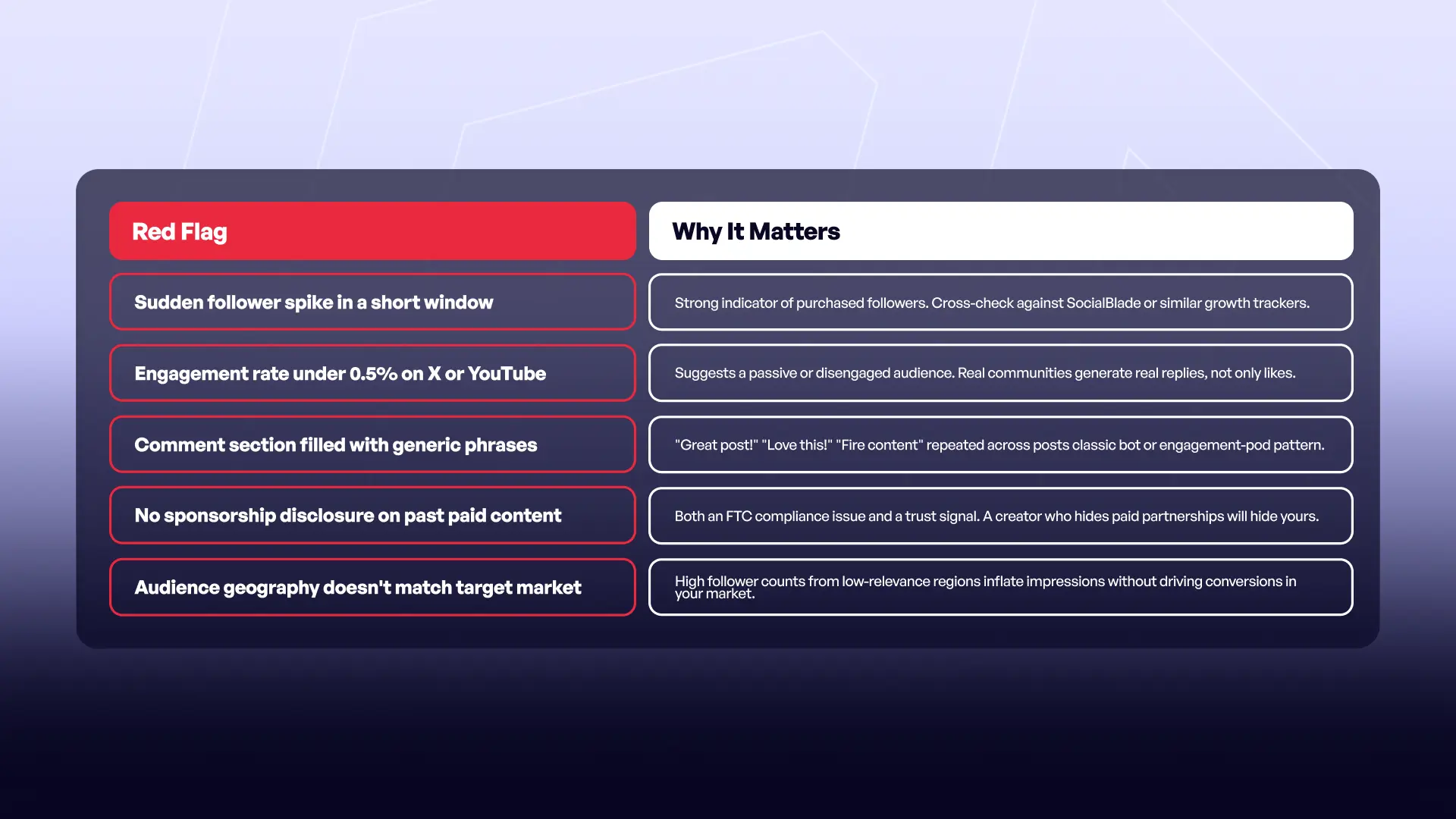
Red Flags That Should End the Conversation
These signals indicate either audience fraud, reputational risk, or structural campaign problems. Any one of them is sufficient to remove a creator from consideration.
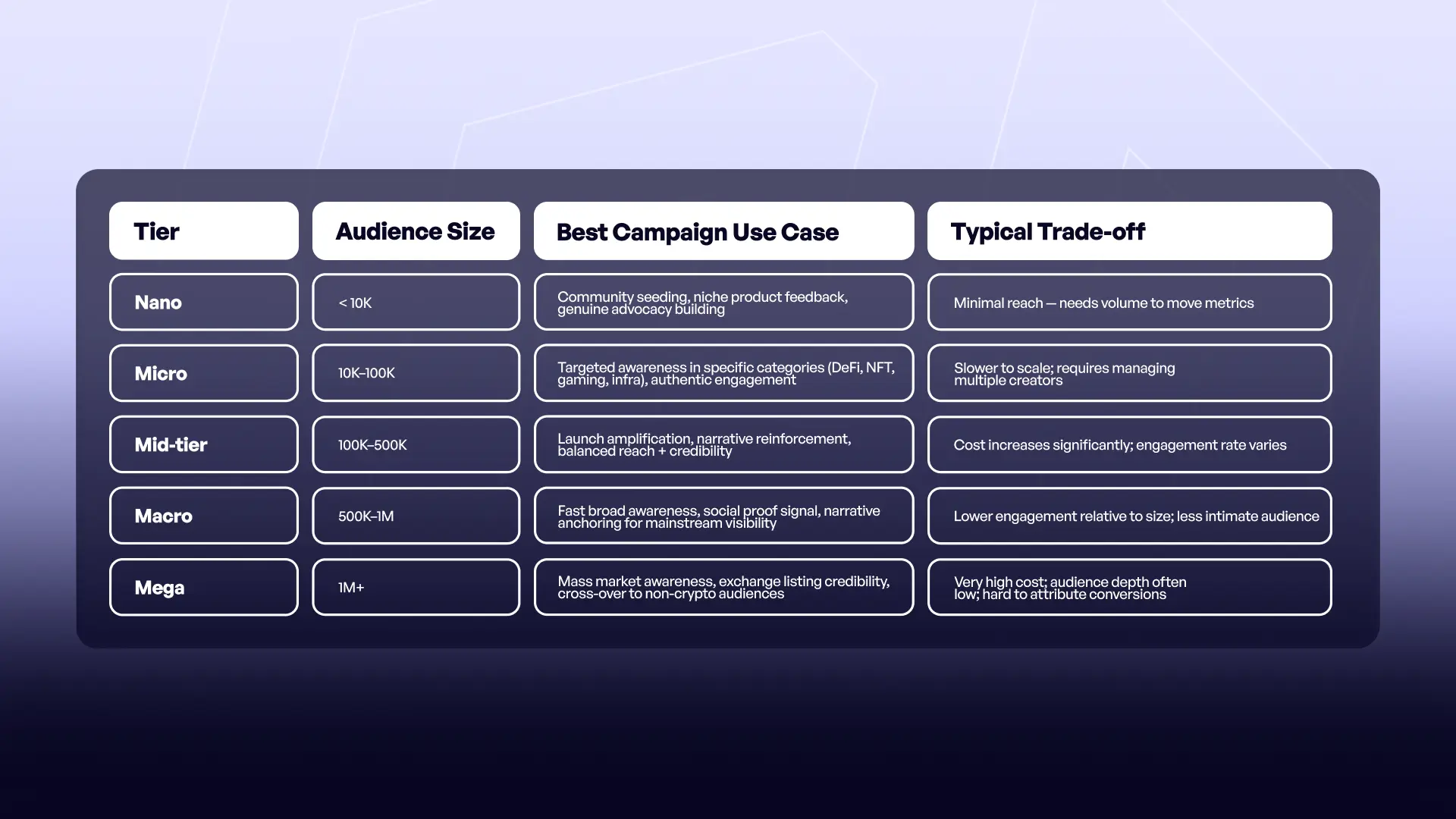
KOL Tiers: What Each Level Is Actually Good For
Tier is a starting point for campaign planning, not a quality signal. The most effective campaigns mix tiers intentionally: micro and nano creators for credibility and community depth, mid-tier for narrative amplification, macro or mega for fast broad awareness at launch moments when speed matters most.
Frequently Asked Questions
What is the single most important KOL vetting signal?
Audience quality, specifically, whether the audience actively engages with the creator’s content in your category. Follower count tells you potential reach. Comment quality, reply depth, and conversion history tell you whether that reach turns into action.
How do I tell if an influencer’s engagement is real?
Look at the nature of comments, not just the volume. Real engagement includes questions, disagreements, follow-up threads, and replies that reference specific content points. Repetitive short phrases, accounts with no profile history, and comments from accounts following thousands of others with no followers of their own are the clearest bot signals.
Should I prioritize reach or niche alignment?
Niche alignment first, every time. A KOL with 80,000 followers who lives in your product’s exact category will outperform one with 800,000 general crypto followers. The audience already cares about what you are building, you are not convincing them the category matters, you are simply getting in front of people who already know it does.
How much should I budget for a test campaign?
Run initial tests with three to five micro or mid-tier KOLs using dedicated referral links and a defined conversion target. Budget between $5,000 and $20,000 for the test phase. The goal is not returns from the test, it is data. Which creators drove actual wallet connects, community joins, or on-chain actions? Scale those relationships and cut the rest.
The Right KOL Is a Strategic Decision
Most KOL selection errors come from optimizing for the wrong variable at the wrong stage: chasing reach when you need conversion, prioritizing cost when you need credibility, or moving quickly when the decision requires patience and audit. The five-step framework above structures the decision in the right sequence: objective first, audience quality second, content credibility third, reputation fourth, and controlled testing before scale.
If you want access to a curated KOL network with verified audience quality and campaign history across X, YouTube, TikTok, and podcasts, connect with Cryptic. We match projects to KOLs based on real campaign fit and we manage briefing, attribution, and performance tracking from first contact through post-campaign reporting.