The best venture capitals in 2026 for Web3 and crypto projects are not simply the ones with the largest funds. They are the firms that deploy capital with conviction, provide genuine operational support beyond the check, and have built track records across multiple market cycles. That distinction matters more now than it did in 2021, when almost every fund was writing cheques into anything with a token.
Crypto venture funding topped $19 billion by mid-October 2025, a level that confirms sustained institutional appetite despite a period of compressed valuations and regulatory uncertainty. The first quarter of 2025 alone saw blockchain startups raise $4.8 billion, the strongest single quarter since late 2022. However, capital is concentrating: the top 30 venture funds captured 75% of all VC fundraising in 2024, and the bifurcation between tier-one firms and the rest has widened significantly.
For founders, this means the firm you choose matters far more than the round size. A cheque from Paradigm or a16z opens different doors than one from a first-time fund, and the wrong investor at the wrong stage can constrain your trajectory more than an empty bank account. This guide profiles the ten best venture capitals actively deploying into Web3 and crypto in 2026, covering their investment thesis, stage focus, check sizes, notable portfolio companies, and what they actually look for from founders.
Key context: In 2026, the strongest investment tailwinds are in stablecoin infrastructure, real-world asset (RWA) tokenization, AI and blockchain convergence, DePIN, and institutional-grade DeFi. The firms that have built clear theses around these themes are the most active deployers right now.
The State of Venture Capital in Web3 in 2026
The venture capital landscape for crypto projects has undergone structural change since the 2021–2022 peak. Three trends define the current environment for founders raising in 2026.
Capital Is Concentrating at the Top
In 2024, just nine funds raised 46% of all venture capital globally. Andreessen Horowitz alone captured roughly 10% of the year’s total. LPs have moved into a flight-to-quality posture, concentrating capital in firms with strong distribution track records. For crypto founders, this means the gap between getting a meeting at Paradigm and getting one at a mid-tier fund has widened, but the firms that do commit are deploying with greater conviction and larger cheques than they were two years ago.
Tokens and Equity Are Now Treated Differently
The regulatory clarity that has emerged in 2025 and 2026, particularly in the US, EU, and Singapore, has forced VCs to be more precise about whether they are making equity investments, token investments, or both. Firms like Paradigm and a16z have refined their legal structures to accommodate both instruments. DWF Labs has built a model that explicitly combines venture and market-making in a single partnership. Founders now need to understand exactly what instrument a VC is acquiring and what alignment that creates, because token vesting, governance rights, and liquidity timelines differ substantially across deal structures.
Operational Support Is the Real Differentiator
The best venture capitals in 2026 compete less on cheque size than on what comes with the cheque. a16z’s platform includes dedicated teams for recruitment, regulatory strategy, media, and security. Pantera provides exchange listing relationships and DeFi ecosystem connections. Binance Labs offers direct integration into the world’s largest exchange ecosystem. For crypto projects specifically, this operational layer, particularly around token distribution, KOL access, exchange listings, and community building, determines whether a raise translates into real market traction. Many founders pair their raise with a dedicated crypto marketing agency to handle this layer in parallel.
What to Look for in a Venture Capital Partner
Not every VC is the right fit for every stage or project type. Before approaching any firm on this list, evaluate them against these four criteria.
Thesis Alignment
The best venture capitals have specific, public theses. Paradigm publishes research papers. Multicoin writes long-form investment arguments. a16z produces the State of Crypto report annually. If a firm has not published a view on your sector in the past 12 months, they are unlikely to have conviction when your pitch lands. Map your project to the firm’s stated thesis before reaching out.
Stage and Check Size Fit
Approaching a growth-stage fund at pre-seed is a waste of everyone’s time. Coinbase Ventures and Electric Capital are active at the earliest stages with smaller cheques. Paradigm and a16z deploy at seed but their typical engagement size suggests projects with significant traction. DWF Labs can deploy $50M+ into a single round for established protocols. Know where you sit on the maturity curve before building your target list.
Geographic and Regulatory Alignment
Regulatory environment shapes which investors can lead your round. US-regulated projects benefit from Coinbase Ventures’ compliance infrastructure and a16z’s deep policy relationships. Asia-Pacific projects benefit from HashKey Capital’s licensed rails and Binance Labs’ regional network. Projects navigating the EU’s MiCA framework benefit from VCs with established European relationships. DWF Labs has offices in Dubai, Singapore, and the US, which matters for projects targeting multi-jurisdiction distribution.
Portfolio Network Value
A VC’s portfolio is the network you gain access to. Paradigm’s portfolio includes Uniswap, Optimism, Magic Eden, and Phantom. Being a Paradigm portfolio company opens specific doors in the DeFi and infrastructure world. Binance Labs’ portfolio is the Binance ecosystem. Coinbase Ventures’ portfolio includes projects that get distribution advantage on the largest US exchange. Choose the network that accelerates your specific go-to-market.
Comparison: Best Venture Capitals for crypto in 2026
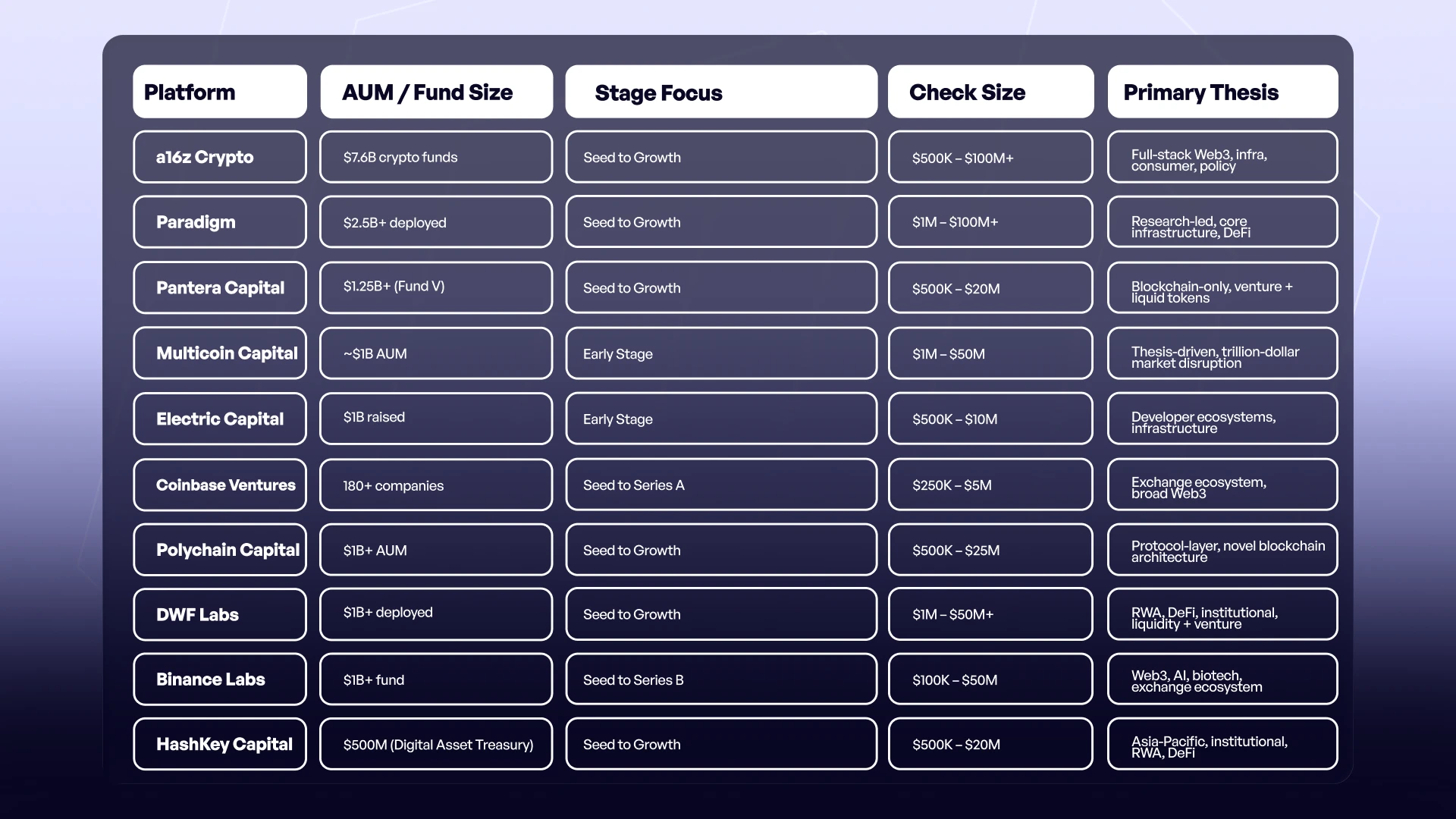
The table below provides a reference overview of each firm’s core parameters. Detailed profiles follow.
Andreessen Horowitz (a16z Crypto)
Best full-stack venture capital platform for Web3 founders
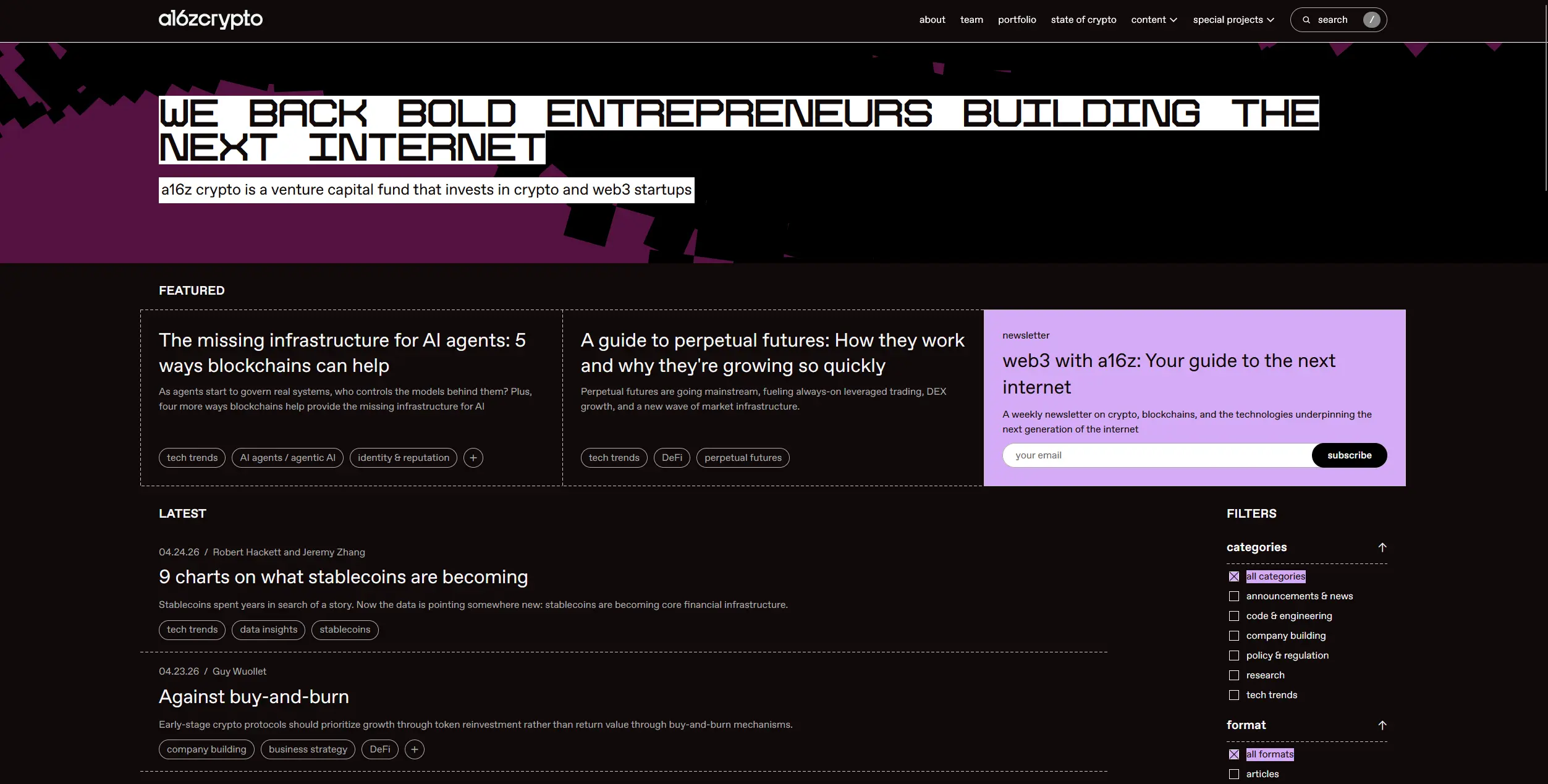
Andreessen Horowitz is the most complete platform investor in the Web3 category. Its dedicated crypto fund, which has raised $7.6 billion across multiple vehicles, is backed by an operating layer that most firms cannot replicate: dedicated teams for recruitment, security, regulatory strategy, policy, media (Future), governance, and the CSX accelerator programme for early-stage founders. a16z does not simply write cheques. It provides ongoing support across company-building dimensions that go well beyond capital, which is why the firm consistently wins the most competitive deals despite rarely being the highest bidder.
The firm’s investment thesis spans the full Web3 stack: Layer 1 and Layer 2 infrastructure, DeFi protocols, consumer applications, wallets, developer tools, and institutional adoption pathways. Recent activity has concentrated around stablecoins, AI and blockchain convergence, and the institutional infrastructure needed to bring traditional financial rails on-chain. The State of Crypto report a16z publishes annually has become one of the most closely watched research documents in the industry, and founders who can benchmark their metrics against it are significantly better positioned when pitching.
Key Details
- Founded: 2009 (dedicated crypto fund launched 2018)
- Crypto AUM: $7.6B raised across crypto-dedicated funds
- Stage: Seed through growth; also token investments and private sales
- Check size: $500K to $100M+ depending on stage and instrument
- Notable portfolio: Solana, Uniswap, Optimism, EigenLayer, OpenSea, Coinbase, MakerDAO, Phantom
- Best fit: Projects that need capital plus heavyweight platform support across hiring, policy, and ecosystem positioning
Paradigm
Best research-driven investor for core infrastructure and DeFi
Paradigm is the most technically credible venture capital firm in crypto. Founded in 2018 by Matt Huang (former Sequoia Capital) and Fred Ehrsam (Coinbase co-founder), the firm has built its identity around research-led investing and deep technical engagement with portfolio companies. Paradigm’s researchers and engineers regularly contribute to protocol codebases, audit smart contract security, and co-author EIPs and technical standards, a level of builder involvement that no other major VC replicates consistently.
The firm’s portfolio reads as a map of the most important infrastructure in DeFi and the broader crypto stack: Uniswap, Optimism, Ethereum-adjacent tooling, Magic Eden, Phantom, and Compound. In 2025, Paradigm co-financed a $500 million raise for Tempo, the largest single blockchain startup round of the year, signalling that it is comfortable deploying at scale when conviction is high. Check sizes range from $1 million at the earliest stage to $100 million-plus for growth investments. The firm is the right choice for teams building core systems, consensus mechanisms, market microstructure, cryptographic primitives, novel DeFi architecture, rather than consumer applications built on top of existing infrastructure.
Key Details
- Founded: 2018
- AUM: $2.5B+ deployed across funds
- Stage: Seed through growth; early-stage conviction is a signature
- Check size: $1M to $100M+
- Notable portfolio: Uniswap, Optimism, Magic Eden, Phantom, Compound, Arbitrum
- Best fit: Technical founders building foundational protocol infrastructure, market structure, or novel DeFi primitives
Pantera Capital
Best established crypto-only venture fund with deep DeFi and payments thesis
Pantera Capital is the oldest institutional crypto-focused investment firm in the United States, having launched its blockchain venture funds in 2013. Over more than a decade in the market, Pantera has developed one of the deepest playbooks for investing across the full crypto cycle, covering both venture equity in companies and direct token investments in protocols. Its portfolio spans exchanges (Bitstamp), infrastructure (Circle, Polkadot), DeFi (Balancer), payments (Ripple), and consumer crypto, giving it breadth that most crypto-native VCs cannot match.
In 2025, Pantera raised a $1.25 billion Solana treasury vehicle, signalling strong conviction in Solana’s continued institutional adoption and making it one of the most aggressive institutional buyers of SOL in a single vehicle. The firm is currently raising its fifth venture fund. Managing Partner Paul Veradittakit has stated that Pantera has consistently outperformed traditional venture capital since 2013. For founders raising from a firm with a proven multi-cycle track record and strong DeFi, exchange, and payments network effects, Pantera is among the most strategically valuable partners on this list.
Key Details
- Founded: 2013
- Fund size: Fifth venture fund in raise; $1.25B Solana treasury vehicle raised 2025
- Stage: Seed through growth; venture and liquid token strategies
- Check size: $500K to $20M venture; larger for token positions
- Notable portfolio: Circle, Bitstamp, Ripple, Coinbase, Polkadot, Filecoin, Cosmos, 0x
- Best fit: Founders in DeFi, payments, exchange infrastructure, or custodial services who want a crypto-only partner with a 10+ year track record
Multicoin Capital
Best thesis-driven VC for trillion-dollar market disruption bets
Multicoin Capital is the most opinionated major venture capital firm in crypto. Founded in 2017 by Kyle Samani and Tushar Jain in Austin, Texas, the firm explicitly describes itself as thesis-driven: it makes long-term, high-conviction investments in category-defining companies and protocols, and actively publishes its reasoning in long-form investment theses that have shaped how the industry thinks about token economics, validator networks, and the application layer.
Multicoin was among the earliest and most vocal institutional supporters of Solana, Helium, and The Graph, all now significant protocols, and its track record of identifying infrastructure plays before they became consensus has earned it sustained LP trust. In 2025, Fortune reported that Multicoin’s AUM grew over 50% year-on-year as crypto markets recovered. The firm manages approximately $1 billion in assets across its venture and hedge fund vehicles. Its venture fund backs early-stage founders with cheques ranging from $1 million to $50 million, and the firm actively assists portfolio companies on tokenomics design, go-to-market execution, and exchange relationships.
Key Details
- Founded: 2017
- AUM: ~$1B across venture and hedge fund
- Stage: Early stage, with a preference for pre-product conviction bets
- Check size: $1M to $50M
- Notable portfolio: Solana, Helium, The Graph, Arweave, Render, Hivemapper
- Best fit: Founders building protocol-level products aimed at disrupting trillion-dollar markets who can defend a contrarian thesis
Electric Capital
Best early-stage VC for developer ecosystem and infrastructure founders
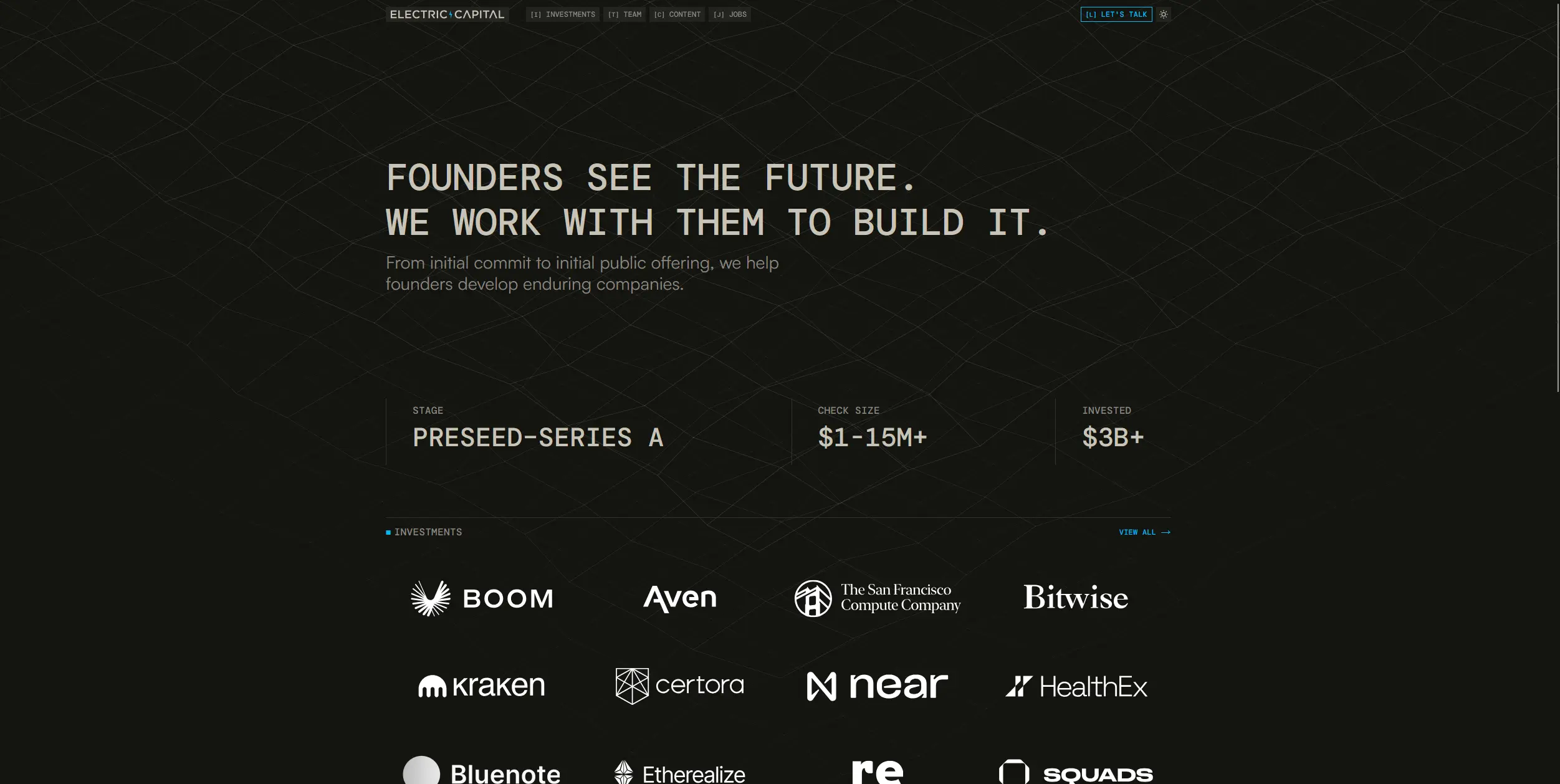
Electric Capital is a crypto-native venture firm that distinguishes itself through a data-driven, engineering-first approach to investing. Founded by former Facebook and Google engineers, the firm publishes the annual Developer Report, the most widely cited analysis of developer activity across blockchain ecosystems, which gives it both a proprietary signal set for investment decisions and significant industry credibility that attracts technical founders.
The firm raised $1 billion across two vehicles in 2024, $400 million for venture investments and $600 million for direct token allocations, with AUM growth exceeding 50% year-on-year according to Fortune’s analysis of financial disclosures. Electric has backed Near Protocol, Celo, and Dfinity at early stages and maintains an in-house engineering team that contributes to portfolio company codebases. For technical founders building blockchain infrastructure or developer tooling, Electric offers one of the most founder-aligned partnerships available: the firm understands the codebase, can evaluate the technical differentiation, and actively helps with developer ecosystem growth.
Key Details
- Founded: 2018
- AUM: $1B raised (2024); 50%+ AUM growth year-on-year
- Stage: Early stage, seed and Series A focus
- Check size: $500K to $10M
- Notable portfolio: Near Protocol, Celo, Dfinity, Acala, Mysten Labs
- Best fit: Technical founders building blockchain infrastructure, developer tooling, or protocol-layer systems who want an engineering-aligned investor
Coinbase Ventures
Best strategic investor for exchange distribution and US regulatory access
Coinbase Ventures is the investment arm of Coinbase, the largest US-regulated cryptocurrency exchange. With over 180 portfolio companies and a focus on seed to Series A investments, it provides something no other firm on this list can: a direct strategic relationship with the most regulatorily compliant, institutionally trusted exchange in the US market. A Coinbase Ventures investment does not guarantee a listing on Coinbase, but it creates a natural pathway for due diligence and relationship-building that significantly increases the probability of being listed or featured within the Coinbase ecosystem.
The firm invests across the full Web3 stack, from foundational infrastructure and developer tools to DeFi protocols, wallets, and consumer applications. Cheque sizes range from $250K at the earliest stage to $5M for larger seed rounds. Coinbase Ventures is particularly valuable for projects that are building in the US regulatory environment or that need to demonstrate compliance credibility to institutional investors downstream. Its portfolio includes projects across every major category, Layer 2 scaling, stablecoins, DeFi, NFT infrastructure, making it one of the broadest-scope investors on this list.
Key Details
- Founded: 2018
- Portfolio: 180+ companies
- Stage: Seed to Series A primary focus
- Check size: $250K to $5M
- Strategic value: Exchange distribution pathway, US compliance credibility, institutional investor signalling
- Best fit: Projects building in the US regulatory environment that benefit from Coinbase’s compliance posture and distribution network
Polychain Capital
Best VC for novel blockchain architecture and consensus innovation
Polychain Capital was founded in 2016 by Olaf Carlson-Wee, Coinbase’s first employee, and has maintained a consistent focus on backing protocol-layer innovation and novel blockchain architecture across multiple market cycles. With over $1 billion in AUM and a reputation for early, high-conviction bets on foundational technology, Polychain occupies a similar positioning to Paradigm, research-informed, technically credible, and most interested in the infrastructure layer rather than consumer applications.
In early 2026, Polychain led a $110 million investment into Berachain, one of the largest early-stage blockchain infrastructure rounds of the year, signalling continued active deployment in novel L1 consensus mechanisms. The firm backs projects from seed through growth with cheques ranging from $500K to $25M. Its portfolio includes Cosmos, Filecoin, Dfinity, Compound, and Celo, a list that skews heavily toward infrastructure and protocol-level systems. Founders building novel consensus mechanisms, Layer 1 architectures, or cross-chain infrastructure will find Polychain one of the most aligned investors in the market.
Key Details
- Founded: 2016
- AUM: $1B+
- Stage: Seed through growth
- Check size: $500K to $25M
- Notable portfolio: Cosmos, Filecoin, Dfinity, Compound, Celo, Berachain
- Best fit: Founders working on novel L1 architectures, consensus mechanisms, or core blockchain infrastructure
DWF Labs
Best VC for RWA, institutional DeFi, and liquidity-plus-venture partnerships
DWF Labs represents a new model of crypto investment that combines venture capital with market-making and liquidity provision in a single partnership. Founded in 2022 and headquartered in Singapore with offices in Dubai and, as of 2025, the United States, DWF has deployed over $1 billion across 470+ portfolio companies and projects since its founding. The firm entered a strategic partnership with World Liberty Financial in 2025, and manages active positions across RWA, DeFi, AI and crypto convergence, and DePIN.
DWF’s model is most valuable for projects that need both capital and a liquidity partner simultaneously, teams that are tokenized and want an investor who can support price discovery and market depth alongside their venture relationship. Notable portfolio companies include TRON, Mantle, TON, Jupiter, Algorand, and XDC, which reflects a broad appetite across ecosystems and stages. The firm is particularly relevant for projects aiming to bridge TradFi onto blockchain rails or targeting institutional buyers as a primary market. Its expanded US presence in 2025 positions it well for projects navigating the increasingly complex regulatory landscape in that market.
Key Details
- Founded: 2022
- Deployed: $1B+ across 470+ projects
- Model: Venture investment + market making in a single partnership
- Check size: $1M to $50M+
- Notable portfolio: TRON, Mantle, TON, Jupiter, Algorand, XDC, WLFI
- Best fit: Projects that need capital and liquidity simultaneously, particularly in RWA, institutional DeFi, AI x crypto, or DePIN
Binance Labs
Best exchange-backed VC for global ecosystem access and early-stage Web3
Binance Labs is the venture and incubation arm of the world’s largest crypto exchange, managing over $1 billion in capital across its funds. It invests at all stages from seed to Series B, with a focus on Web3, AI, and biotech projects that can benefit from the Binance ecosystem’s extraordinary distribution reach. Being a Binance Labs portfolio company provides access to Binance’s 170 million user base, its Launchpad token sale platform, its exchange listings infrastructure, and its global community network, advantages that no other VC can replicate.
The firm’s sixth incubation programme invested in seven startups across gaming, DeFi, AI, and infrastructure, and Binance Labs has historically produced some of the highest-profile token launches in the market. Check sizes range from $100K at the earliest stage to $50M for more established projects. For projects targeting the Asian market in particular, Binance Labs provides network effects, regulatory relationships, and user distribution channels that Western-focused VCs cannot offer. However, the strategic value is deepest for founders building products that will benefit from direct integration into the Binance or BNB Chain ecosystem.
Key Details
- Founded: 2018
- Fund size: $1B+
- Stage: Seed to Series B; incubation program for earliest-stage founders
- Check size: $100K to $50M
- Notable portfolio: Axie Infinity, 1inch, Dune Analytics, Manta Network, Scroll
- Best fit: Founders who want direct access to Binance’s distribution network and Asian market reach
HashKey Capital
Best venture capital for Asia-Pacific institutional access and RWA
HashKey Capital is a Hong Kong-based digital asset investment manager that has positioned itself as the institutional bridge between traditional Asian finance and the blockchain economy. Founded in 2018 and operating under Hong Kong’s SFC regulatory framework, HashKey holds the distinction of being among the first fully licensed digital asset managers in Asia, giving it regulatory credibility that few crypto-native VCs in the region can match. In 2025, HashKey launched a $500 million Digital Asset Treasury fund, one of the largest institutional crypto vehicles raised in Asia in a single year.
The firm’s investment thesis is built around RWA tokenization, institutional-grade DeFi, and the infrastructure needed to connect Asian capital markets with on-chain financial products. Its portfolio reflects this approach, with significant positions across DeFi infrastructure, stablecoins, and institutional custody. For Web3 projects targeting Asian institutional investors, licensed exchanges in Hong Kong or Singapore, or RWA tokenization markets in MENA and APAC, HashKey provides regulatory relationships and institutional distribution channels that Western-focused VCs cannot offer. The firm’s connection to the HashKey Exchange, one of Hong Kong’s licensed virtual asset exchanges, provides portfolio companies with direct market access infrastructure.
Key Details
- Founded: 2018
- Fund size: $500M Digital Asset Treasury (2025); multi-fund structure
- Stage: Seed through growth
- Check size: $500K to $20M
- Regulatory standing: SFC licensed, Hong Kong
- Notable portfolio: DeFi infrastructure, institutional custody, RWA tokenization projects
- Best fit: Projects targeting Asian institutional investors, Hong Kong/Singapore regulatory frameworks, or APAC distribution for RWA and DeFi products
How to Approach the Best Venture Capitals in 2026
Getting a meeting with a top-tier venture capital is a function of warm introductions, thesis alignment, and the quality of your traction metrics. The process below reflects what the leading Web3 VCs have publicly described as their evaluation criteria.
Build the Right Target List
Start with the firms whose published theses most closely match your sector and stage. Do not mass-apply. Sending the same deck to 50 funds signals a lack of conviction and research. A targeted list of 10 to 15 firms that have explicitly published interest in your category will generate higher-quality conversations than 100 cold emails.
Lead With Traction, Not Vision
Every VC in 2026 has seen thousands of visionary whitepapers. What cuts through is data: daily active users, developer activity metrics, protocol revenue, TVL growth rate, or whatever the relevant success metric is for your category. a16z explicitly publishes the metrics it benchmarks in the State of Crypto report. Paradigm’s research papers reveal what technical signals they care about. Lead with your strongest numbers and contextualise them against industry benchmarks.
Pursue Warm Introductions
Cold outreach to general partner email addresses generates almost no responses at the top tier. The most reliable path to a meeting is through portfolio founders, accelerator relationships, or ecosystem events. Attend Consensus, Token2049, Devcon, and ETHGlobal. Build relationships with portfolio founders. Many of the best venture capitals will respond to an introduction from a founder they have already backed.
Structure Your Data Room Before Outreach
Have a prepared data room before your first meeting. This should include your deck, financial model, token structure (if applicable), audit reports, legal entity structure, cap table, and any key partnership agreements. Coming to a first meeting without a structured data room signals operational immaturity. The best venture capitals move quickly when they have conviction, reduce friction by being prepared.
Final Thoughts: Choosing the Best Venture Capital for Your Web3 Project
The best venture capitals in 2026 share three characteristics: they have clear, public investment theses, they have demonstrated consistent deployment across market cycles, and they offer operational value beyond the cheque itself. Choosing correctly among them requires honest self-assessment about your stage, sector, geographic market, and what kind of partner support will actually move the needle for your project.
a16z is unmatched as a full-stack platform investor. Paradigm is the right choice for technical founders building core infrastructure. Pantera provides the deepest crypto-only track record. Multicoin backs the boldest contrarian bets. Electric Capital aligns most closely with technical, developer-ecosystem projects. Coinbase Ventures provides US regulatory credibility and distribution. Polychain leads on novel consensus and L1 architecture. DWF Labs provides liquidity plus capital simultaneously. Binance Labs delivers unmatched exchange distribution. HashKey Capital opens Asian institutional markets.
The worst outcome in fundraising is closing a round with a VC who does not understand your sector, cannot provide relevant introductions, and adds no value beyond the initial cheque. Take the time to choose the right partner, not just the fastest cheque.
If your crypto project needs marketing infrastructure, KOL strategy, exchange announcement campaigns, or community growth to complement your funding round, connect with Cryptic. We have worked with Binance, Bybit, OKX, NEAR, Algorand, and Canton Network, and understand how to build the market presence that makes a raise matter.
FAQ
What do venture capital firms look for in a crypto project?
In 2026, leading VCs prioritise real traction over ambitious whitepapers. The most important signals include strong developer activity, ecosystem growth, and genuine user retention. Projects are also expected to have clear token utility or a well-defined equity structure, a credible founding team with relevant experience, and a defensible position in the market. As the industry matures, regulatory readiness has become close to a baseline requirement rather than a differentiator.
How do crypto VCs differ from traditional venture capital?
Crypto VCs operate with two investment instruments: equity and tokens. This introduces fundamentally different return dynamics compared to traditional venture capital. Token investments can become liquid much earlier than equity, which impacts portfolio strategy and risk management. In addition, many crypto VCs go beyond passive investing by actively trading, running validator infrastructure, and participating in governance within the ecosystems they back.
What check sizes do top Web3 VCs deploy?
Check sizes vary depending on the stage and the firm. Seed rounds typically range between $250K and $3M. Series A rounds, especially from firms like Andreessen Horowitz, Paradigm, and Pantera Capital, generally fall between $5M and $50M. At the growth stage, investments can exceed $100M. Some firms, such as DWF Labs, have deployed single-round checks above $50M for more established protocols.
Which sectors are venture capital firms prioritizing in 2026?
The strongest investment themes in 2026 include stablecoin infrastructure and payments, real-world asset (RWA) tokenization, AI and blockchain convergence, DePIN (decentralized physical infrastructure networks), institutional-grade DeFi, and Layer 2 scaling solutions. These sectors reflect a broader shift toward real-world utility and scalable infrastructure as the market matures.
How should a Web3 project approach a top-tier VC?
Preparation is critical. Founders should research a firm’s recent investments, published theses, and partner insights before reaching out. The initial pitch should focus on on-chain metrics, user traction, and real usage rather than token price performance. A well-prepared data room should include legal structure, tokenomics, and team background. Warm introductions through portfolio founders or ecosystem connections significantly increase the likelihood of a response compared to cold outreach.
Is it better to raise from a crypto-native VC or a generalist fund?
Crypto-native VCs typically provide more relevant support for Web3 projects, including guidance on token design, exchange relationships, ecosystem partnerships, and governance. Generalist funds such as Sequoia Capital and Lightspeed Venture Partners offer larger check sizes and stronger access to traditional distribution channels, which becomes more valuable at later stages. In practice, many projects benefit from a mixed syndicate that combines both types of capital, especially from Series A onward.
| Platform | AUM / Fund Size | Stage Focus | Check Size | Primary Thesis |
|---|---|---|---|---|
| a16z Crypto | $7.6B crypto funds | Seed to Growth | $500K – $100M+ | Full-stack Web3, infra, consumer, policy |
| Paradigm | $2.5B+ deployed | Seed to Growth | $1M – $100M+ | Research-led, core infrastructure, DeFi |
| Pantera Capital | $1.25B+ (Fund V) | Seed to Growth | $500K – $20M | Blockchain-only, venture + liquid tokens |
| Multicoin Capital | ~$1B AUM | Early Stage | $1M – $50M | Thesis-driven, trillion-dollar market disruption |
| Electric Capital | $1B raised | Early Stage | $500K – $10M | Developer ecosystems, infrastructure |
| Coinbase Ventures | 180+ companies | Seed to Series A | $250K – $5M | Exchange ecosystem, broad Web3 |
| Polychain Capital | $1B+ AUM | Seed to Growth | $500K – $25M | Protocol-layer, novel blockchain architecture |
| DWF Labs | $1B+ deployed | Seed to Growth | $1M – $50M+ | RWA, DeFi, institutional, liquidity + venture |
| Binance Labs | $1B+ fund | Seed to Series B | $100K – $50M | Web3, AI, biotech, exchange ecosystem |
| HashKey Capital | $500M (Digital Asset Treasury) | Seed to Growth | $500K – $20M | Asia-Pacific, institutional, RWA, DeFi |