
Quick answer
Uniswap v4 remains the largest DEX by volume and the standard for Ethereum trading. Hyperliquid is the breakout perpetuals DEX of 2026. dYdX v4 leads on institutional derivatives. Jupiter dominates Solana aggregation. Curve is the stablecoin swap standard.
Decentralized exchanges have had their moment, and then some. By 2026, DEXs are no longer the scrappy alternative to centralized platforms. They are the infrastructure. On-chain trading volumes have hit record levels, institutional liquidity is flowing into DeFi, and the best DEX platforms today rival CEXs on execution speed, depth, and user experience.
The problem is, not every DEX deserves your capital.
Some are ghost chains with inflated TVL numbers. Others charge fees that eat your trades alive. A few are genuinely world-class, and knowing which is which can be the difference between a profitable strategy and a frustrating one.
This guide breaks down the best decentralized exchanges in 2026, ranked by what actually matters: liquidity, fees, supported assets, cross-chain capability, and real trading experience. Whether you are a DeFi native or a trader who just moved off a CEX, this list was built for you.
What Makes a DEX Worth Using in 2026
Before diving into the rankings, here is the framework used to evaluate every platform on this list. A great DEX in 2026 needs to clear five bars.
Liquidity Depth: Thin liquidity means high slippage. As a result, high slippage means you are losing money before a trade even closes. Therefore, the best DEX platforms maintain deep pools across their core pairs, with enough volume to absorb large orders without moving the price against you.
Fee Structure: Trading fees matter more than most people calculate. For example, a 0.3% fee on every trade compounds into a serious drag over time. Because of this, the top DEXs in 2026 offer competitive base fees, with some going as low as 0.01% on stable pairs.
Chain and Asset Coverage: Single-chain DEXs are increasingly limited. Therefore, the best platforms either operate natively across multiple chains or integrate seamlessly with bridges and aggregators. In addition, asset variety matters too, from blue-chip tokens to long-tail altcoins and perpetuals.
Security and Smart Contract Track Record: A DEX that has never been exploited is table stakes. However, what separates the best from the rest is a track record of clean audits, bug bounties, and transparent on-chain governance.
User Experience: Speed, interface clarity, wallet compatibility, and mobile usability have all improved dramatically across DeFi. As a result, a clunky UI is no longer acceptable when competitors are shipping near-CEX experiences.
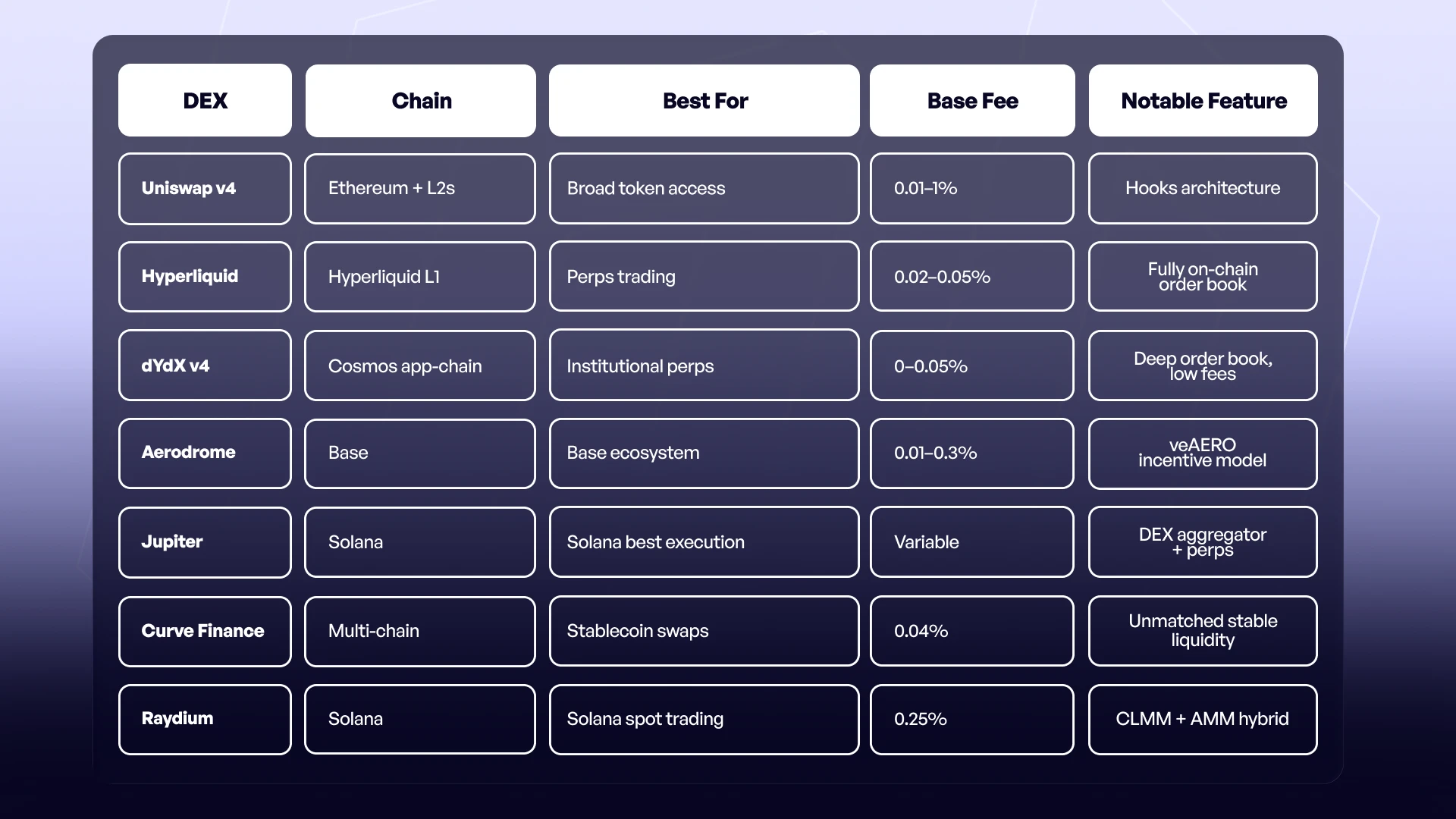
Best DEXs in 2026 At a Glance
Best DEXs in 2026 — Full Breakdown
Uniswap v4

Uniswap did not get to the top by accident. As the original AMM that rewrote DeFi, it has continued to evolve, and v4 is its most significant upgrade yet. The headline feature is hooks, custom smart contract logic that developers can attach to liquidity pools. This unlocks dynamic fees, custom oracles, limit orders natively within pools, and far more sophisticated liquidity management than v3 ever allowed.
Uniswap v4 operates across the Ethereum mainnet, Arbitrum, Optimism, Base, and Polygon. Its liquidity depth on major pairs remains unmatched in the EVM ecosystem, and the sheer number of tokens available on the platform makes it the go-to for traders who need access to newer or niche assets.
The fee range varies, 0.01% on stable pairs, up to 1% on exotic ones, and the new singleton contract architecture significantly reduces gas costs per swap. For most EVM traders, Uniswap v4 is still the first stop.
Best for: EVM traders who need broad token access and deep liquidity.
Chains: Ethereum, Arbitrum, Optimism, Base, Polygon
Watch out for: High gas on mainnet for small trades; use L2 deployments instead
Hyperliquid

Hyperliquid is the most talked-about DEX story in 2026, and the hype is earned. Built on its own L1 blockchain, it runs a fully on-chain order book that processes trades at speeds previously only possible on centralized exchanges. No AMM mechanics, no slippage from pool imbalances, just limit and market orders executed on-chain with sub-second finality.
The platform focuses primarily on perpetuals, supporting dozens of crypto assets with up to 50x leverage. Fees sit at 0.02% for makers and 0.05% for takers, which undercuts most competitors significantly. Hyperliquid also launched its own native token with a points-to-airdrop mechanic that drove massive user adoption in 2025, and the ecosystem has continued to grow from there.
If you are trading perps and you care about execution quality, Hyperliquid is the most serious on-chain alternative to Binance Futures and OKX that exists today.
Best for: Perpetuals traders who want CEX execution without a CEX
Chains: Hyperliquid L1
Watch out for: Limited spot market compared to perps; ecosystem still maturing
dYdX v4

dYdX has been in the perpetuals DEX space longer than almost anyone, and v4 represents its most ambitious bet yet. Migrating off Ethereum and StarkEx to its own Cosmos-based application chain gave dYdX full control over its order book, block times, and fee structure. The result is a platform that handles institutional-grade order sizes with genuine depth.
Maker fees can drop to zero depending on volume tier, while takers pay up to 0.05%. The platform supports over 35 trading pairs and allows cross-margined positions, which is a critical feature for serious traders managing multiple perpetual exposures at once. Governance is fully decentralized through the DYDX token, and the validator set is well-distributed across the Cosmos ecosystem.
dYdX v4 does not try to be everything. It is a focused, professional-grade perps exchange, and that discipline shows in the product quality.
Best for: Active perps traders who need institutional-grade depth and cross-margin
Chains: dYdX Chain (Cosmos ecosystem)
Watch out for: Steeper learning curve; less suited for casual spot traders
Aerodrome Finance

Aerodrome Finance has become the liquidity backbone of the Base ecosystem. Built as a next-generation evolution of Velodrome, Aerodrome combines an AMM with a sophisticated vote-escrow incentive model that routes liquidity to where it is most needed.
The veAERO model allows token holders to lock AERO, vote on which pools receive emissions, and collect a share of trading fees from those pools. This creates a self-reinforcing loop: protocols bribe veAERO holders to direct liquidity toward their tokens, which deepens the pools, which attracts more volume, which generates more fees. In practice, it has made Aerodrome the most capital-efficient DEX on Base by a meaningful margin.
For traders, the benefit is consistently deep liquidity on Base pairs at fees as low as 0.01% on stable swaps.
Best for: Base ecosystem traders and liquidity providers looking for yield-optimized positioning
Chains: Base
Watch out for: veAERO mechanics require active management to maximize returns
Jupiter

On Solana, Jupiter is not just a DEX; it is the trading layer the entire ecosystem routes through. As a DEX aggregator, Jupiter scans liquidity across every major Solana DEX, including Raydium, Orca, Meteora, and others, then executes the optimal route for your swap. The result is best-execution pricing without manual comparison.
Beyond aggregation, Jupiter expanded into perpetuals in 2024 and has continued to grow that product through 2026. The perps product uses a JLP pool model where liquidity providers earn fees from traders taking the other side of leveraged positions. Volume has grown substantially, cementing Jupiter’s position as the highest-traffic trading interface on Solana.
The fee structure varies by route and asset, but on-chain Solana fees remain fractions of a cent per transaction, a structural advantage that EVM chains still cannot fully match.
Best for: Solana traders who want best-execution aggregation and access to perps
Chains: Solana
Watch out for: Aggregator routing can be opaque; always verify slippage settings on thin pairs
Curve Finance

Curve Finance does one thing and does it better than anyone else in DeFi: stablecoin and pegged-asset swaps. Its AMM is purpose-built for low-slippage trades between assets that should trade near parity, USDC, USDT, DAI, FRAX, stETH, and dozens of other pairs. The fee structure is razor-thin at 0.04%, and liquidity is some of the deepest in the entire DeFi ecosystem.
In 2026, Curve remains essential infrastructure for protocols, treasuries, and traders who move large stablecoin volumes. Its crvUSD stablecoin has added another dimension to the platform, and the veCRV governance model continues to generate meaningful fee revenue for long-term lockers.
Curve is not the place to buy altcoins. It is the place to move serious stablecoin volume with minimal slippage and maximum confidence in execution.
Best for: Stablecoin traders, DeFi treasuries, and yield farmers on stable pairs
Chains: Ethereum, Arbitrum, Optimism, Polygon, Avalanche, and more
Watch out for: Not designed for volatile asset pairs; UI is functional but dated
Raydium

Raydium is Solana’s most established native DEX, combining a traditional AMM with concentrated liquidity market maker (CLMM) pools. The platform serves as the primary on-chain venue for new token launches on Solana, making it the default first stop for traders chasing early-stage assets.
The base fee sits at 0.25% for standard pools, with variable fees on CLMM pools depending on the tier. Raydium’s integration with OpenBook (the on-chain order book formerly known as Serum) adds additional depth to certain pairs beyond what the AMM alone provides. For traders focused on the Solana meme coin and new token ecosystem, Raydium remains the central hub.
Best for: Solana traders focused on new launches, meme coins, and early-stage assets Chains: Solana
Watch out for: Concentrated liquidity requires active management to avoid impermanent loss on volatile pairs
How to Choose the Right DEX for You
The best DEX in 2026 is not one platform; it is the right platform for your specific strategy. Here is how to narrow it down.
If you trade on Ethereum or its L2s, Uniswap v4 should be your default for spot trades, with Curve as the go-to whenever stablecoins are involved. In that case, use Arbitrum or Base deployments to keep gas costs manageable.
If perpetuals are your primary market, the decision comes down to Hyperliquid versus dYdX v4. Hyperliquid wins on speed and UX, while dYdX v4 wins on cross-margin sophistication and institutional depth. As a result, many serious traders use both depending on the position.
If you operate on Solana, route all swaps through Jupiter first. Then, for new token launches and early liquidity, Raydium is where the action is.
If stablecoin volume is core to your strategy, Curve is the answer, regardless of chain. This is because its liquidity depth and fee efficiency on stable pairs have not been meaningfully challenged.
If you are building on or trading within the Base ecosystem, Aerodrome’s liquidity concentration and incentive model make it the most capital-efficient venue on the chain.
One practical rule: always check slippage before confirming, regardless of the DEX. Even on deep platforms, thin pairs can move against you fast.
For projects launching a token on these DEXs, liquidity is only half the battle. Driving real trading volume takes community and visibility, which is where a crypto marketing agency comes in.
Final Thoughts
The DEX landscape in 2026 is not one-size-fits-all, and that is actually a good thing. As a result, specialization has driven genuine quality improvements across the board. Hyperliquid redefined what on-chain perps can feel like. Jupiter made Solana trading frictionless. Uniswap v4 opened the door to programmable liquidity. Meanwhile, Curve remains the unsexy, indispensable backbone of stablecoin DeFi.
Your job as a trader is not to pick the “best” DEX in the abstract. Instead, it is to match your strategy to the platform built for it. Do that, and you are already ahead of most of the market.
Work With Cryptic
Building a token project and not sure how to reach the right traders and DeFi communities? Cryptic is a Web3-native marketing agency that helps crypto projects grow their on-chain presence, build community, and drive real volume, not vanity metrics. We have run crypto marketing, community building, and crypto PR campaigns for projects like Bybit, Binance, and Algorand since 2020. If PR is your priority, compare the best crypto PR agencies in 2026.
See our case studies to see what we do.
FAQ
What is the best DEX for beginners in 2026?
Uniswap v4 on a low-fee L2 like Base or Arbitrum is the most accessible starting point. The interface is clean, the liquidity is deep on major pairs, and gas costs are manageable. Jupiter on Solana is also beginner-friendly and handles routing automatically.
Which DEX has the lowest fees in 2026?
Curve Finance offers some of the lowest fees in DeFi at 0.04% on stable pairs. Hyperliquid’s maker fee of 0.02% is among the lowest for perpetuals trading. On Solana, network fees are fractions of a cent regardless of which DEX you use.
Is it safe to trade on a DEX in 2026?
The top DEX platforms on this list have strong security track records, multiple audits, and active bug bounty programs. That said, smart contract risk is never zero in DeFi. Stick to established platforms, verify contract addresses before interacting, and never connect your wallet to unfamiliar sites. The same scrutiny applies to the crypto wallet you connect with, since transaction simulation and approval controls vary widely from one wallet to the next.
What is the difference between an AMM and an order book DEX?
An AMM (automated market maker) prices trades algorithmically based on the ratio of assets in a liquidity pool. An order book DEX matches buyers and sellers directly, similar to how a centralized exchange works. Uniswap and Curve are AMMs. Hyperliquid and dYdX v4 use on-chain order books.
Can I trade perpetuals on a DEX in 2026?
Yes, and the quality is genuinely competitive with centralized platforms. Hyperliquid and dYdX v4 are the two strongest options for on-chain perpetuals in 2026, with deep liquidity, tight spreads, and sub-second execution.
What is a DEX aggregator?
A DEX aggregator scans multiple DEXs simultaneously and routes your trade through the combination of platforms that gives you the best price. Jupiter on Solana is the leading example. Aggregators are especially useful when trading less liquid assets where liquidity is fragmented across multiple pools.
Which DEX is best for stablecoin trading?
Curve Finance is the clear answer. It was built specifically for low-slippage swaps between stable and pegged assets, and its liquidity depth on USDC, USDT, DAI, and similar pairs is unmatched in DeFi.
| DEX | Chain | Best For | Base Fee | Notable Feature |
|---|---|---|---|---|
| Uniswap v4 | Ethereum + L2s | Broad token access | 0.01-1% | Hooks architecture |
| Hyperliquid | Hyperliquid L1 | Perps trading | 0.02-0.05% | Fully on-chain order book |
| dYdX v4 | Cosmos app-chain | Institutional perps | 0-0.05% | Deep order book, low fees |
| Aerodrome | Base | Base ecosystem | 0.01-0.3% | veAERO incentive model |
| Jupiter | Solana | Solana best execution | Variable | DEX aggregator + perps |
| Curve Finance | Multi-chain | Stablecoin swaps | 0.04% | Unmatched stable liquidity |
| Raydium | Solana | Solana spot trading | 0.25% | CLMM + AMM hybrid |