
Quick answer
Bybit leads overall on derivatives depth, rewards, and product innovation. Binance dominates on raw volume and asset selection. OKX offers the most complete Web3 integration. Coinbase is the clearest choice for US-regulated access. MEXC wins on fee structure for limit order traders.
Choosing among the top 10 crypto exchanges in 2026 is not as straightforward as picking the biggest platform by volume. The market has matured significantly: trading fees have converged across major platforms, regulatory compliance has become a baseline expectation, and the differentiators now lie in product depth, derivatives infrastructure, coin selection, and the quality of the overall trading experience.
The 255 spot exchanges tracked by CoinMarketCap generate over $1.15 trillion in combined 24-hour volume. Of those, a handful account for the overwhelming majority of global activity. This guide covers the ten that matter most in 2026, ranked not solely by raw volume, but by the combination of volume, reliability, fee structure, product range, and user experience that determines which platform is actually worth using.
Whether you are a derivatives trader, an altcoin researcher, a passive investor seeking the lowest fees, or a Web3 builder who needs a platform with strong on-chain integration, this comparison covers the exchange that fits your use case.
What to Look for in a Crypto Exchange in 2026
Notably, most exchange comparison guides focus on fees and stop there. In practice, five factors determine whether a platform serves your needs.
Trading Fees and Volume Discounts
Spot trading fees on major exchanges cluster around 0.1% per side, but the details matter. For example, MEXC charges zero maker fees. Binance and Bybit reduce fees significantly when users hold or pay with native tokens. By contrast, Coinbase charges retail users up to 1.2%, making it among the most expensive for active traders. Ultimately, understanding the fee structure at your typical volume tier determines actual cost better than headline rates.
Liquidity and Order Book Depth
Volume figures in exchange rankings are an imperfect proxy for liquidity. CoinMarketCap’s Liquidity Score weights this more accurately. Binance leads on raw liquidity at 921. Coinbase scores 797, while Gate reaches 801 despite its broader altcoin focus. For large orders, liquidity matters more than fee rates, slippage on a thin order book can cost far more than a competitive fee advantage.
Asset and Product Selection
Gate lists 1,877 coins, while MEXC covers 1,966 and KuCoin reaches 1,005. By comparison, Binance offers 632 and Coinbase lists 386. In practice, the right number depends entirely on your strategy: deep liquidity across major pairs, or early access to a long tail of altcoins and new listings. Tokenized equities are the newest line in that selection, and we rank where to buy tokenized stocks in a separate guide. Derivatives traders additionally care about the range of perpetual contracts, options products, and funding rates across positions.
Regulatory Status and Security
Binance, Coinbase, OKX, and Kraken operate under multiple regulatory frameworks in different jurisdictions. In fact, Coinbase is the most regulated among the group, with full US licensure and a public company structure. Bybit, Gate, and MEXC operate in jurisdictions with lighter regulatory frameworks. Security records, proof-of-reserves publication frequency, and insurance fund sizes are practical proxies for operational safety when regulation is limited. For EU users who need a platform with a licensed European entity under MiCA, see our guide to the best MiCA-licensed crypto exchanges.
User Interface and On-Chain Integration
OKX’s native Web3 wallet and DEX integration set it apart from pure-CEX competitors. Similarly, Bybit’s unified account, copy trading, and earn products have made it the platform of choice for users who want exchange and DeFi-like functionality in a single interface. Therefore, for users who plan to interact with on-chain protocols as well as trade spot, the depth of the platform’s Web3 layer is increasingly a primary selection criterion.
Top 10 Crypto Exchanges at a Glance
Exchange data sourced from CoinMarketCap live rankings. Volume figures are approximate 24-hour spot totals as of May 2026.
| Platform | 24h Volume | Best For | KYC Required | Spot Fees |
|---|---|---|---|---|
| Bybit | $2.55B | Derivatives, rewards, global reach | Yes (tiered) | 0.1% maker/taker |
| Binance | $11.16B | Largest volume, broadest asset range | Yes | 0.1% (BNB discount) |
| OKX | $2.17B | Web3 wallet, institutional tools | Yes | 0.08% maker / 0.1% taker |
| Coinbase | $2.01B | US regulated, beginner-friendly | Yes (strict) | 0.6% / 1.2% (retail) |
| KuCoin | $2.46B | Altcoin variety, KCS staking | Optional (limits) | 0.1% (lower with KCS) |
| Gate | $2.12B | Widest listing selection | Yes | 0.2% maker / 0.2% taker |
| MEXC | $3.25B | Zero maker fees, early token access | Optional (limits) | 0% maker / 0.05% taker |
| Bitget | $944M | Copy trading, derivatives | Yes | 0.1% maker / 0.1% taker |
| HTX | $1.29B | Asia-Pacific focus, token launches | Yes | 0.2% maker / 0.2% taker |
| Upbit | $1.75B | South Korean market leader | Yes (KYC strict) | 0.05% flat |
Bybit
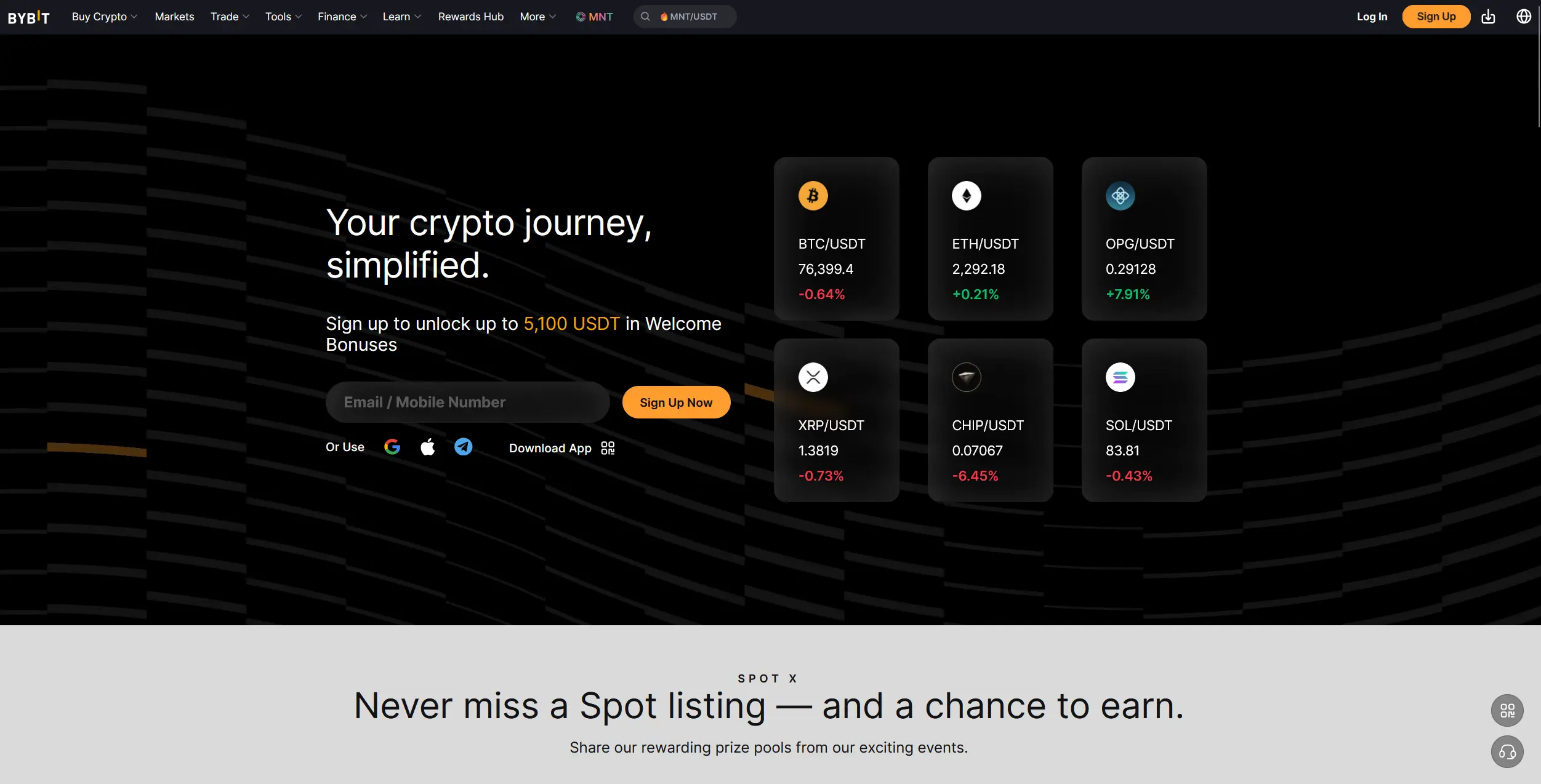
Best overall crypto exchange in 2026, derivatives leader with world-class UX
Over time, Bybit has evolved from a derivatives-focused exchange into one of the most comprehensive trading platforms in the market. Indeed, with over $2.55 billion in daily spot volume, 694 listed coins, and 1,211 trading pairs, it now competes with Binance on breadth while maintaining the operational quality that made it the go-to platform for professional derivatives traders. Furthermore, its perpetual contract infrastructure is widely regarded as industry-leading, with consistently tight spreads, deep liquidity across major pairs, and a funding rate mechanism that has stayed reliable through multiple high-volatility periods.
Beyond raw trading, Bybit’s product ecosystem distinguishes it from competitors. For instance, the Bybit Earn suite covers flexible and fixed-term deposits, liquidity mining, and dual investment products. In turn, copy trading allows retail users to mirror positions from verified professional traders, and the Bybit Card provides real-world spending utility directly from exchange balances. In particular, for institutional users, the portfolio margin system allows cross-collateralisation across spot, futures, and options positions, significantly increasing capital efficiency versus platforms that segregate account types.
Key Stats
- 24h Spot Volume: $2.55B
- Coins: 694
- Markets: 1,211
- Spot Fees: 0.1% maker / 0.1% taker (discounts available)
- Derivatives: Perpetuals, options, inverse contracts across 200+ pairs
- KYC: Required for full access
- Fiat support: 75+ currencies
- Strengths: Derivatives depth, copy trading, earn products, Bybit Card, institutional tools
Binance
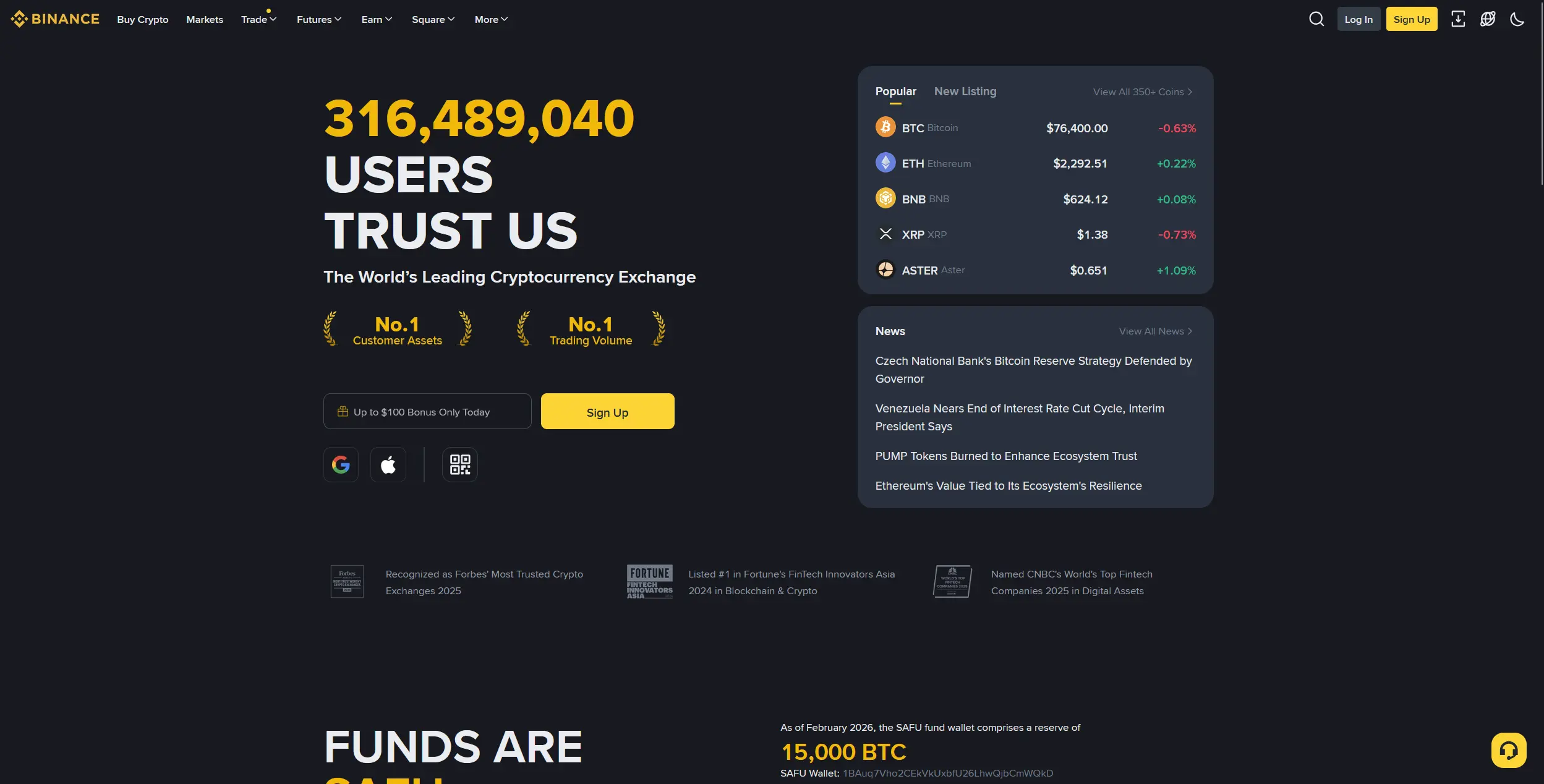
Largest crypto exchange by volume, unmatched asset selection
Today, Binance remains the largest crypto exchange in the world by trading volume, processing over $11.16 billion in daily spot trades across 2,087 markets and 632 coins. As a result, no other platform comes close on raw scale, and that scale creates a compounding liquidity advantage: the tightest spreads on major pairs, the most consistent order book depth, and the strongest institutional market-maker relationships in the industry. As such, for anyone trading Bitcoin, Ethereum, or the top 50 tokens by market cap, Binance offers the best execution environment available.
In addition, the platform’s breadth extends across spot, margin, futures, options, staking, lending, launchpad token sales, and NFT trading. Binance Pay enables peer-to-peer crypto payments, and the BNB token reduces trading fees by 25% when used for payments and powers a significant portion of the Binance Smart Chain ecosystem. However, Binance continues to navigate regulatory complexity across multiple jurisdictions, including ongoing proceedings in the US and restrictions in several EU markets. Therefore, users outside supported regions should verify local compliance before opening an account.
Key Stats
- 24h Spot Volume: $11.16B
- Coins: 632
- Markets: 2,087
- Spot Fees: 0.1% standard; 0.075% with BNB payment
- KYC: Required
- Weekly Visits: 9.45M
- Strengths: Volume, liquidity, asset breadth, BNB ecosystem, educational resources
OKX
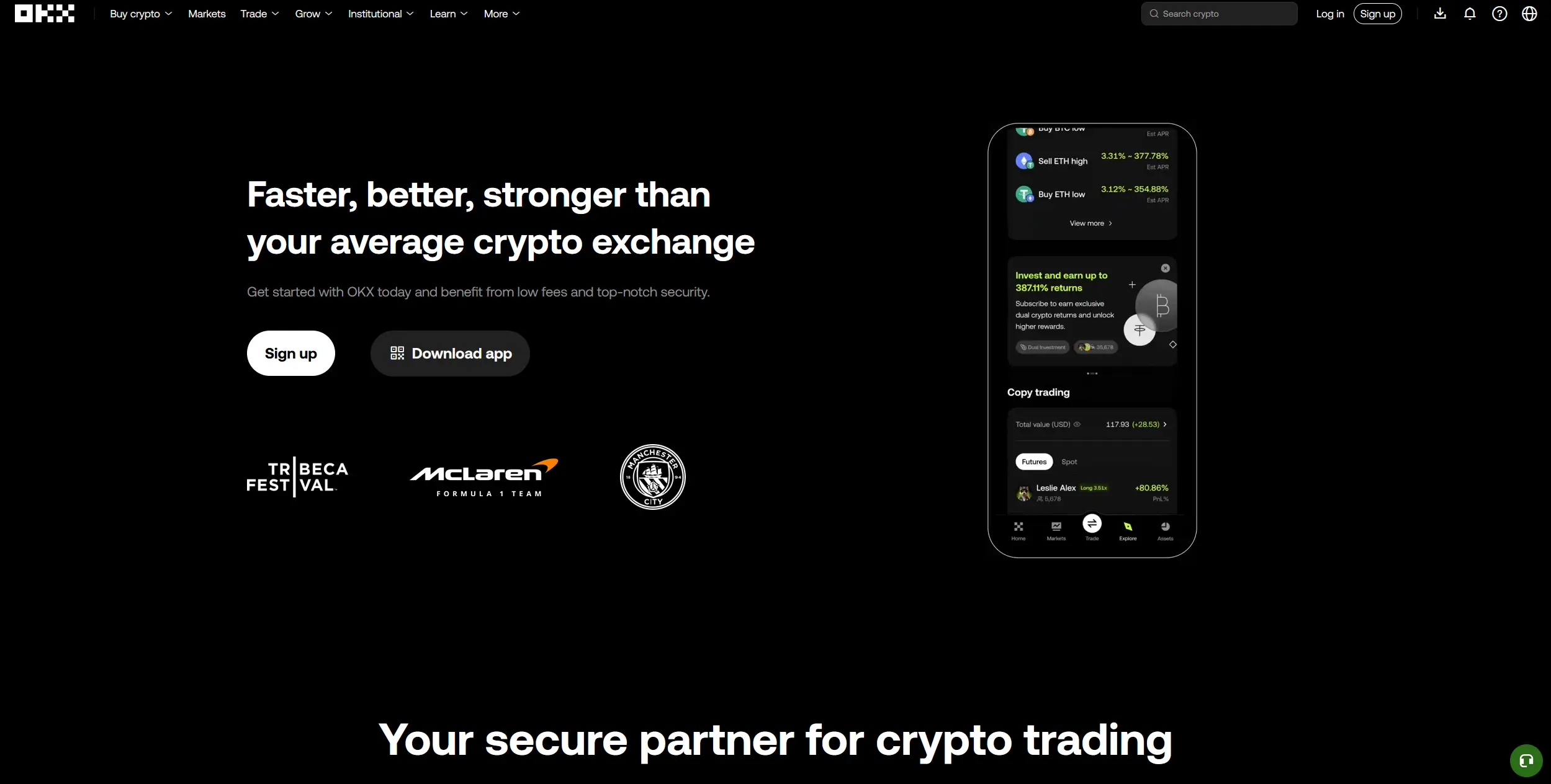
Best crypto exchange for Web3 integration and institutional tools
Meanwhile, OKX occupies a distinctive position in the exchange market: it is the platform that has most successfully bridged centralised trading infrastructure and Web3 functionality. Specifically, its native Web3 wallet supports 80+ blockchains and provides built-in DEX aggregation, NFT marketplace access, and DeFi protocol connectivity alongside the traditional spot and derivatives trading interface. For users who split activity between CEX trading and on-chain DeFi, OKX eliminates the friction of managing separate wallets and exchange accounts. Even so, an exchange-linked wallet is only half of a custody setup: our guide to the best crypto wallets compares self-custody options across hot wallets and hardware storage.
On the institutional side, OKX’s unified account system also shares collateral across spot, margin, futures, options, and perpetual positions, a capital efficiency advantage that most competing platforms have not yet replicated at the same depth. In total, the exchange processed $2.17 billion in daily spot volume with a Liquidity Score of 747, across 1,237 markets and 380 coins. In addition, OKX scored a strategic investment from Intercontinental Exchange (ICE), parent of the New York Stock Exchange, in 2025, signalling a trajectory toward deeper integration with traditional financial infrastructure.
Key Stats
- 24h Spot Volume: $2.17B
- Coins: 380
- Markets: 1,237
- Spot Fees: 0.08% maker / 0.1% taker
- Web3 Wallet: 80+ chain support, DEX aggregation, DeFi access
- KYC: Required
- Weekly Visits: 5.15M
- Strengths: Web3 integration, unified margin account, institutional tools, OKX Card
Coinbase
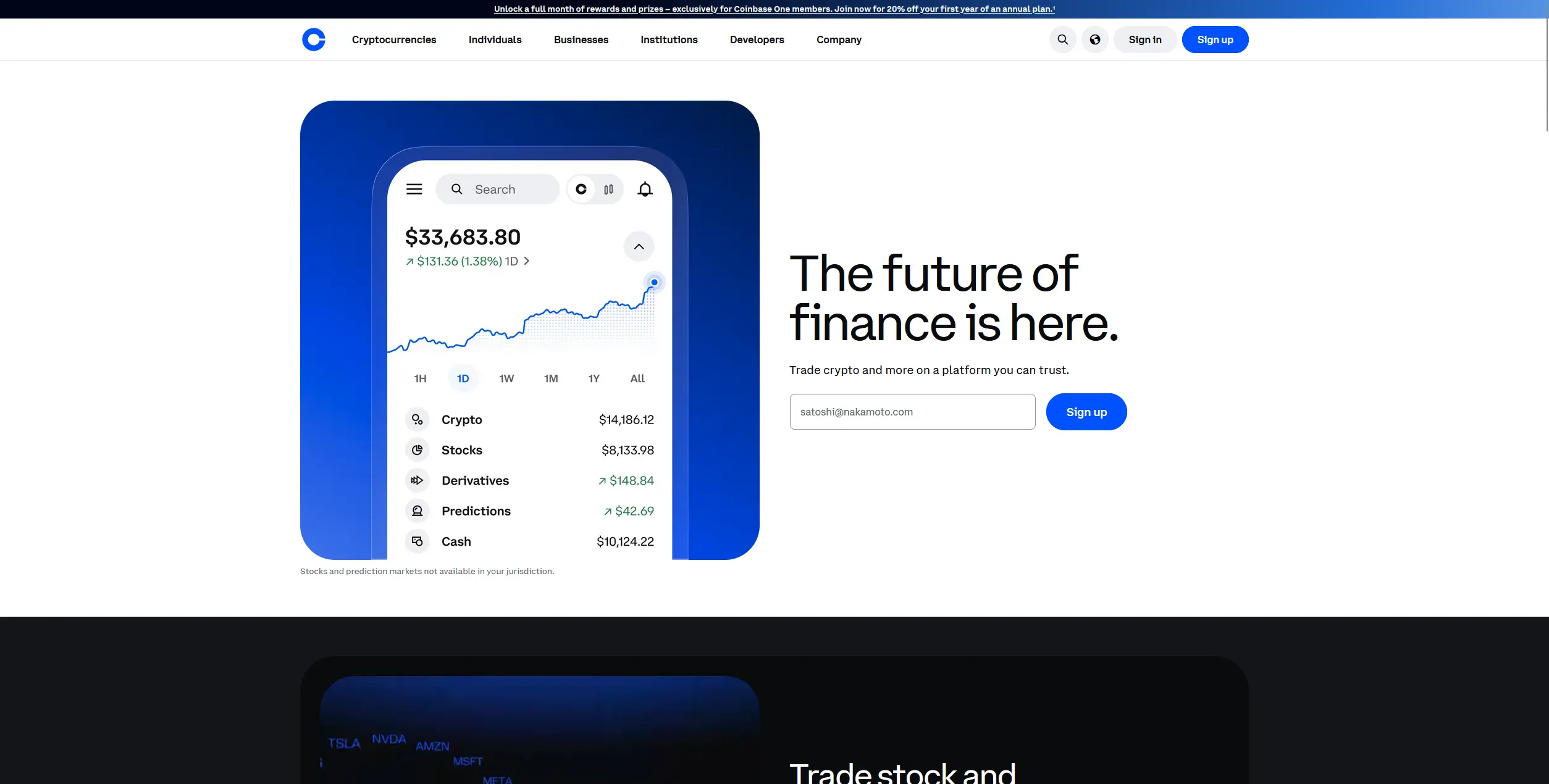
Best regulated crypto exchange, strongest for US users
Crucially, Coinbase holds a structurally unique position in the exchange landscape: it is the only major publicly traded crypto exchange, operating under the most rigorous regulatory framework among the top ten. For US-based users particularly, this matters, Coinbase is fully licensed across US jurisdictions, maintains a clean regulatory record relative to competitors, and offers FDIC-insured USD balances up to $250,000. As a result, these credentials have made it the default choice for institutional investors, fiduciaries, and users who prioritise regulatory certainty over fee optimisation.
However, the trade-off is cost. Coinbase’s retail interface charges 0.6% to 1.2% per transaction, making it among the most expensive major exchanges for active traders. By contrast, the Coinbase Advanced Trade interface reduces fees to 0.05% to 0.6% for users who access it directly, but the gap between retail and professional pricing is substantial. In total, Coinbase processes $2.01 billion in daily spot volume, listing 386 coins across 503 markets. Beyond that, its educational resources, staking products, and the Coinbase One subscription tier add value for users who prioritise a clean, full-service crypto experience over minimal cost.
Key Stats
- 24h Spot Volume: $2.01B
- Coins: 386
- Markets: 503
- Retail Fees: 0.6% to 1.2%
- Advanced Trade Fees: 0.05% to 0.6%
- KYC: Strict, required for all account activity
- Strengths: Regulation, US market leadership, institutional trust, staking, clean UX
KuCoin
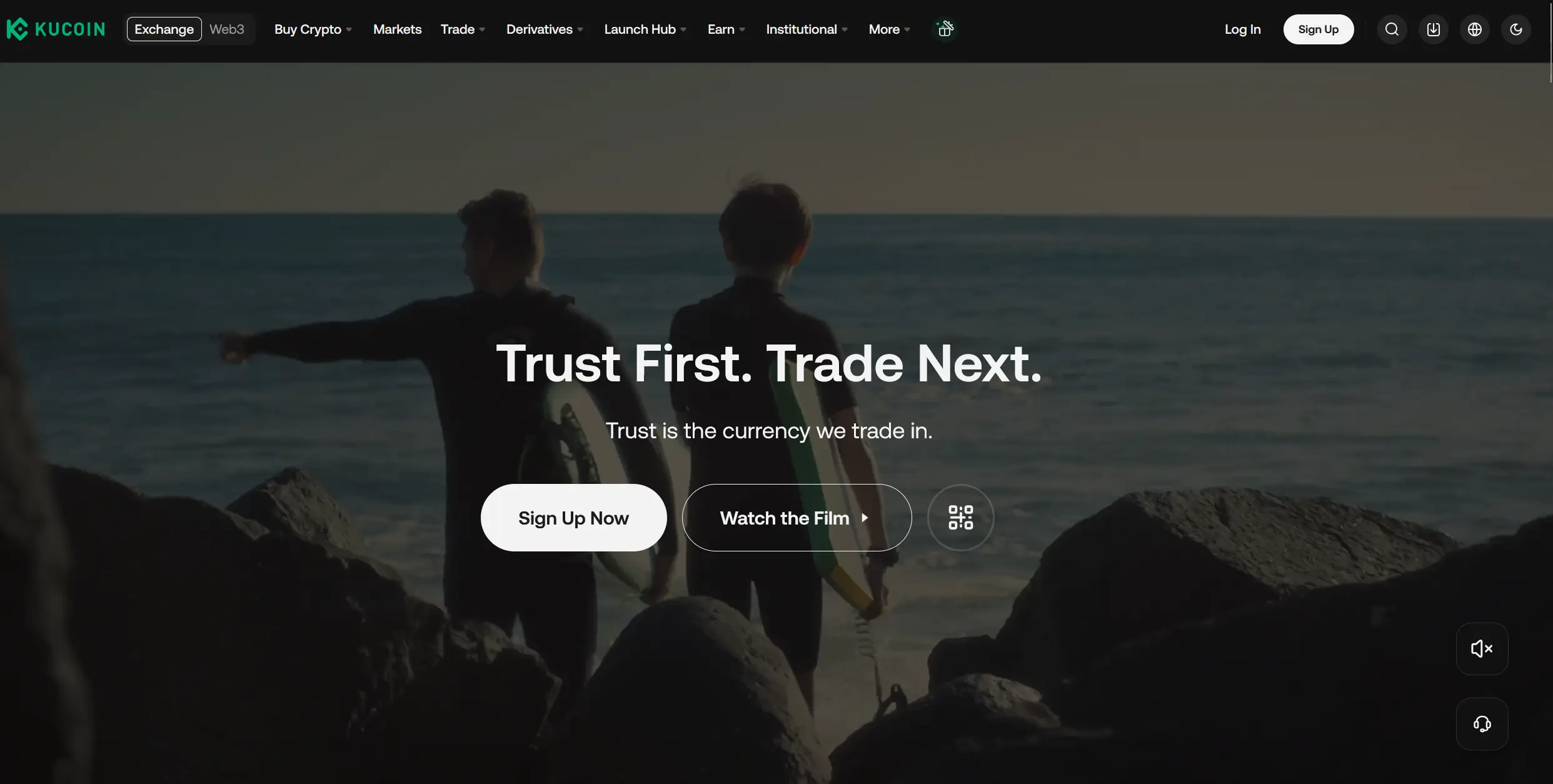
Best crypto exchange for altcoin variety and KCS ecosystem benefits
Notably, KuCoin has built its identity around breadth: 1,005 listed coins across 1,666 markets make it one of the deepest altcoin exchanges available on a major platform. Indeed, for traders who need exposure to smaller-cap tokens, new project launches, or niche blockchain ecosystems, KuCoin consistently provides access earlier and more comprehensively than competitors. Overall, its 24-hour spot volume of $2.46 billion places it firmly among the top-tier exchanges, with a Liquidity Score of 721 that reflects genuine market depth rather than inflated numbers.
In addition, the KCS (KuCoin Token) ecosystem provides structural fee advantages: holding KCS reduces trading fees, and KuCoin shares 50% of daily trading fee revenue with KCS holders through a daily distribution. Beyond that, copy trading, lending, and staking products round out the platform’s DeFi-adjacent features. KuCoin allows limited trading without full KYC, though withdrawal limits apply, a policy that appeals to privacy-conscious users but creates regulatory uncertainty in jurisdictions with strict requirements.
Key Stats
- 24h Spot Volume: $2.46B
- Coins: 1,005
- Markets: 1,666
- Spot Fees: 0.1% (reduced with KCS holdings)
- KYC: Optional for limited trading; required for full withdrawal access
- Strengths: Altcoin depth, KCS fee sharing, copy trading, broad market access
Gate
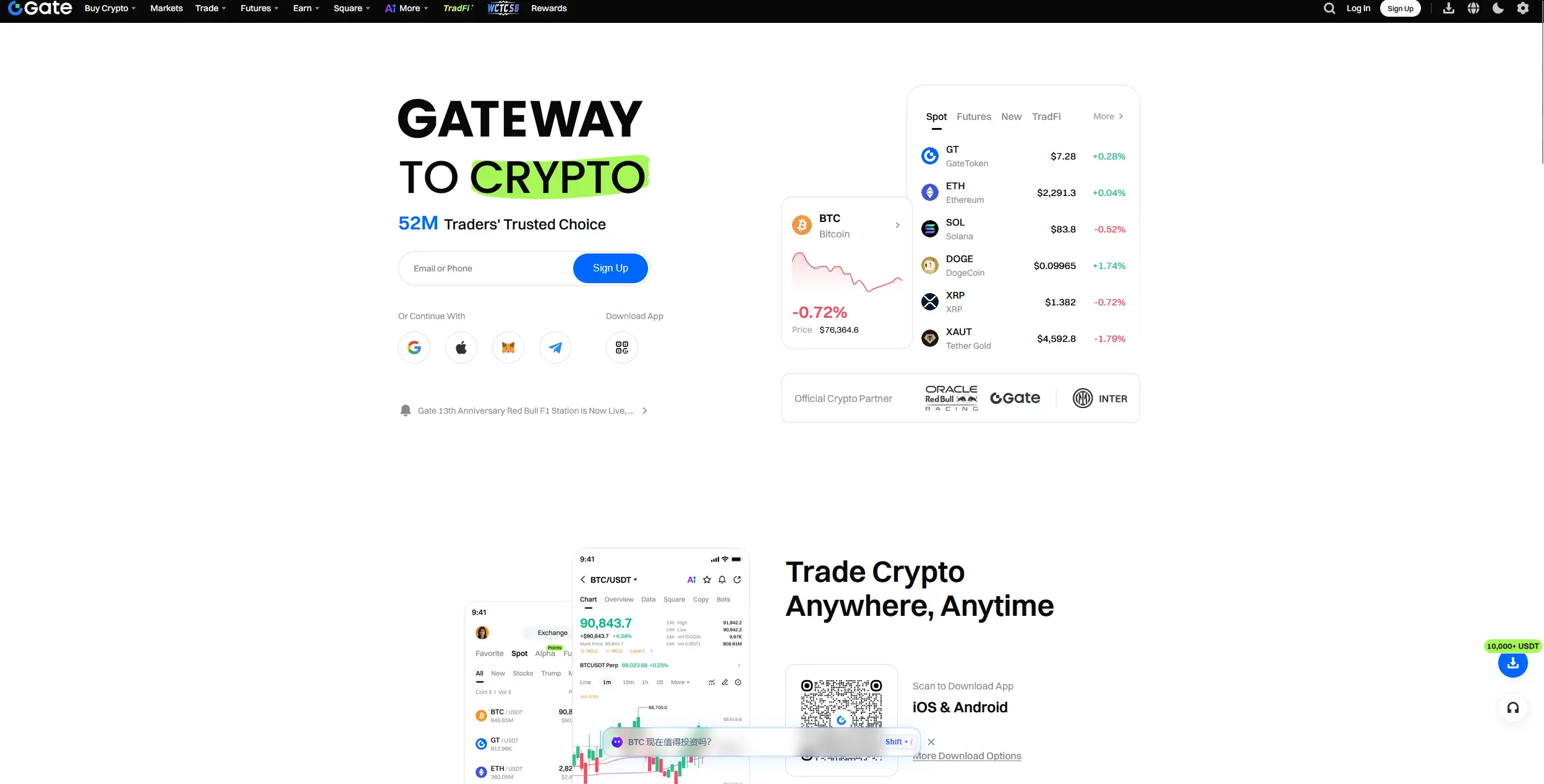
Best crypto exchange for widest coin selection
Indeed, Gate lists more coins than any other major exchange, 1,877 at time of publication, across 2,641 markets. Likewise, for traders and researchers who need access to emerging projects, niche tokens, and early-stage listings, Gate is frequently the first major platform to offer trading pairs for new assets. Indeed, this breadth is the exchange’s primary differentiator and the reason it maintains 3.3 million weekly visitors despite facing stronger brand recognition competition from Binance and Coinbase.
Meanwhile, the platform processes $2.12 billion in daily spot volume with a Liquidity Score of 801, which is competitive for its tier. While spot trading fees of 0.2% per side are higher than MEXC, Bybit, and Binance, they remain reasonable given the access premium on smaller-cap assets. Gate’s GT token provides fee discounts and governance participation, and the exchange supports over 60 fiat currencies for deposit and withdrawal, making it accessible to users in markets that other platforms do not serve directly.
Key Stats
- 24h Spot Volume: $2.12B
- Coins: 1,877
- Markets: 2,641
- Spot Fees: 0.2% maker / 0.2% taker
- Fiat Support: 60+ currencies
- Weekly Visits: 3.3M
- Strengths: Largest coin selection, early listings, broad fiat support
MEXC
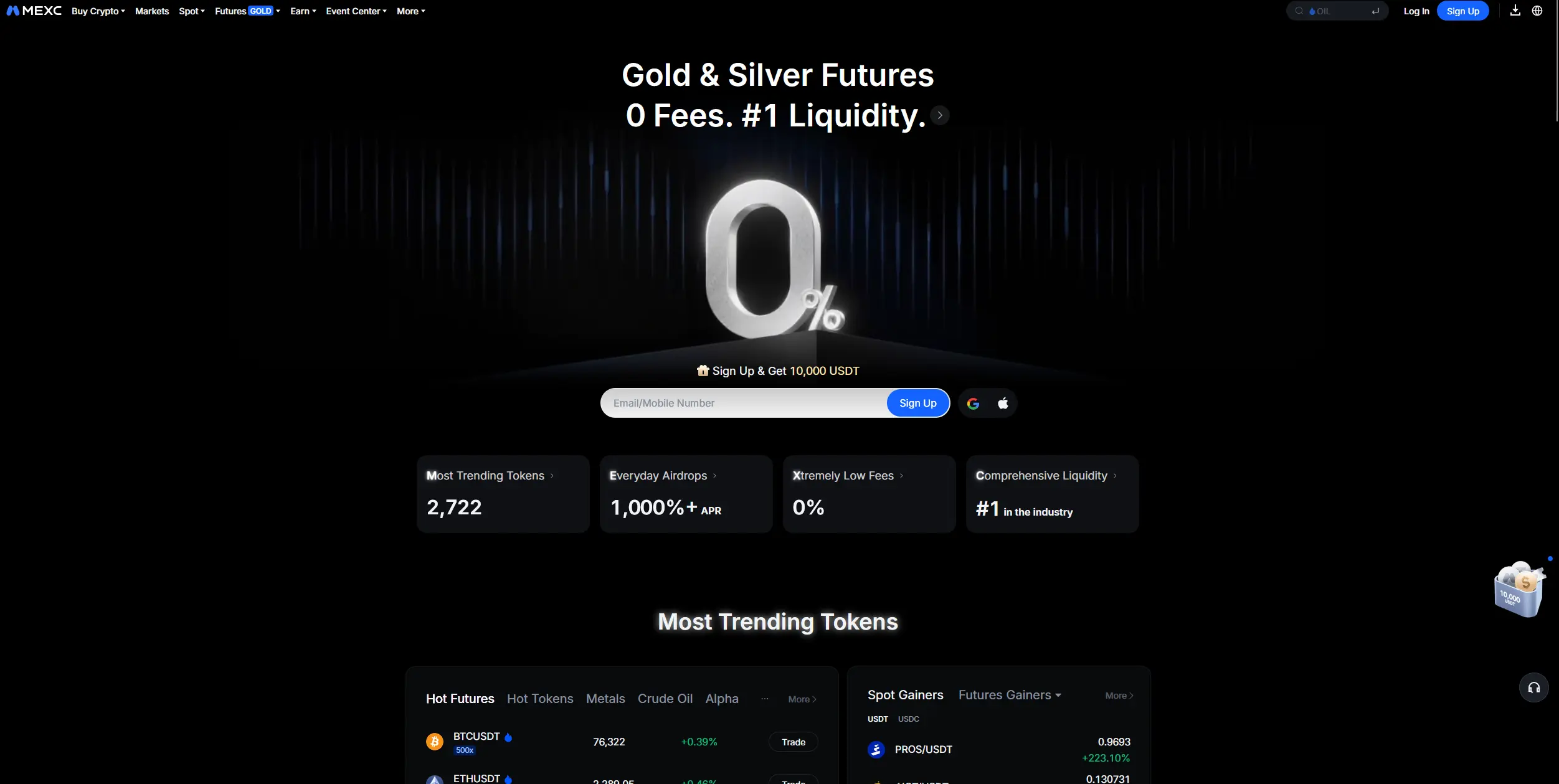
Best crypto exchange for lowest fees and early token access
In particular, MEXC stands out on two specific criteria that matter disproportionately to active traders: it charges zero maker fees on spot trading, and it consistently lists new tokens earlier than most competing platforms. Together, these factors make it the preferred exchange for users who trade high volumes of limit orders or who want early access to newly launched assets before they reach Binance or Coinbase. At $3.25 billion in daily spot volume and 9.8 million weekly visits, it is among the most actively used platforms in the market despite lower brand visibility than Binance.
Notably, the 1,966 listed coins make MEXC the broadest exchange by asset coverage on this list. Furthermore, taker fees of 0.05% are also below the market standard, making MEXC competitive even for market order traders. Although KYC is optional for limited trading, full access requires identity verification. Meanwhile, the platform’s derivatives coverage has expanded significantly and now includes a wide range of perpetual contracts alongside its spot trading core.
Key Stats
- 24h Spot Volume: $3.25B
- Coins: 1,966
- Markets: 3,150
- Spot Fees: 0% maker / 0.05% taker, industry-leading
- KYC: Optional for limited access
- Weekly Visits: 9.81M
- Strengths: Zero maker fees, early token listings, broadest coin coverage
Bitget
Best crypto exchange for copy trading and derivatives newcomers
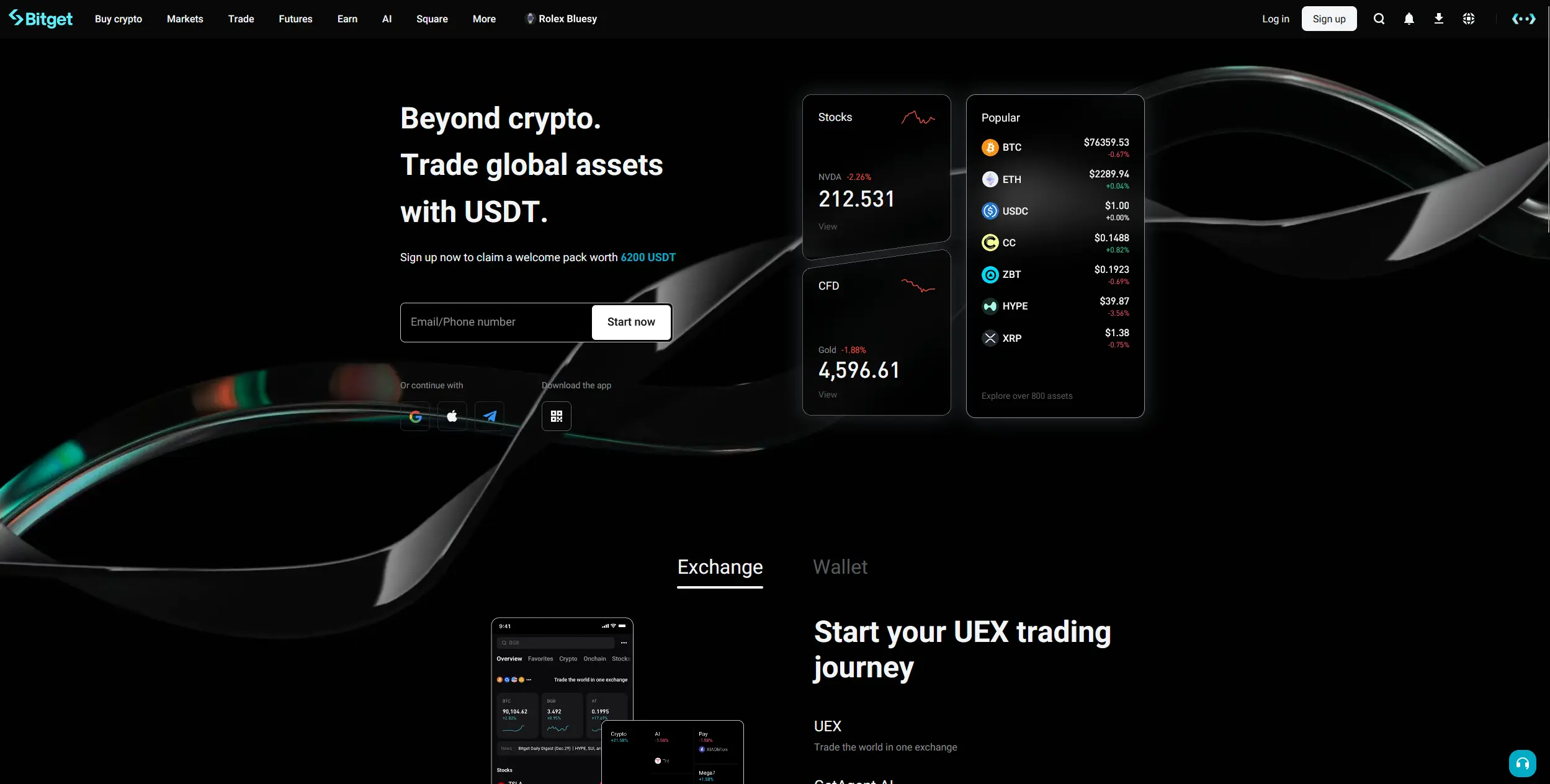
Similarly, Bitget has built a strong reputation primarily through its copy trading product, which allows users to automatically mirror the positions of verified professional traders in real time. As a result, it is one of the most accessible derivatives platforms for users who lack the time or experience to manage active positions manually. In total, the exchange lists 728 coins across 1,245 markets, processes $944 million in daily spot volume, and attracts 3.9 million weekly visitors, figures that reflect a loyal, focused user base rather than broad-market dominance.
Beyond copy trading, Bitget offers a full derivatives product suite including perpetuals, futures, and options, with competitive 0.1% fees across both maker and taker sides. In addition, the BGB (Bitget Token) provides fee discounts and staking rewards. Finally, Bitget has expanded its regulatory footprint over the past two years and now operates under licences in multiple jurisdictions, improving its standing for compliance-sensitive users.
Key Stats
- 24h Spot Volume: $944M
- Coins: 728
- Markets: 1,245
- Spot Fees: 0.1% maker / 0.1% taker
- Copy Trading: Mirror professional traders automatically
- KYC: Required
- Strengths: Copy trading, derivatives access, BGB discounts
HTX
Best established exchange for Asia-Pacific markets and token launches
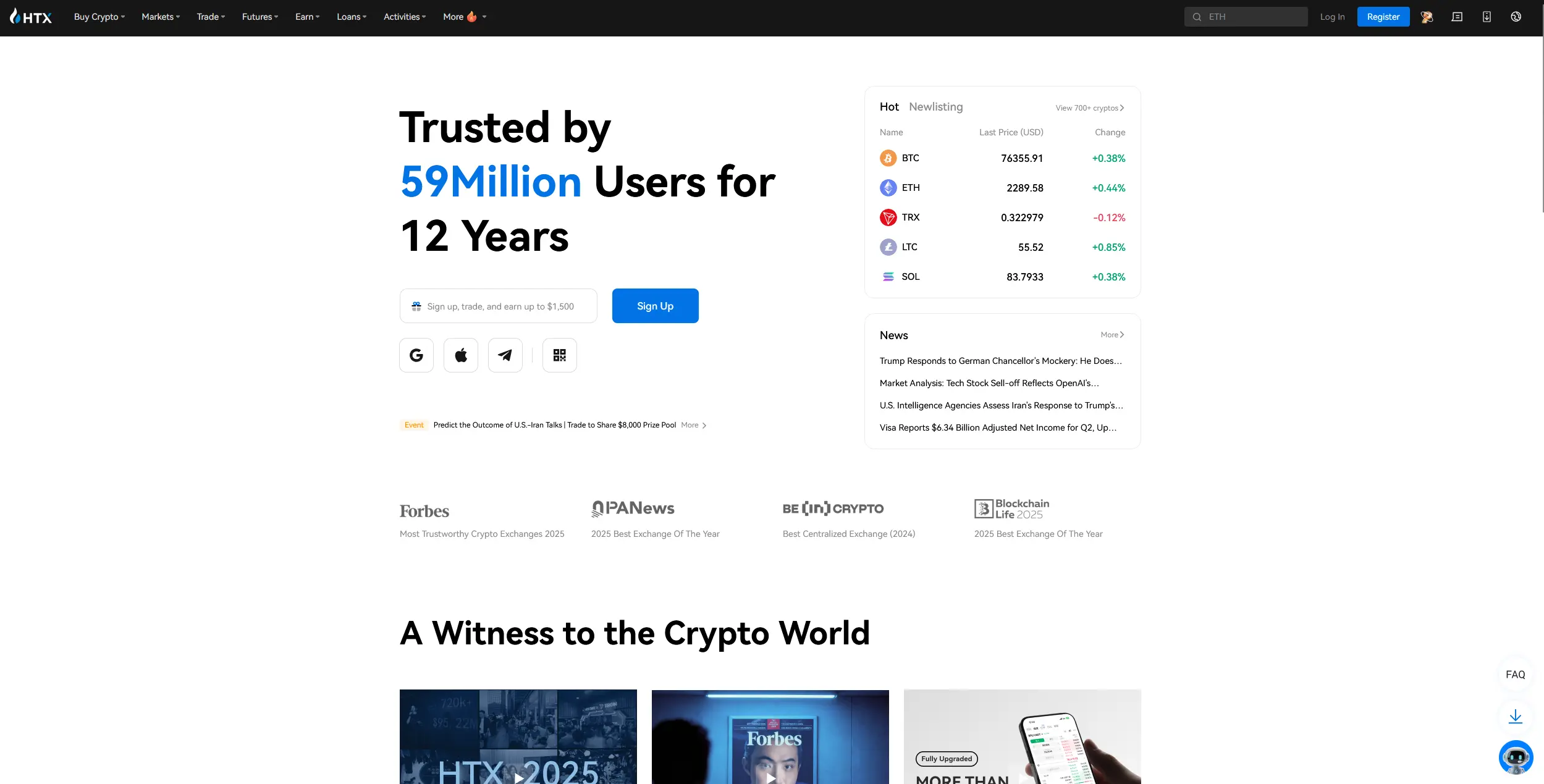
Founded in 2013, HTX, formerly known as Huobi, is one of the longest-running exchanges in the market. Specifically, it generates $1.29 billion in daily spot volume across 891 markets and 696 coins, with a particular strength in Asia-Pacific user bases and Chinese-language markets. Meanwhile, the exchange has navigated a turbulent few years following regulatory changes in China and a rebranding in 2023, and now operates under the HTX identity with a focus on institutional services, token launches, and fiat onramps for markets that other platforms serve less directly.
In addition, HTX’s Launchpad programme for new token offerings has historically produced some of the highest-profile project launches in the market. Furthermore, the exchange supports 45+ fiat currencies, making it one of the more accessible platforms for regional markets across Southeast Asia, the Middle East, and parts of Africa. However, its 0.2% spot fee structure is higher than the lowest-cost competitors, which creates a cost disadvantage for active spot traders, but the platform’s institutional services, OTC desk, and custody offerings serve users whose priority is execution quality and regional access rather than margin compression.
Key Stats
- 24h Spot Volume: $1.29B
- Coins: 696
- Markets: 891
- Spot Fees: 0.2% maker / 0.2% taker
- Fiat Support: 45+ currencies
- Founded: 2013
- Strengths: Asia-Pacific reach, institutional services, token launches, OTC desk
Upbit
Leading South Korean crypto exchange, dominant in KRW markets
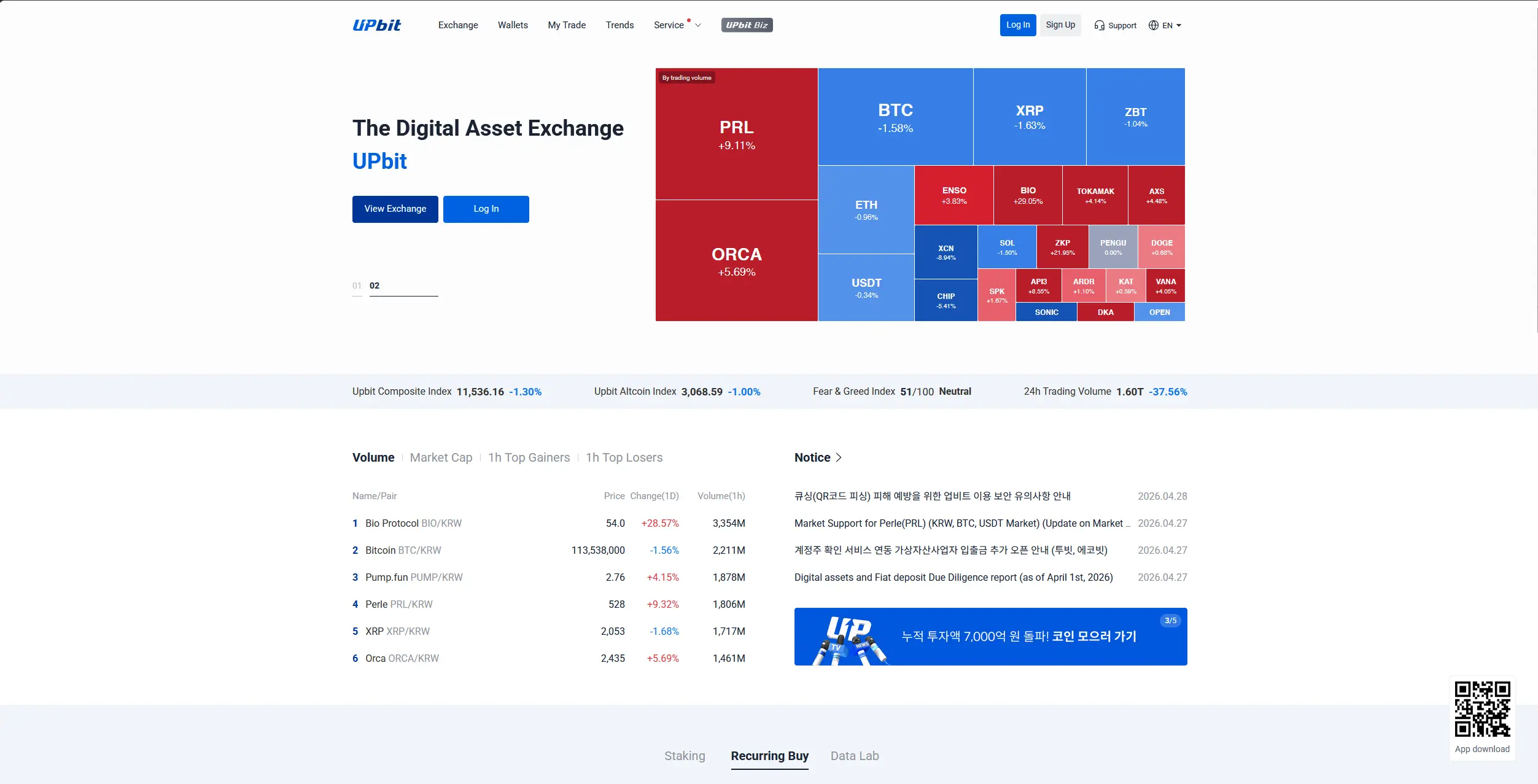
By contrast, Upbit is the dominant crypto exchange in South Korea, one of the most active crypto trading markets in the world. Specifically, it processes $1.75 billion in daily spot volume, the vast majority denominated in Korean Won (KRW), across 705 markets listing 313 coins. Notably, its Liquidity Score of 556 reflects the concentration of volume in KRW pairs rather than broad global liquidity, but within its home market, Upbit commands a position comparable to what Binance holds globally.
For international traders, Upbit’s relevance lies primarily in its influence on altcoin price discovery: tokens that list on Upbit often see significant volume spikes, and Upbit listings are frequently treated as a positive signal by market participants. Additionally, the exchange charges a flat 0.05% fee regardless of trade size or direction, which is among the most transparent and competitive fee structures on this list. Finally, KYC is strictly required and tied to Korean banking relationships, which creates a significant barrier to entry for non-Korean users.
Key Stats
- 24h Spot Volume: $1.75B
- Coins: 313
- Markets: 705
- Spot Fees: 0.05% flat across all pairs
- KYC: Strict, linked to Korean banking
- Primary Currency: KRW
- Strengths: South Korean market dominance, low flat fee, altcoin listing influence
How to Choose the Right Crypto Exchange in 2026
Ultimately, no single exchange is optimal for every use case. The right platform depends on your trading activity, location, regulatory requirements, and which assets you need to access.
Trading Style
- Active derivatives trading: Bybit offers the deepest perpetual contract markets with the most consistent liquidity and the best institutional tooling
- Spot trading with lowest fees: MEXC charges zero maker fees. Bybit and Binance offer the best fee-to-liquidity combination for taker orders
- Copy trading: Bitget has the most developed copy trading product. Bybit also offers a strong copy trading layer
- Long-term holding with yield: Bybit Earn, KuCoin Earn, and Binance Earn all offer flexible and fixed-term staking products
Asset Focus
- Major pairs (BTC, ETH, SOL, BNB): Binance offers the tightest spreads and deepest liquidity on tier-one assets
- Altcoins and new listings: Gate and MEXC offer the widest selection and earliest access to new tokens
- US-listed assets with regulatory certainty: Coinbase is the only platform with full US regulatory standing across all listed assets
Location
- United States: Coinbase is the only fully regulated option for US users at full scale
- Europe (EEA): Bybit, OKX, and Binance all operate with EEA compliance. OKX’s MiCA-aligned card and fiat products are particularly relevant
- Asia-Pacific: Bybit and HTX have strong regional infrastructure. Upbit dominates the Korean market
- Global with minimal KYC friction: KuCoin and MEXC allow limited trading without full KYC
Pairing Exchange Strategy with Marketing
Projects targeting specific regions often pair exchange strategy with local market presence. Cryptic runs campaigns out of Dubai, London and Amsterdam.
Final Thoughts on the Top 10 Crypto Exchanges in 2026
Today, the top 10 crypto exchanges in 2026 collectively serve hundreds of millions of users across every major market. What has changed from earlier cycles is the level of product sophistication: exchanges now compete on derivatives infrastructure, Web3 integration, earn products, and compliance standing, not just on listing breadth or trading fees alone.
Bybit leads on overall product quality and innovation for active traders, while Binance leads on raw scale and asset availability. Meanwhile, OKX leads on Web3 integration, and Coinbase leads on regulatory standing. Finally, MEXC leads on cost efficiency for high-volume limit order traders. Ultimately, each platform has earned its position through genuine product strength rather than marketing spend alone.
Above all, the most important factor in choosing among these platforms is not which exchange ranks highest by volume, but which platform’s fee structure, asset selection, regulatory status, and product depth align with how you actually trade and where you are based. For projects rather than traders, an exchange listing is only the start. A specialized crypto marketing agency turns that listing into sustained market presence.
For Web3 projects looking to build presence across these exchanges, through crypto PR, KOL marketing campaigns, exchange listing announcements, and go-to-market strategy, work with a crypto marketing agency. We have run campaigns with Binance, Bybit, OKX, and NEAR, and understand how to position projects effectively across every major exchange ecosystem. For teams focused on earned media, see our ranking of the best crypto PR agencies in 2026.
FAQ
What is the largest crypto exchange by volume in 2026?
Binance remains the largest crypto exchange by 24-hour trading volume in 2026, processing over $11 billion in daily spot volume according to CoinMarketCap. However, Bybit leads on overall user experience, derivatives product depth, and rewards for active traders.
Which crypto exchange has the lowest fees in 2026?
MEXC charges 0% maker fees on spot trading, making it the lowest-fee option for limit order traders. Bybit and OKX charge 0.1% or lower for most users, with additional discounts via VIP tiers and native tokens. Coinbase charges significantly higher retail fees, typically between 0.6% and 1.2%.
Is KYC required to use a crypto exchange?
Most major exchanges require KYC for full access. KuCoin and MEXC allow limited trading without KYC but enforce withdrawal limits. Regulated platforms like Coinbase and Binance require full identity verification before trading or withdrawals. Requirements vary by jurisdiction.
Which crypto exchange is best for beginners?
Coinbase is considered the most beginner-friendly exchange due to its clean interface, regulatory clarity, and educational resources. Bybit and Binance also offer simplified modes while supporting more advanced trading as users grow.
Which crypto exchange is best for derivatives trading?
Bybit is widely regarded as the leading derivatives platform in 2026, offering perpetuals, options, and inverse contracts with strong liquidity. OKX is another major competitor, especially with its unified trading account system.
Are crypto exchanges safe in 2026?
Leading exchanges publish proof-of-reserves, maintain insurance funds, and operate under varying regulatory frameworks. However, security differs per platform. Using hardware wallets for long-term storage and keeping only active trading funds on exchanges reduces risk significantly.
| Platform | 24h Volume | Best For | KYC Required | Spot Fees |
|---|---|---|---|---|
| Bybit | $2.55B | Derivatives, rewards, global reach | Yes (tiered) | 0.1% maker/taker |
| Binance | $11.16B | Largest volume, broadest asset range | Yes | 0.1% (BNB discount) |
| OKX | $2.17B | Web3 wallet, institutional tools | Yes | 0.08% maker / 0.1% taker |
| Coinbase | $2.01B | US regulated, beginner-friendly | Yes (strict) | 0.6% / 1.2% (retail) |
| KuCoin | $2.46B | Altcoin variety, KCS staking | Optional (limits) | 0.1% (lower with KCS) |
| Gate | $2.12B | Widest listing selection | Yes | 0.2% maker / 0.2% taker |
| MEXC | $3.25B | Zero maker fees, early token access | Optional (limits) | 0% maker / 0.05% taker |
| Bitget | $944M | Copy trading, derivatives | Yes | 0.1% maker / 0.1% taker |
| HTX | $1.29B | Asia-Pacific focus, token launches | Yes | 0.2% maker / 0.2% taker |
| Upbit | $1.75B | South Korean market leader | Yes (KYC strict) | 0.05% flat |