Selecting among the best blockchain gaming projects in 2026 is not as straightforward as picking the game with the largest daily active user count. The Web3 gaming market has undergone a fundamental reset from the speculative play-to-earn peak of 2021–2022: projects that prioritised token emission models over game quality have been filtered out, and the survivors , along with a new cohort of better-capitalised studios , have emerged with demonstrably stronger gameplay loops, more sustainable tokenomics, and the infrastructure to support genuine player bases rather than mercenary yield farmers.
The blockchain gaming sector attracted over $1.4 billion in investment in 2025, with capital concentrated in projects that could demonstrate active player retention , a metric largely ignored during the prior cycle , alongside on-chain asset ownership and token integration. Of the hundreds of projects in development, a handful have built the combination of playable products, sustainable economies, and community infrastructure that makes them worth serious engagement in 2026. This guide covers the ten that matter most , ranked by gameplay quality, economic sustainability, player adoption, and the strength of the team and backing that determines which projects will still be relevant in two years.
Whether you are a gamer looking for blockchain titles that are genuinely worth playing, an investor evaluating GameFi token opportunities, or a guild manager assessing which projects will sustain scholarship programmes into 2027, this comparison covers the project that fits your priority.
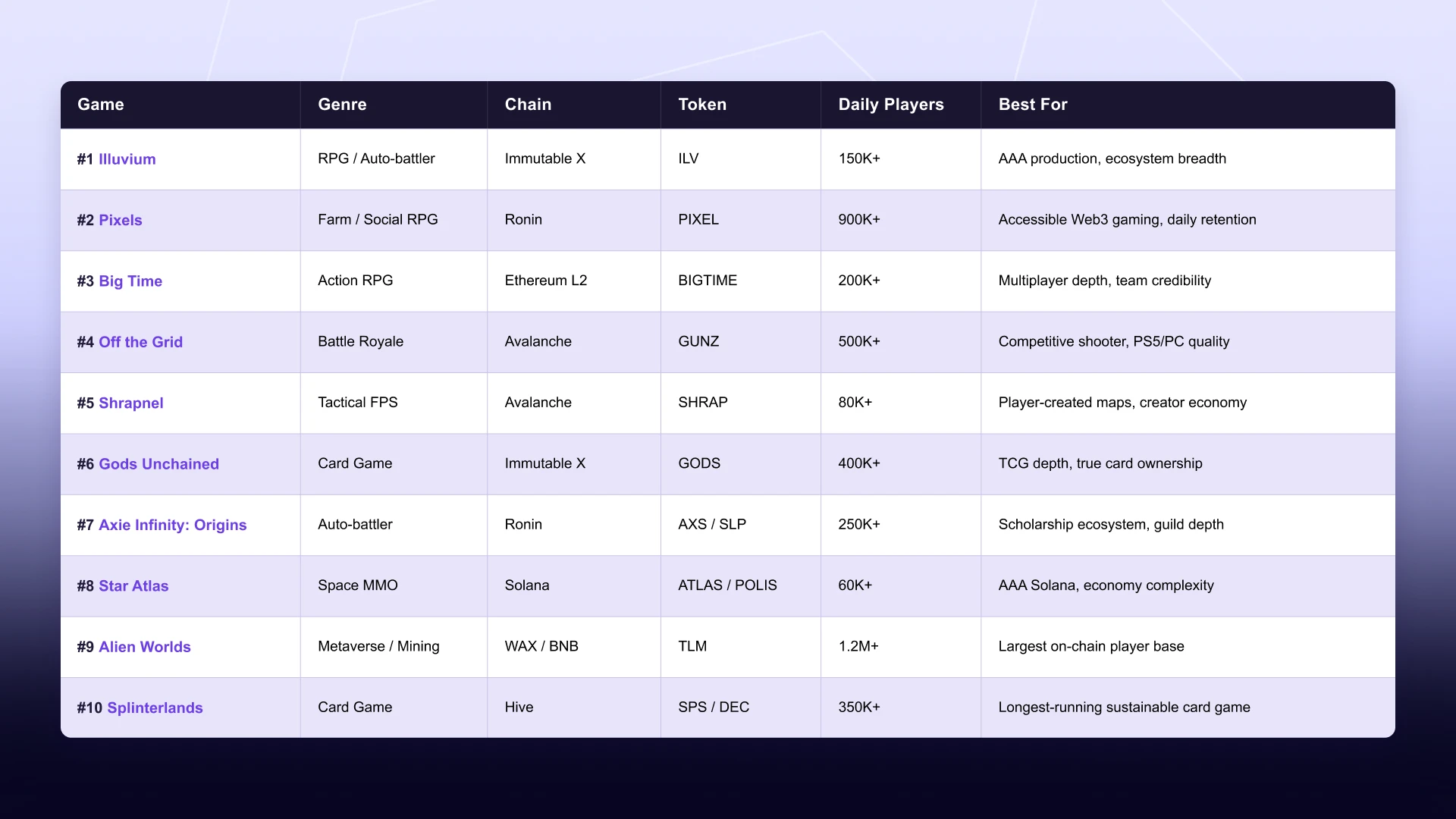
Quick answer: Illuvium leads on production quality and ecosystem breadth for AAA-aspiring blockchain games. Pixels leads on active daily player retention for accessible Web3 gaming. Big Time leads on multiplayer RPG depth and team credibility. Off the Grid leads on blockchain-integrated competitive shooter quality. Shrapnel leads on community creation tools and player-owned map development.
What to Look for in a Blockchain Gaming Project in 2026
Most blockchain gaming guides focus on token price and stop there. In practice, five factors determine whether a project sustains a genuine player base.
Gameplay Quality as the Primary Filter
The defining lesson of the 2022 GameFi correction was that no tokenomics model can sustain a game that is not genuinely enjoyable to play. Projects that attracted players purely through token incentives saw user bases collapse the moment rewards declined, because there was no underlying game worth staying for. In 2026, gameplay quality , session length, player retention beyond 30 days, organic community formation independent of financial incentives , is the primary signal that separates sustainable projects from extraction vehicles.
Tokenomics and Economic Sustainability
The play-to-earn model fails when token emission outpaces new player entry , a mathematical inevitability in games where earning is the primary motivation. Sustainable blockchain game economies in 2026 are designed around spending sinks that match or exceed emission rates: crafting, upgrades, seasonal content, competitive entry fees, and cosmetic purchases all function as deflationary mechanisms that extend the economic lifespan of the game’s token. Projects with visible in-game GDP metrics and documented token sink effectiveness are substantially more investable than those relying on projected future player growth to absorb emission.
Team Track Record and Studio Backing
The attrition rate among blockchain gaming projects is high , most announced games in 2021–2022 never shipped a playable product. Team credibility in 2026 is evaluated primarily on shipped products: studios that have delivered a playable game, regardless of its success, have demonstrated operational capability that vaporware projects cannot match. Backing from gaming-native VCs , Andreessen Horowitz Games, Bitkraft, Animoca Brands, Immutable , provides additional validation that the team has passed a credibility threshold that general crypto VCs lack domain expertise to evaluate.
Blockchain Integration and Asset Ownership
The strongest blockchain gaming projects in 2026 use on-chain infrastructure for the elements where it adds genuine player value , asset ownership, interoperability, player-driven marketplaces, and provably fair randomness , without requiring players to understand blockchain mechanics to enjoy the game. Games that front-load wallet creation, gas fee management, and transaction confirmation into the core gameplay loop consistently show worse retention than titles that abstract blockchain benefits behind familiar game interfaces.
Community and Guild Ecosystem
Sustained blockchain gaming communities develop guild infrastructure , organised groups of players who collectively manage scholarship programmes, competitive teams, and asset pools. Games that have developed active guild ecosystems demonstrate a level of community depth that solo-player engagement metrics cannot replicate. Guild activity is a leading indicator of game health: when guilds dissolve and scholarship programmes close, player retention collapse typically follows within weeks.
Quick Comparison: Best Blockchain Gaming Projects at a Glance
Illuvium
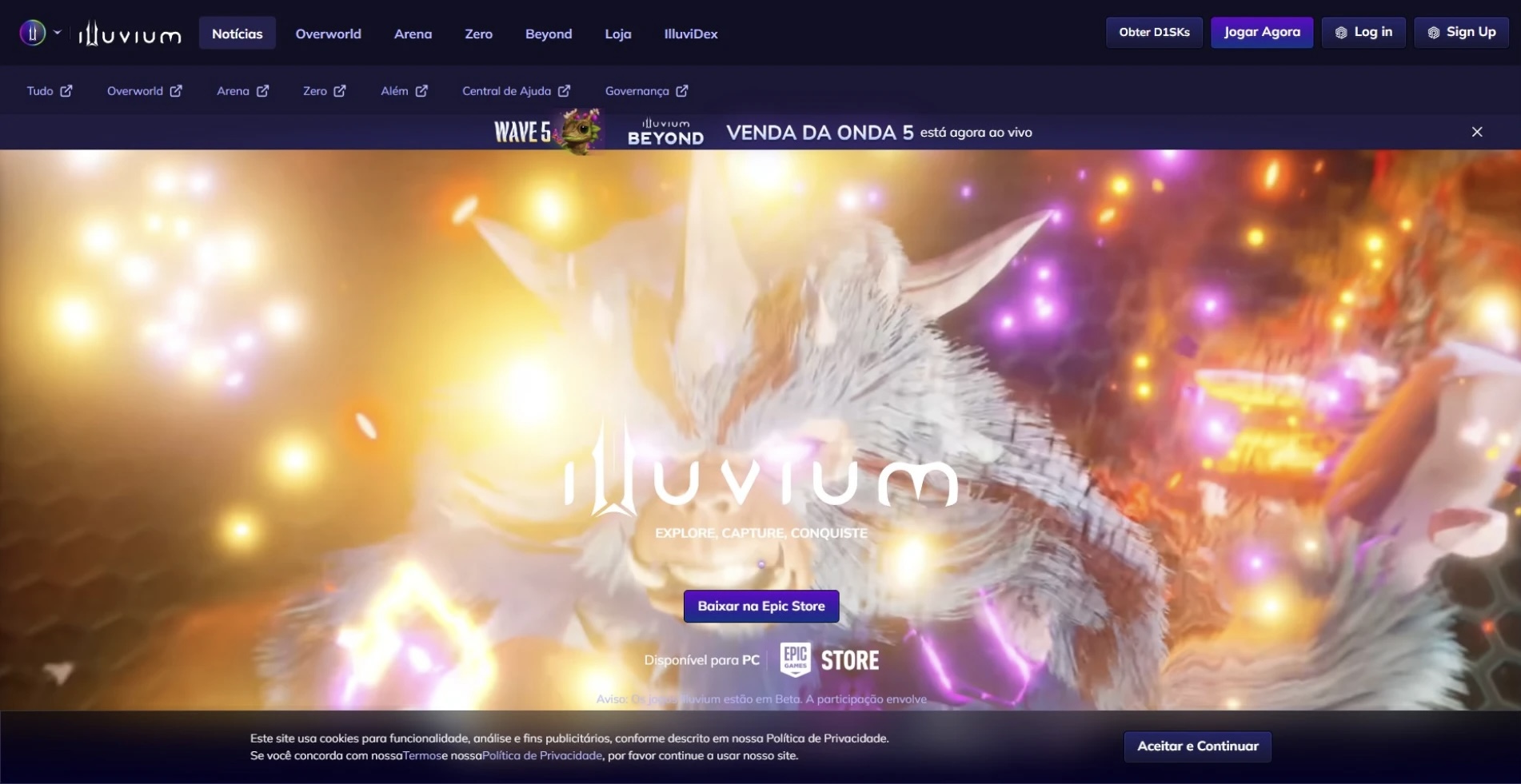
Best overall blockchain gaming project in 2026 , AAA production with multi-game ecosystem
Illuvium represents the most ambitious execution of the AAA blockchain gaming thesis in the market. Built on Immutable X and developed by a studio with over 200 staff at peak development, the Illuvium universe spans three interconnected games , Illuvium: Open World (exploration and creature capture), Illuvium: Arena (auto-battler PvP), and Illuvium: Beyond (digital collectibles and staking) , all operating within a shared asset ecosystem where NFTs captured in one game are usable across the others. This inter-game asset composability is the feature that most clearly distinguishes Illuvium from blockchain games that treat NFT ownership as a tokenomics mechanism rather than a genuine gameplay advantage.
The ILV token governs the Illuvium DAO and provides staking rewards from in-game revenue, creating a sustainable yield mechanism where protocol income , derived from in-game item sales, land sales, and tournament entry fees , funds holder distributions rather than inflationary token emission. Illuvium’s land sale generated significant revenue before game launch and its land gameplay mechanics , where players build extractors on-chain assets to generate resources , create an ongoing economic activity layer above the core game that sustains engagement between content updates.
Key Stats
- Genre: Open World RPG / Auto-battler / Collectibles
- Chain: Immutable X (Ethereum L2)
- Token: ILV (governance and staking)
- Daily Active Players: 150K+ across all three game products
- Key Feature: Cross-game asset interoperability , one NFT, three games
- Funding: $72M raised from Framework Ventures, Delphi Digital, and others
- Strengths: AAA production quality, multi-game ecosystem, ILV staking yield, land economy
Pixels
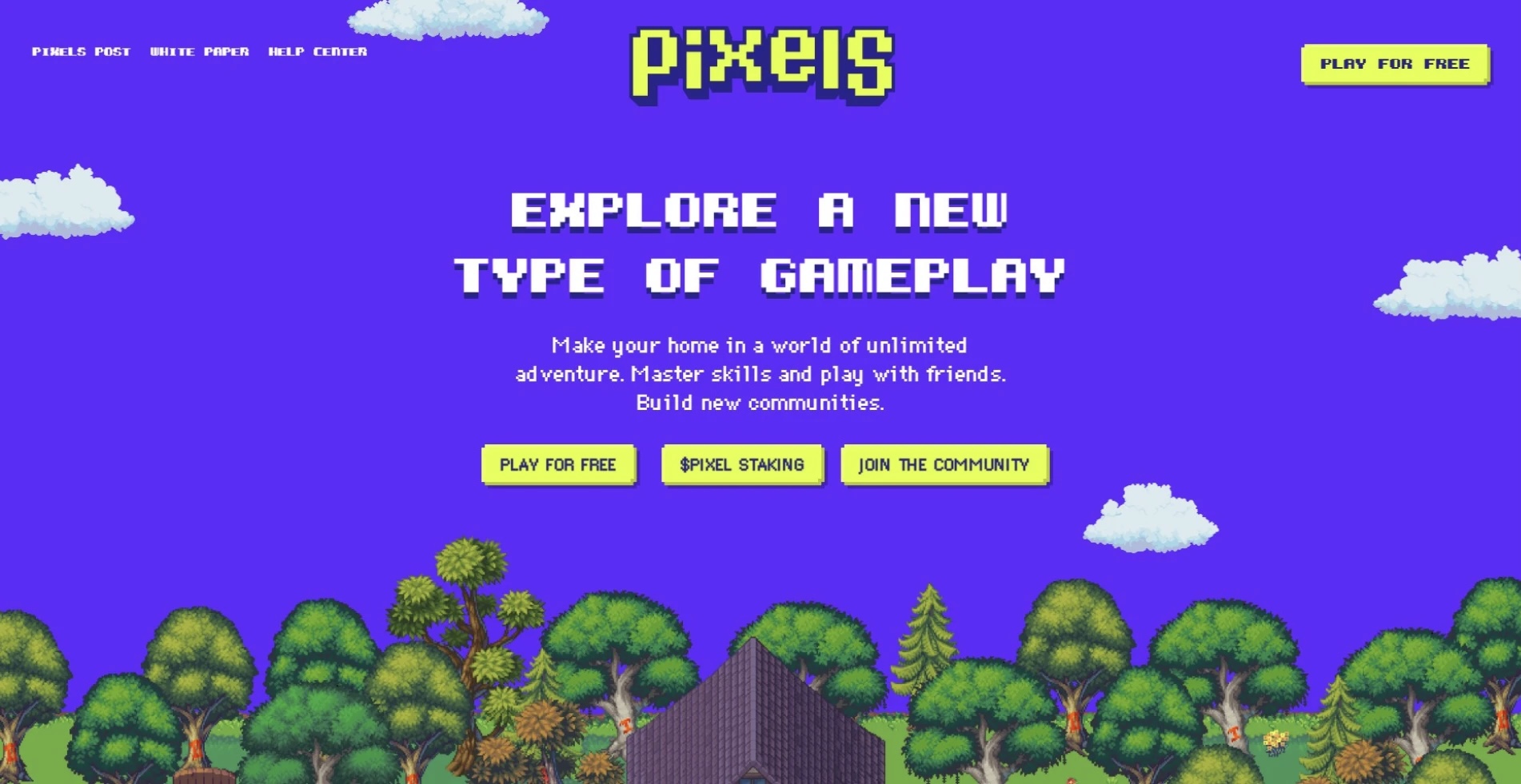
Best Web3 game for daily player retention , accessible farm RPG on Ronin with 900K+ daily users
Pixels is the blockchain gaming market’s clearest example of accessibility-driven retention. Its browser-based farm and social RPG format , pixel art aesthetic, simple farming mechanics, community building, and social exploration , attracts a player demographic that other blockchain games with high hardware requirements and complex mechanics consistently exclude. The result is a daily active user base that peaked above 900,000 and has maintained retention rates that no technically sophisticated blockchain game has matched, demonstrating that accessible design is a more reliable driver of sustained player counts than production budget.
Built on the Ronin blockchain , the gaming-optimised Ethereum sidechain developed by Sky Mavis for Axie Infinity , Pixels benefits from near-zero transaction costs and fast finality that make frequent in-game asset interactions economically viable for players without significant crypto holdings. The PIXEL token funds in-game resource systems and governance, with token sinks designed into the core farming loop rather than bolted on as an afterthought. Pixels’ integration with the broader Ronin ecosystem gives it access to the existing Axie community and the gaming-native infrastructure that general-purpose L2s cannot match.
Key Stats
- Genre: Farm / Social RPG , browser-based
- Chain: Ronin (Sky Mavis gaming L2)
- Token: PIXEL
- Daily Active Players: 900K+ (peak); stable 500K+ sustained base
- Key Feature: Browser-accessible, no high-spec hardware requirement
- Funding: Backed by Animoca Brands, Sky Mavis ecosystem
- Strengths: Highest sustained DAU in Web3 gaming, Ronin cost efficiency, accessible design, social mechanics
Big Time
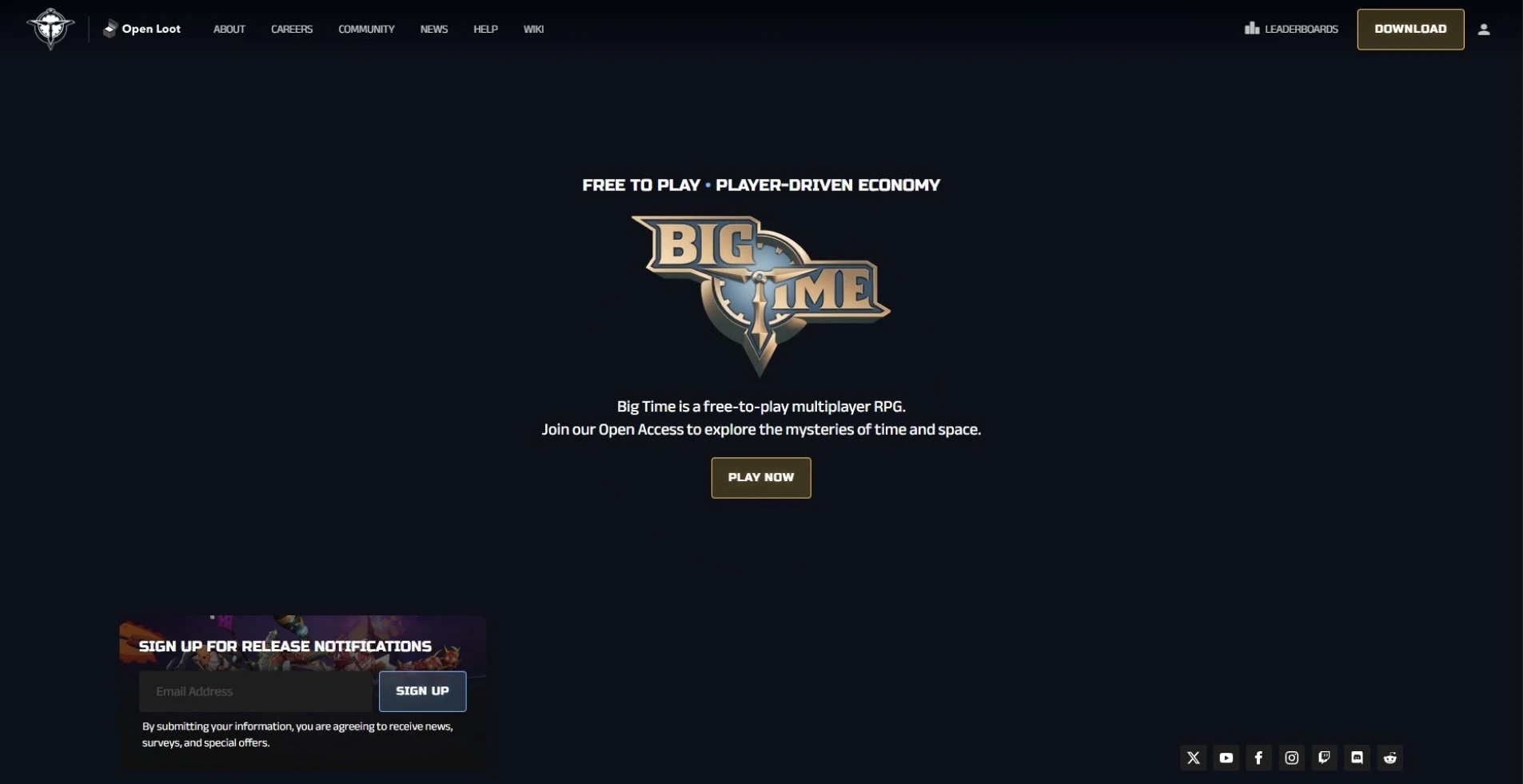
Best multiplayer action RPG on blockchain , AAA-credentialed team with cooperative dungeon gameplay
Big Time is developed by Big Time Studios, a team whose founders include veterans from Epic Games, Activision, EA, and Riot Games , arguably the strongest traditional gaming pedigree of any Web3 gaming studio. The game itself is a multiplayer action RPG where players explore time-distorted dungeons cooperatively, collecting cosmetic NFTs and crafting materials through gameplay rather than purchasing them through auctions. The deliberate decision to make NFTs cosmetic-only rather than gameplay-affecting represents a meaningful design philosophy that distinguishes Big Time from games where token ownership creates pay-to-win dynamics.
The BIGTIME token powers the in-game economy for crafting, seasonal content, and space (player-owned expanding inventory systems), with token sinks designed to match emission rates across player tiers. Big Time’s cosmetic marketplace generates significant secondary volume, driven by time-limited drops and event-specific cosmetics that create genuine scarcity without gatekeeping gameplay access. The studio’s closed beta and controlled expansion model , releasing to expanding player pools over 18 months rather than launching open access immediately , has produced stronger retention data than launch-day open access models across comparable blockchain games.
Key Stats
- Genre: Multiplayer Action RPG , cooperative dungeon crawler
- Chain: Ethereum L2 (proprietary Open Loot infrastructure)
- Token: BIGTIME
- Daily Active Players: 200K+
- Key Feature: AAA-credentialed team; cosmetic-only NFTs , no pay-to-win
- Funding: $21M from Animoca Brands, FTX Ventures (pre-collapse), and others
- Strengths: Team credibility, cooperative gameplay depth, cosmetic NFT model, controlled expansion
Off the Grid
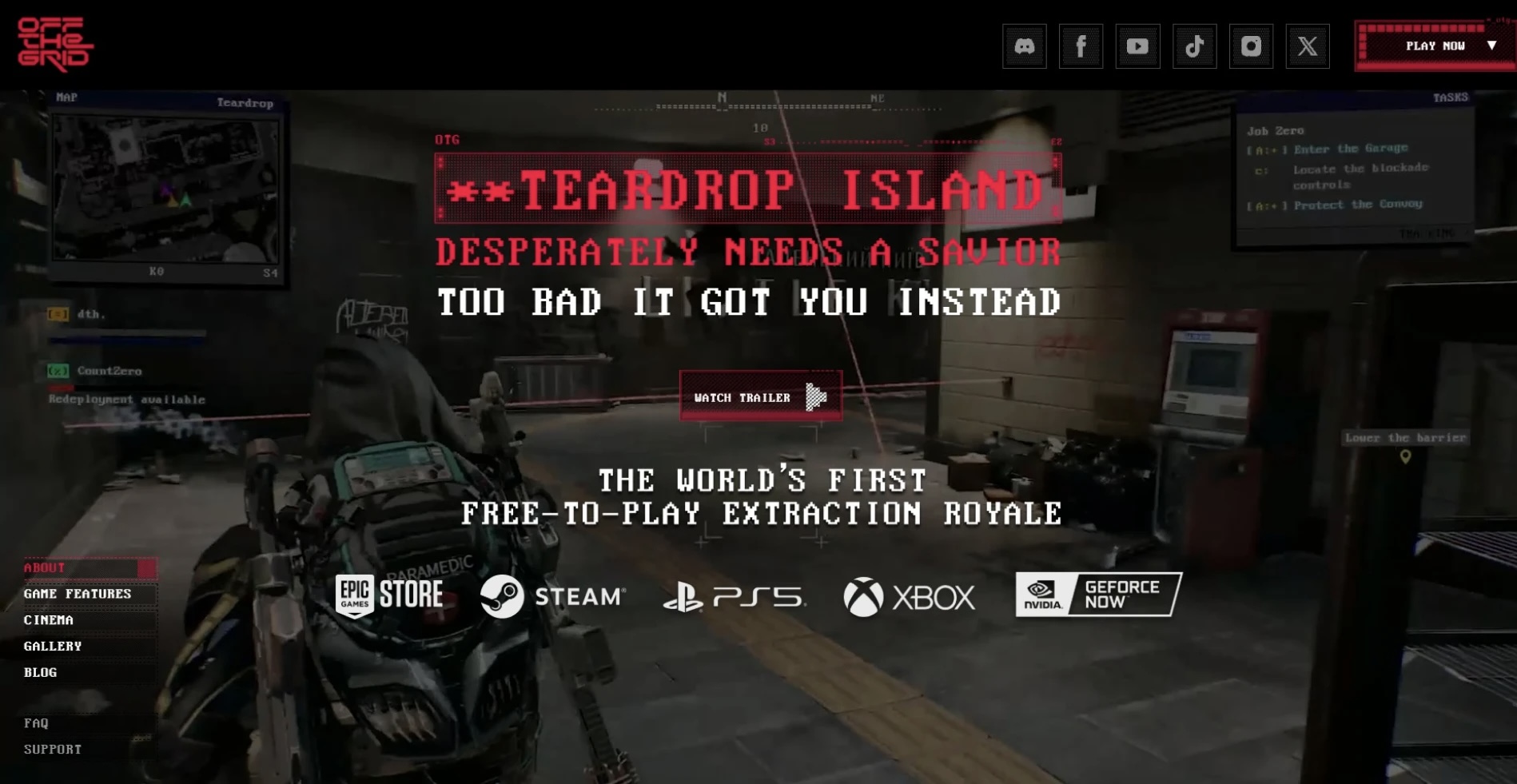
Best blockchain battle royale in 2026 , console-quality competitive shooter with Avalanche integration
Off the Grid (OTG) represents the most credible attempt to bring blockchain integration to the competitive shooter genre , historically the gaming vertical most resistant to crypto mechanics due to its highly competitive, fraud-sensitive player base. Developed by Gunzilla Games with Neill Blomkamp (District 9 director) as creative director, OTG is a third-person battle royale with a cyberpunk narrative layer, available on PS5 and PC. Its blockchain integration is deliberately subtle: players can optionally extract rare item drops to true NFT ownership on Avalanche, while the core game functions as a standard battle royale without requiring crypto engagement.
The GUNZ token powers the in-game economy for item crafting, cosmetic purchases, and the optional on-chain extraction system. The deliberate separation between core gameplay and blockchain features has allowed OTG to attract mainstream gaming audiences that would reject a crypto-mandatory gameplay loop , with blockchain features available as an optional depth layer for players who want asset ownership rather than a requirement that alienates the standard gaming audience. With 500K+ daily players and a PS5 launch that brought the game to non-crypto audiences, OTG demonstrates the hybrid model that is likely to define the next generation of blockchain gaming adoption.
Key Stats
- Genre: Battle Royale / Third-person Shooter
- Chain: Avalanche
- Token: GUNZ
- Daily Active Players: 500K+
- Platform: PS5 and PC , console-quality production
- Key Feature: Optional blockchain integration , non-crypto player accessible
- Strengths: Console quality, mainstream audience, optional Web3, Neill Blomkamp creative direction
Shrapnel
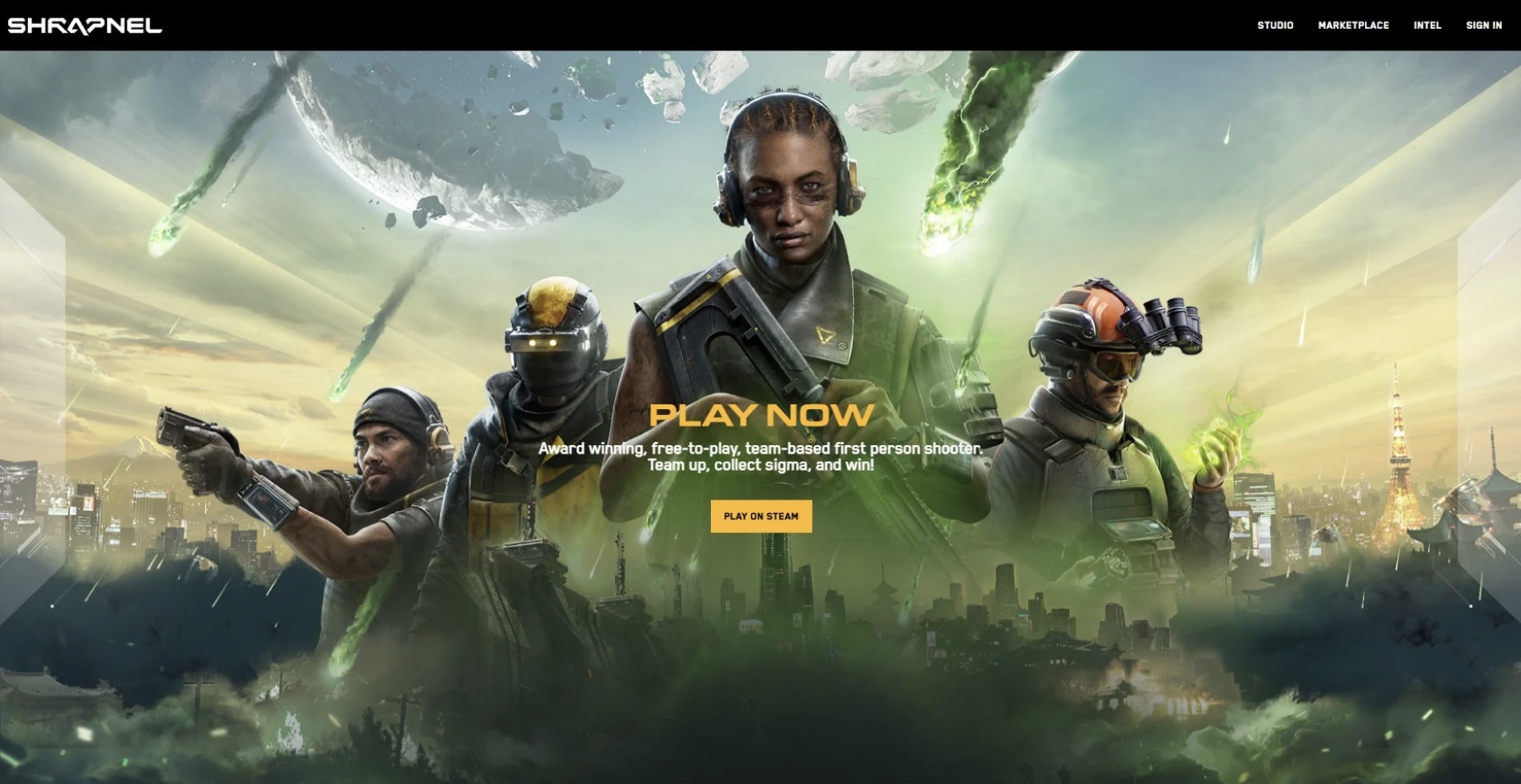
Best blockchain FPS for creator economy , player-built maps with on-chain IP ownership
Shrapnel is a tactical extraction FPS that has built its product differentiation around creator economy mechanics rather than play-to-earn economics. Players can build, publish, and monetise custom game maps , environments, mode rules, asset placement , with on-chain ownership of the IP they create, receiving royalties from player entries into their custom experiences. This creator-first model inverts the typical blockchain game economic model: rather than paying players to play, it pays creators to build the content that makes the game worth playing, creating a virtuous cycle where platform quality improves as the creator economy grows.
The SHRAP token funds creator royalties, map entry fees, and cosmetic crafting, with sinks designed around the map marketplace and competitive tournament entry systems. Shrapnel’s Avalanche infrastructure enables the high-throughput transaction processing that a continuously updating map marketplace requires without gas cost friction that would make micro-royalty payments economically unviable. The studio’s veteran team , including ex-343 Industries and ex-Activision talent , has produced a game that meets the technical bar for competitive FPS players, which is the prerequisite for the creator economy mechanics to attract a meaningful content development community.
Key Stats
- Genre: Tactical Extraction FPS
- Chain: Avalanche
- Token: SHRAP
- Daily Active Players: 80K+
- Key Feature: Player-created map IP ownership with on-chain royalties
- Funding: $35M from Griffin Gaming Partners, Polychain, and others
- Strengths: Creator economy model, map IP ownership, FPS quality, Avalanche throughput, royalty mechanics
Gods Unchained
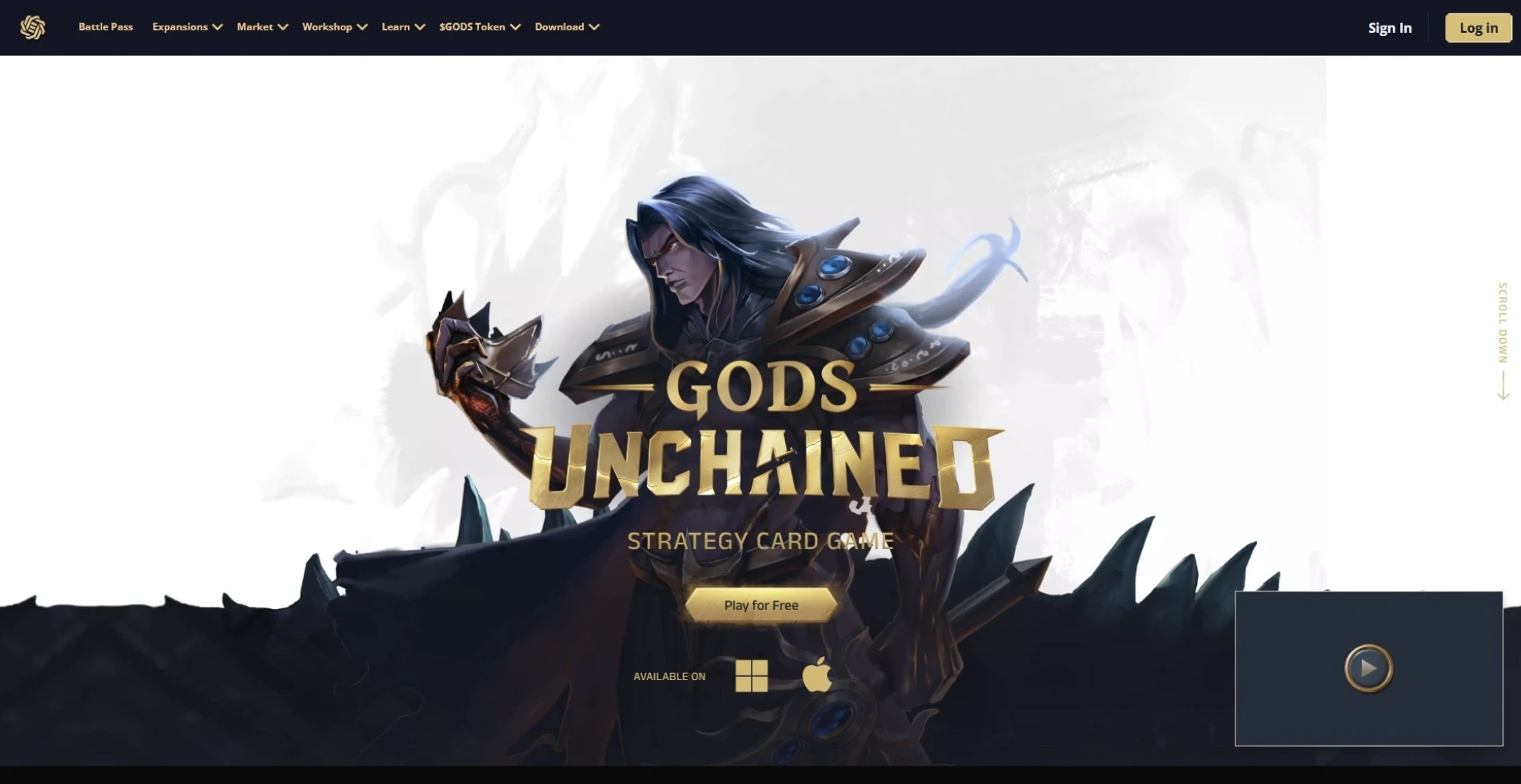
Best blockchain trading card game , true card ownership with Immutable X depth
Gods Unchained is the most technically mature blockchain trading card game in the market, having launched in 2019 and sustained an active competitive community across multiple market cycles. Built on Immutable X, it provides zero-gas NFT card trading that makes frequent collection management , buying, selling, and trading individual cards , economically viable for players at all budget levels. The game’s card balance and competitive meta are managed by a dedicated game design team with experience from Magic: The Gathering and Hearthstone, producing a card game depth that blockchain-native design teams typically lack the domain expertise to achieve.
The GODS token powers crafting, card fusing, and seasonal rewards, with a meaningful distinction from play-to-earn models: the core competitive game is entirely free to play with a weekly reward card system that allows skill-based progression without financial investment. Premium collection and cosmetic upgrade paths provide the spending model that sustains the economy without gatekeeping competitive access. Gods Unchained’s integration with the broader Immutable ecosystem , sharing infrastructure with Illuvium, Guild of Guardians, and other Immutable-native games , creates cross-game community effects that isolated games cannot access.
Key Stats
- Genre: Trading Card Game
- Chain: Immutable X
- Token: GODS
- Daily Active Players: 400K+
- Key Feature: True card ownership with zero-gas trading; free-to-play competitive base
- Funding: Backed by Coinbase Ventures, Libertus Capital
- Strengths: TCG depth, Immutable ecosystem, zero-gas trading, free-to-play competitive access
Axie Infinity: Origins
Best blockchain game for guild ecosystem depth , Ronin infrastructure with scholarship legacy
Axie Infinity Origins , the rebuilt, free-to-play version of the original Axie Infinity , represents Sky Mavis’s response to the economic collapse of the original play-to-earn model. By removing the mandatory NFT purchase barrier and introducing a free starter Axie programme, Origins dramatically lowered the barrier to entry that had made the original game’s scholarship model structurally unsustainable as AXS and SLP prices declined. The Origins relaunch has rebuilt an active player base of 250K+ daily users on the Ronin chain, with competitive PvP mechanics and seasonal ranking systems replacing the pure grinding economics of the original version.
Axie Infinity’s greatest asset in 2026 is its guild ecosystem , hundreds of active guilds across Southeast Asia, Latin America, and Eastern Europe that have survived the economic cycle by transitioning from scholarship-extraction models to genuine competitive community structures. This guild infrastructure represents years of community formation that no new blockchain game has replicated, making Axie Infinity Origins the default platform for guild managers who want to leverage existing organisational structures for competitive play rather than building communities from scratch.
Key Stats
- Genre: Auto-battler / Strategy
- Chain: Ronin
- Token: AXS (governance) / SLP (in-game)
- Daily Active Players: 250K+
- Key Feature: Free-to-play starter programme; largest guild ecosystem in Web3 gaming
- Funding: $152M Series B from a16z, Paradigm, Animoca , 2021
- Strengths: Guild depth, Ronin infrastructure, free-to-play access, competitive PvP, scholarship history
Star Atlas
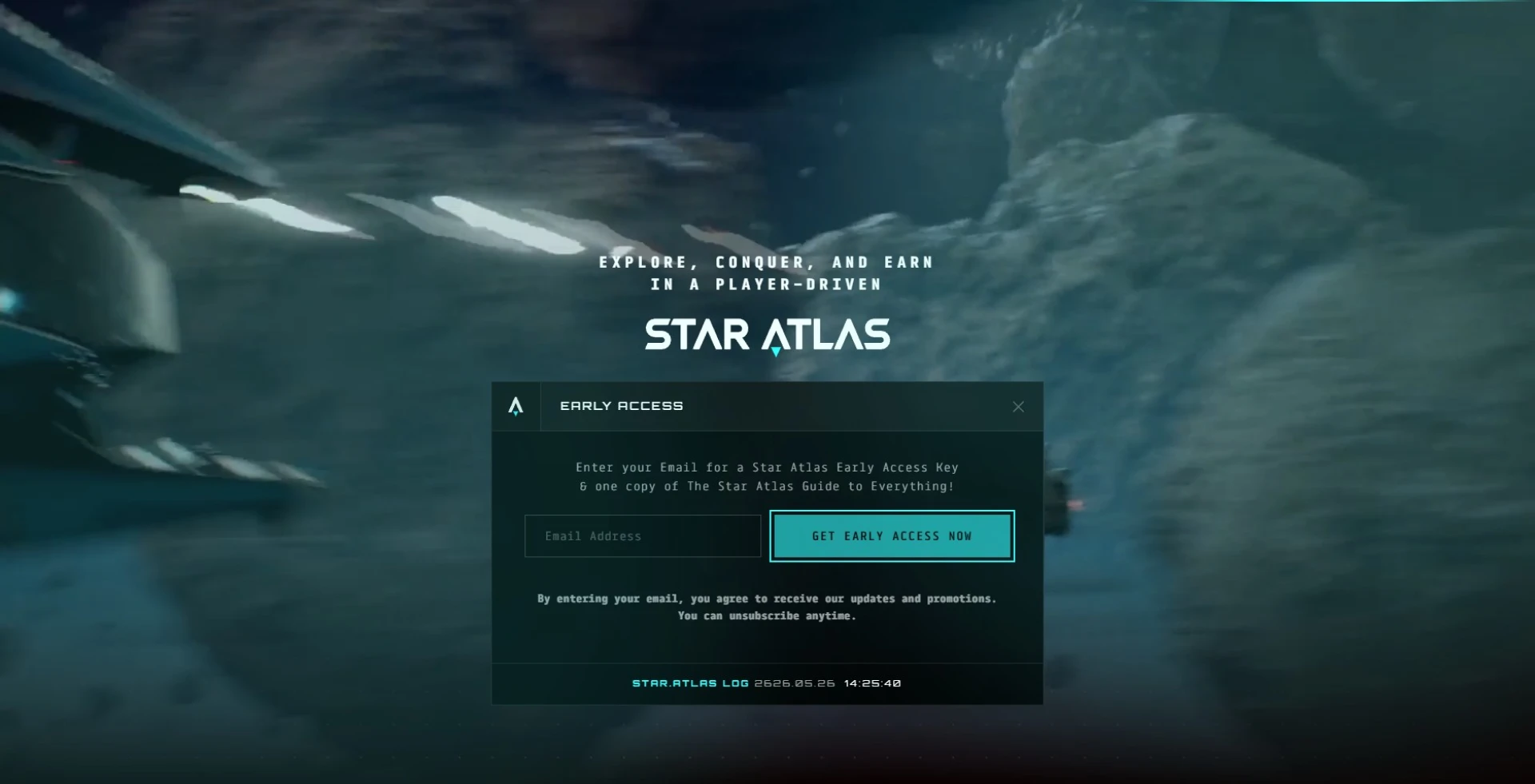
Best AAA blockchain MMO on Solana , space economy with Unreal Engine 5 production
Star Atlas is the most ambitious blockchain MMO in development, building an Unreal Engine 5 space exploration, combat, and political economy game on Solana’s high-throughput infrastructure. The game’s full vision , player-owned fleets, territorial control, political governance, and a complex multi-resource economy , represents a scope that no shipped blockchain game has achieved, making it simultaneously the most exciting long-term blockchain gaming project and the one carrying the most execution risk. The current game state (SCORE mini-game and early access modules) represents a fraction of the eventual product, which the team targets for phased release through 2026–2027.
The dual-token economy , ATLAS for in-game transactions and POLIS for governance , has survived multiple market cycles with active trading volume, sustained by the speculative value of the eventual full game release and by the genuine activity in the existing SCORE economic mini-game where players manage fleet food and fuel consumption for passive ATLAS earnings. For investors with multi-year patience and conviction in the Solana ecosystem, Star Atlas represents the highest-upside blockchain gaming bet in the market; for players seeking immediate gratification, it remains a future proposition rather than a current gaming product.
Key Stats
- Genre: Space MMO / Strategy / Economy
- Chain: Solana
- Token: ATLAS (economy) / POLIS (governance)
- Daily Active Players: 60K+ (current mini-game state)
- Key Feature: Unreal Engine 5; largest scope blockchain game in development
- Funding: $30M from FTX Ventures, Multicoin Capital, Andreessen Horowitz
- Strengths: AAA Solana ecosystem, economy complexity, political governance, UE5 production target
Alien Worlds
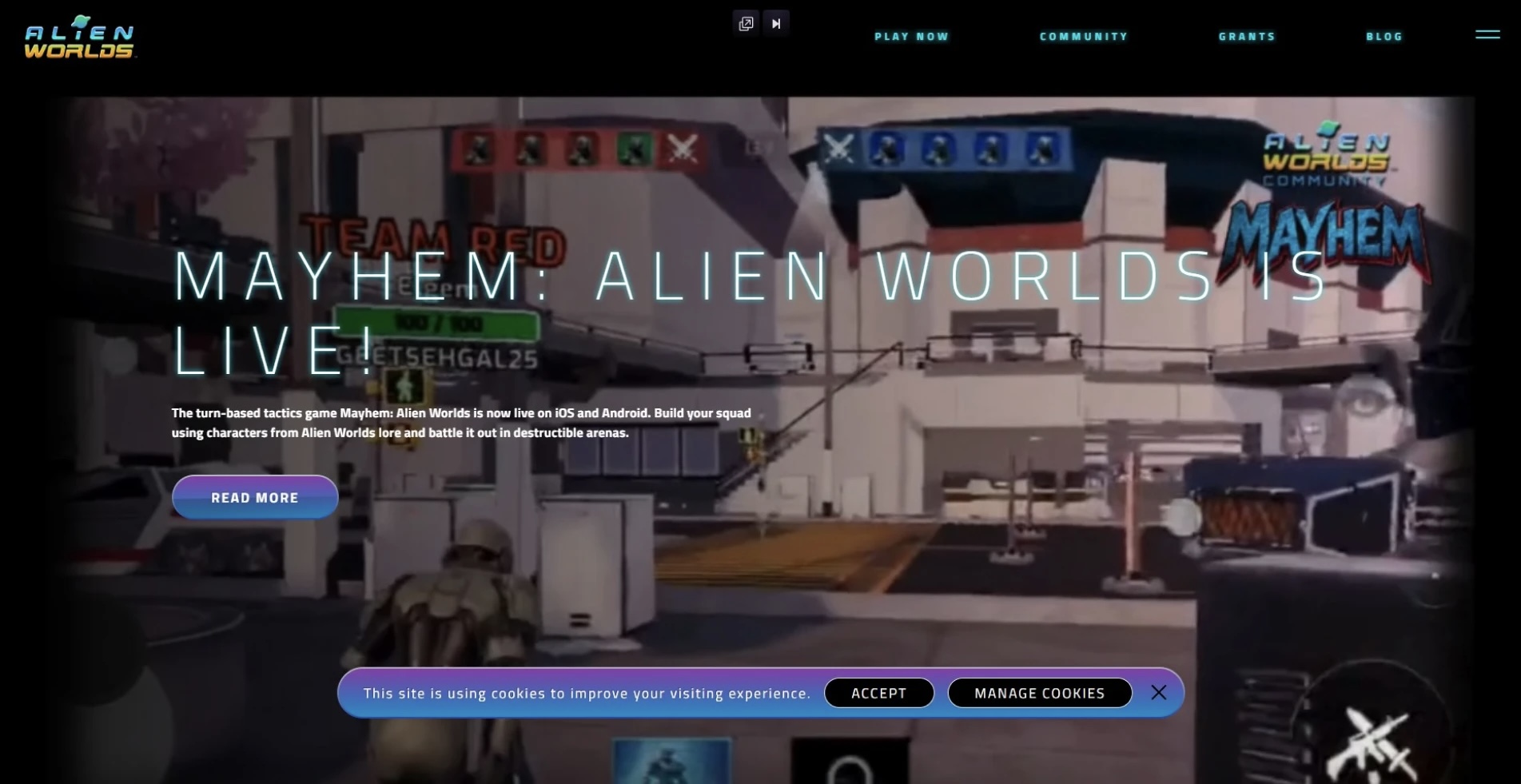
Best blockchain game by raw on-chain player count , WAX mining with multi-chain expansion
Alien Worlds holds the distinction of the largest raw on-chain player count in blockchain gaming , consistently ranking above 1 million daily unique active wallets on DappRadar , driven by its accessible mining mini-game structure on the WAX blockchain. Players mine TLM (Trilium) tokens by clicking a mining button at timed intervals, selecting land plots and mining tools that affect yield rates. The simplicity is intentional: Alien Worlds targets the broadest possible participation funnel, including users in emerging markets who access the game through mobile browsers with minimal hardware requirements.
The game’s multi-chain expansion to BNB Chain and Ethereum has created a more complex asset ecosystem around the core WAX mining product, with staking, governance (Planet DAOs), and NFT collections adding economic depth above the base mining mechanic. Alien Worlds’ player count metrics should be interpreted in context , a significant proportion of wallets represent automated mining operations rather than human players , but the genuine community around Planet DAOs, NFT collecting, and the competitive council election system demonstrates that a real community has formed around the platform’s governance layer.
Key Stats
- Genre: Mining / Metaverse / Governance
- Chain: WAX (primary) + BNB Chain + Ethereum
- Token: TLM (Trilium)
- Daily Active Players: 1.2M+ on-chain wallets
- Key Feature: Largest on-chain player base; mobile browser accessible
- Governance: Planet DAOs with elected councils , on-chain political economy
- Strengths: Accessibility, mobile reach, multi-chain, DAO governance depth, WAX zero-gas
Splinterlands
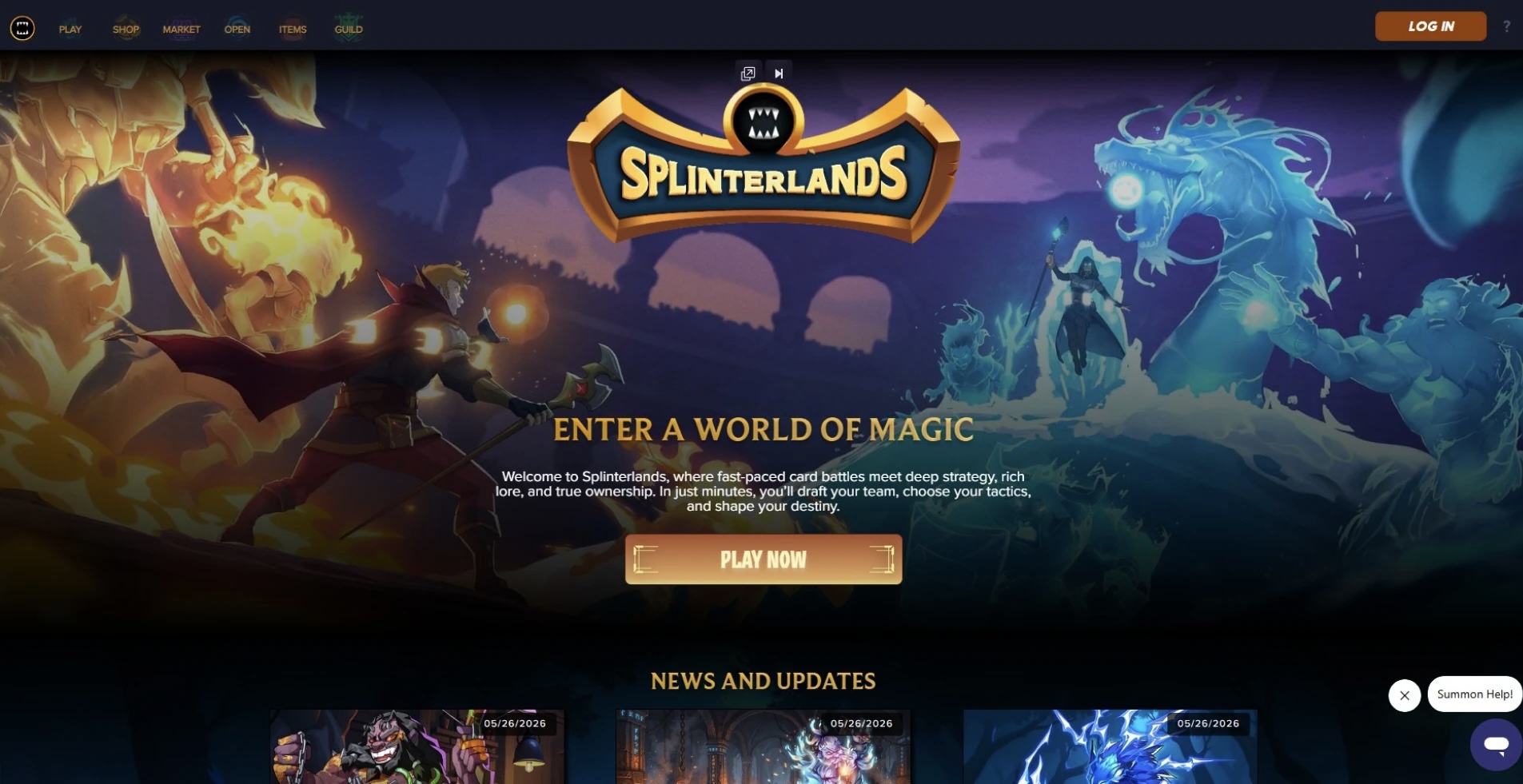
Best long-running blockchain card game , sustainable economics with Hive blockchain depth
Splinterlands is the longest-running successful blockchain card game in the market, having operated continuously since 2018 through multiple crypto market cycles including the 2022 correction that eliminated the majority of its contemporaries. Built on the Hive blockchain , a social and gaming-optimised chain with fast finality and no gas fees , Splinterlands has refined its card battle mechanics, tokenomics, and guild systems over six years of live operation in ways that no newer project can match through design alone. The game’s survival of the 2022 crash while maintaining an active player base of 350K+ daily users represents the most robust proof of long-term viability in the blockchain gaming sector.
The dual-token model , SPS (governance) and DEC (in-game currency) , has been through the full cycle of inflationary pressure, token sink implementation, and economic rebalancing that newer games theorise about without the operational experience to navigate. Splinterlands’ ranked battle system, seasonal reward structure, land expansion, and tournament ecosystem have all been iterated based on years of live player data, producing a game economy that is meaningfully more tuned than any project in development can claim. For guild managers, the established Splinterlands scholarship infrastructure represents the most proven model for collective asset management in blockchain gaming.
Key Stats
- Genre: Trading Card Game / Battle
- Chain: Hive
- Token: SPS (governance) / DEC (in-game)
- Daily Active Players: 350K+
- Key Feature: 6+ years of live operation , longest-running successful blockchain card game
- Guild System: Active scholarship and guild battle ecosystem
- Strengths: Operational longevity, proven tokenomics, zero-gas Hive, guild depth, seasonal content cadence
How to Choose the Right Blockchain Gaming Project in 2026
No single game is optimal for every player or investor. The right project depends on your gaming preferences, capital availability, time commitment, and whether you are primarily a player, investor, or guild operator.
By Gaming Genre
- Action RPG and dungeon crawling: Big Time offers the strongest multiplayer cooperative experience with AAA-credentialed team backing
- Trading card games: Gods Unchained leads on competitive depth and zero-gas trading; Splinterlands leads on operational maturity and guild ecosystem
- Battle royale and shooters: Off the Grid delivers console-quality production with optional blockchain integration that mainstream players can ignore
- Farm and social games: Pixels provides the most accessible entry point with the highest sustained daily user count in Web3 gaming
By Investment Thesis
- AAA quality and ecosystem breadth: Illuvium and Big Time represent the highest-quality execution of the blockchain gaming AAA thesis currently in the market
- Accessibility and user adoption: Pixels and Alien Worlds demonstrate the largest player bases , raw adoption at scale
- Long-term ecosystem bets: Star Atlas offers the highest-upside Solana ecosystem bet with the longest development runway
- Proven sustainability: Splinterlands is the only blockchain game with 6+ years of continuous operation and a live-tested sustainable economy
Frequently Asked Questions
What is the best blockchain game in 2026?
Illuvium leads on production quality and ecosystem breadth for players seeking AAA-grade blockchain experiences. Pixels leads on daily player retention and accessibility. The best game depends entirely on your genre preference , trading card game players should evaluate Gods Unchained; shooter players should look at Off the Grid; mobile and browser players should start with Pixels or Alien Worlds.
Are blockchain games worth playing in 2026?
Illuvium leads on production quality and ecosystem breadth for players seeking AAA-grade blockchain experiences. Pixels leads on daily player retention and accessibility. The best game depends entirely on your genre preference , trading card game players should evaluate Gods Unchained; shooter players should look at Off the Grid; mobile and browser players should start with Pixels or Alien Worlds.
How do I make money from blockchain games?
The primary mechanisms are: in-game asset appreciation (NFT value growth), competitive reward pools (tournament prizes, ranked rewards), scholarship operations (renting assets to players in exchange for yield share), and token staking on governance tokens. The most sustainable income comes from competitive play and guild management rather than passive play-to-earn farming, which the market has demonstrated is not economically viable long-term.
What blockchain is best for gaming in 2026?
Immutable X leads for NFT-heavy games with zero-gas trading. Ronin leads for gaming-optimised infrastructure with Sky Mavis’s established player base. Avalanche leads for high-throughput competitive games. WAX leads for mobile-accessible browser games. The right chain depends on the game’s mechanics , gas cost sensitivity, transaction frequency, and asset trading volume determine which infrastructure fits.
What happened to play-to-earn gaming?
The pure play-to-earn model , where new player capital funds returns to existing players , was mathematically unsustainable and collapsed during the 2022 market correction. The projects that survived have replaced extraction economics with entertainment-first design supported by optional earning mechanics. The term ‘play-to-earn’ has largely been replaced by ‘play-and-earn’ or ‘player-owned economy’ to reflect this design shift.
Are blockchain games safe to invest in?
Blockchain games carry significant execution risk , most announced projects never ship a playable product. The safest investments are projects that have already shipped a playable game with measurable player retention, have backing from gaming-native investors with domain expertise, and have tokenomics models with documented spending sinks. Always allocate a small portfolio percentage to blockchain gaming given the binary risk profile of individual projects.
Final Thoughts on the Best Blockchain Gaming Projects in 2026
The best blockchain gaming projects in 2026 share a common characteristic that distinguishes them from the failed projects of the prior cycle: they are games first, with blockchain economics integrated into systems that enhance the gameplay experience rather than replace it. The projects that have survived market corrections and sustained meaningful player bases have all demonstrated that on-chain asset ownership, player-driven economies, and community governance add genuine value when built on top of games that are worth playing independent of their token mechanics.
Illuvium leads on production quality. Pixels leads on accessibility and retention. Big Time leads on multiplayer depth. Off the Grid leads on mainstream audience reach. Each project has earned its position through delivered product rather than whitepaper promise , the clearest differentiator between sustainable blockchain games and the wave of projects that extracted capital without delivering playable experiences.
The most important factor in choosing among these projects is not which token has performed best historically, but which game you would genuinely want to play if there were no economic reward attached to doing so.
For Web3 gaming projects looking to build visibility, community, and go-to-market presence , through KOL campaigns, guild outreach, launchpad positioning, and exchange listing strategy , connect with Cryptic. We have run campaigns across Binance, Bybit, OKX, and NEAR ecosystems and understand how to position gaming projects for sustainable community growth.