
Quick answer
The best crypto market makers in 2026 are Wintermute, GSR, Keyrock, DWF Labs, Amber Group, Flowdesk, Kronos Research, Jump Crypto, Gravity Team, Pulsar, and EchoTrade. A crypto market maker provides continuous two-sided liquidity on exchange order books, keeping spreads tight and prices stable so a token can be traded at fair value at any time. For token launches, the right market maker is the difference between a healthy listing and a thin, volatile order book.
Updated October 27, 2026: added a Gravity Team comparison against Wintermute, DWF Labs, GSR, Flowdesk and Keyrock, with matching FAQs. Previously updated October 25, 2026: Keyrock, GSR, Flowdesk, Gravity Team, Jump Crypto and EchoTrade details re-checked against 2026 sources, including Keyrock’s Series C, GSR’s acquisitions and Flowdesk’s MiCA license.
A crypto market maker provides continuous two-sided liquidity on exchange order books, keeping spreads tight and prices stable so a token can be traded at fair value at any time. For token launches, the right market maker is the difference between a healthy listing and a thin, volatile order book.
A great token with a thin order book fails on day one. Liquidity, not the whitepaper, is what decides whether early buyers can enter and exit without slippage, and whether the price chart looks investable or broken. In short, that is the job of a crypto market maker.
Since the last cycle, the market-making industry has consolidated. As a result, a handful of firms now provide a substantial share of liquidity across major exchanges and token projects worldwide, and the gap between a top-tier desk and a low-quality one has widened. Below, this guide profiles eleven of the best crypto market makers actively serving token issuers in 2026, covering their model, exchange coverage, ideal client, and what they actually deliver.
A crypto market maker is a firm that continuously quotes buy and sell orders for a token across one or more exchanges, earning the spread while ensuring the asset stays liquid and tradable. For token teams, the choice of partner shapes listing quality, price stability, and how the project is perceived by exchanges and investors.
What a Crypto Market Maker Actually Does
Market makers post bids and asks on an order book and stand ready to trade against incoming flow. Because both sides stay quoted, they narrow the bid-ask spread and add depth, which in turn reduces slippage for everyone else trading the pair.
For a newly listed token, however, this matters more than for an established asset. Without a market maker, a launch order book is shallow: a single sell order can crater the price, while a single buy can spike it. With a competent desk, by contrast, the token holds a stable, investable price band from the first hour of trading.
Most market makers for token issuers operate under a defined agreement with measurable obligations: a maximum spread threshold, a minimum order-book depth, and uptime requirements. Two compensation models dominate. In the loan-and-options model, the project lends tokens to the market maker, who is paid via call options on those tokens. In the retainer model, the project pays a monthly fee and keeps full custody, often with one of the institutional crypto custodians covered in our guide. The retainer model has become more common as projects grew wary of misaligned incentives.
How to Choose a Market Maker for Your Token
Exchange coverage and tier
Naturally, a market maker is only useful on the venues where your token actually trades. Confirm the desk is integrated with your target exchanges, from tier-one venues like Binance and Coinbase down to the mid-tier exchanges where many tokens first list. The strongest desks span 50 to 100-plus exchanges.
Compensation model and alignment
Understand exactly what the desk is being paid and how. While the loan-and-options model can be efficient, it can also misalign incentives if the options structure rewards volatility over stability. A transparent retainer with clear KPIs, by comparison, is easier to govern. Either way, ask for the spread and depth commitments in writing.
Token-launch track record
Launching a brand-new token is different from making markets in an established one. Some desks specialize in early-stage launches and price stabilization; others are built for institutional flow in large-cap assets. Match the desk to your stage.
Transparency and reporting
The best desks provide dashboards showing live spread, depth, and uptime against the agreed KPIs. If a market maker cannot show you how it is performing in real time, that is a red flag.
| Market Maker | Best For | Model | Exchange Reach |
|---|---|---|---|
| Wintermute | Tier-one launches, deep liquidity | Algorithmic, principal | 70 venues, CEX & DEX |
| GSR | Full token lifecycle, capital markets | MM + advisory + OTC | Global, multi-asset |
| Keyrock | Regulated, multi-asset issuers | Algorithmic, compliant | 85+ CEX & DEX |
| DWF Labs | Established protocols, MM + venture | MM + investment | Global, multi-jurisdiction |
| Amber Group | Cross-border, multi-market listings | MM + structured products | 60+ exchanges |
| Flowdesk | Transparency, custody control | Market-making-as-a-service | Global, regulated |
| Kronos Research | Token launches, altcoin liquidity | HFT + quant strategies | Multi-venue, global |
| Jump Crypto | Large-scale, high-volume launches | Quantitative, principal | Major CEX & DEX |
| Gravity Team | Volatility reduction, mid-cap tokens | Algorithmic | 40+ exchanges |
| Pulsar | Spot, perps, and options liquidity | Low-latency algo / HFT | 80+ exchanges |
| EchoTrade | High-volume token launches, multi-exchange liquidity | Quantitative MM + liquidity management | 90+ CEX & DEX |
The Best Crypto Market Makers
1. Wintermute
Best for tier-one launches and deep liquidity
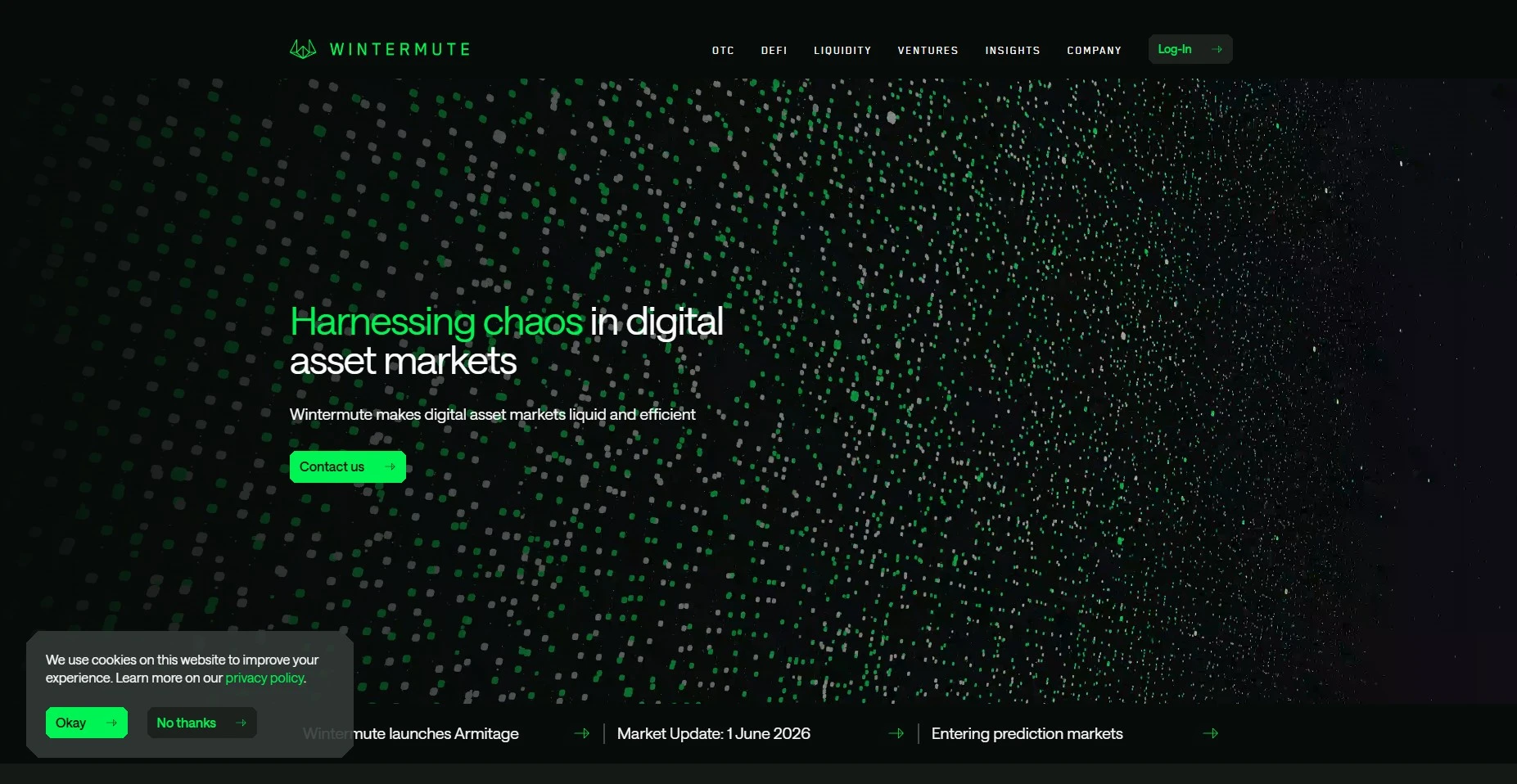
As one of the most active algorithmic market makers in crypto, Wintermute covers 70 trading venues as of October 2026, spanning centralized venues and decentralized protocols. Its scale and order-book depth therefore make it a default choice for projects targeting tier-one listings, where shallow liquidity is fatal. Beyond trading, Wintermute also runs an OTC desk and an investment arm, giving token teams a single relationship across launch liquidity and follow-on support. For a high-profile launch that needs credible depth from hour one, Wintermute is the benchmark.
2. GSR
Best for full token lifecycle support
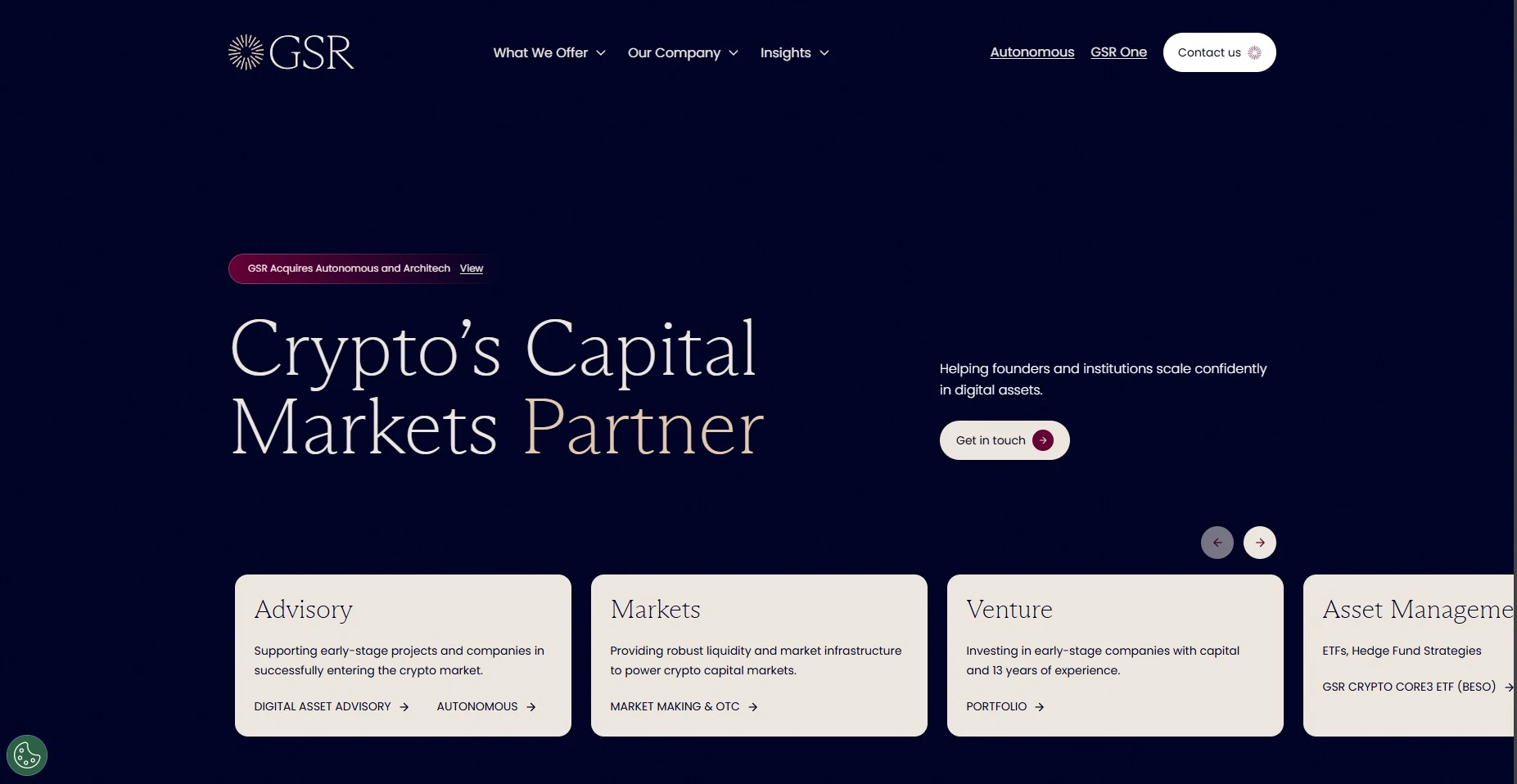
Active since 2013, GSR is one of the oldest firms in crypto market making, and it positions itself as a capital-markets partner across spot, derivatives, and structured products. In March 2026 it bought token launch platform Autonomous and advisory firm Architech for $57 million, extending into token design, launch, and treasury services, so that it can support a project from concept through to mature, liquid trading. For teams that want market making plus strategic guidance from a single counterparty with a long track record, GSR is a strong fit.
3. Keyrock
Best for regulated, multi-asset issuers
Founded in Brussels in 2017, Keyrock provides liquidity across more than 85 centralized and decentralized venues, with a team spanning multiple countries and entities in Belgium, the UK, Switzerland, France, and the US. Beyond reach, it holds Swiss VQF clearance, has filed under the EU MiCA framework, and launched a US entity in 2025. Then, in March 2026, it raised a Series C led by SC Ventures at a valuation of 1.1 billion dollars. As a result, Keyrock suits issuers that want a regulated, transparent partner with market making aligned to institutional standards rather than opportunistic trading.
4. DWF Labs
Best for established protocols wanting MM plus venture
DWF Labs combines market making with venture investment in a single relationship, and it can deploy significant capital into the protocols it backs. With offices across multiple jurisdictions and one of the largest balance sheets among active desks, it operates at a scale few competitors match. As a result, it tends to suit established protocols that want liquidity provision alongside investment and ecosystem support, rather than first-time launches. For projects evaluating DWF, the practical step is to define clear, written terms on scope, custody, and reporting up front, as you would with any large capital partner.
5. Amber Group
Best for cross-border, multi-market listings
Founded by former Wall Street professionals, Amber Group operates across trading, liquidity services, wealth management, and structured products, with strong reach in Asian markets and coverage across dozens of digital-asset exchanges. Its diversified model and global presence make it a fit for projects pursuing cross-border, multi-market listings that need a partner who can operate across jurisdictions and product types.
6. Flowdesk
Best for transparency and custody control
Founded in Paris in 2020, Flowdesk pioneered the market-making-as-a-service model, which gives token issuers full transparency and control while keeping custody of their own treasury. In addition, it is registered as a Digital Asset Service Provider with France’s financial markets authority, now holds a MiCA CASP authorization from the AMF as well as a VARA license in Dubai, and has acted as an approved liquidity provider for regulated products including a Grayscale ETF. For teams that want visibility into exactly how their liquidity is managed, Flowdesk is the choice.
7. Kronos Research
Best for token launches and altcoin liquidity
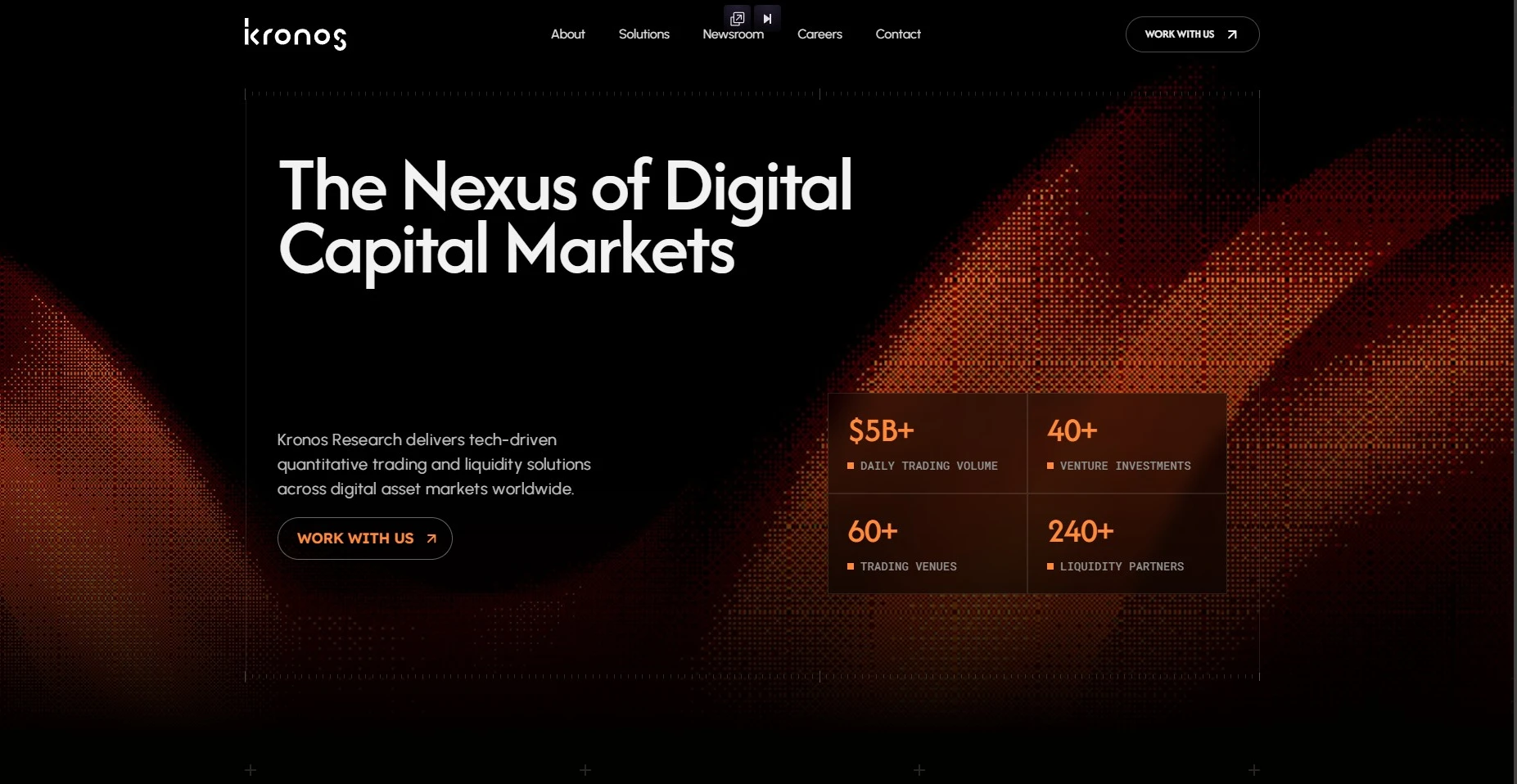
Kronos Research is a quantitative and high-frequency trading firm that provides market-making and liquidity services with a focus on token launches and less liquid altcoins that need fast support. Its proprietary algorithms are built for volatile, emerging tokens, and its client base spans multiple exchanges and projects. Kronos suits projects that want rapid liquidity provisioning at launch and active support for assets that are not yet deeply traded.
8. Jump Crypto
Best for large-scale, high-volume launches
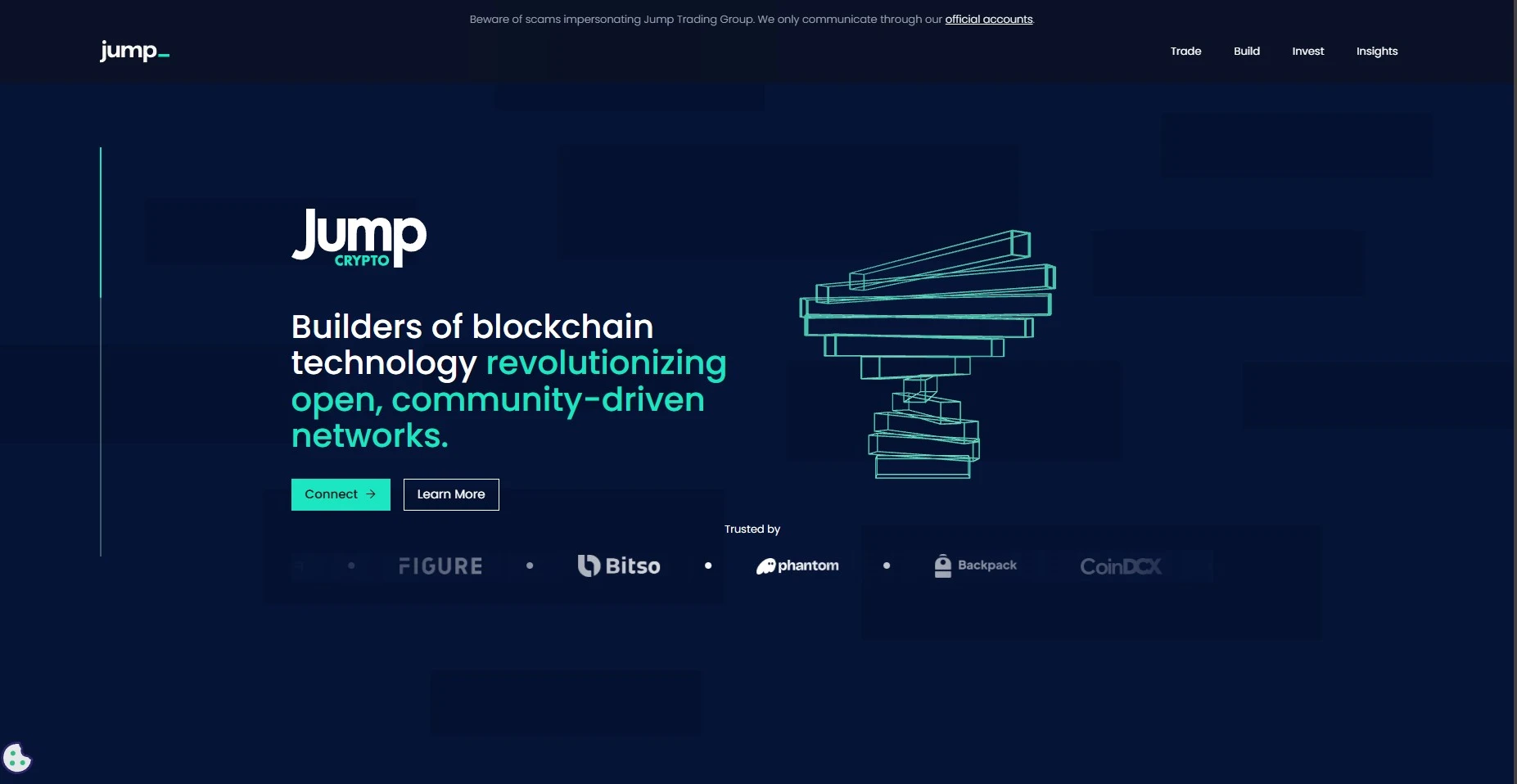
The crypto division of quantitative trading powerhouse Jump Trading, Jump Crypto brings institutional-grade infrastructure and significant scale to token launches, and combines trading with protocol-level building and investment, including Firedancer, its independent validator client for Solana. Jump suits major projects with the size and profile to warrant a heavyweight liquidity partner.
9. Gravity Team
Best for volatility reduction on mid-cap tokens
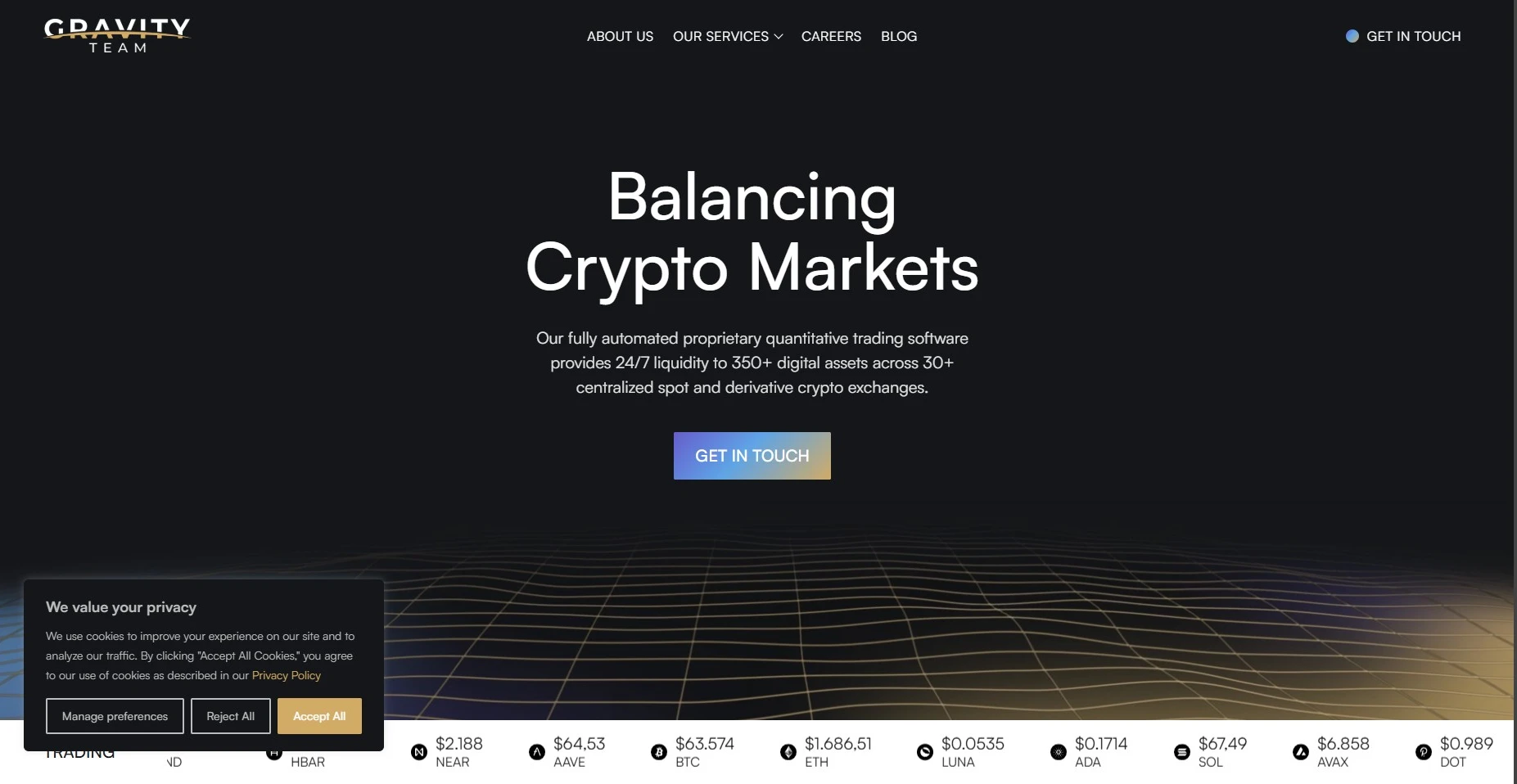
Gravity Team is a crypto-native market maker trading more than 1,400 asset pairs across 40-plus exchanges, accounting for roughly 1 percent of global crypto spot volume. It partners with exchanges and token projects to strengthen liquidity, reduce volatility, and improve trading efficiency. It is a solid fit for mid-cap token projects focused on keeping price action orderly across multiple venues.
10. Pulsar
Best for spot, perps, and options liquidity
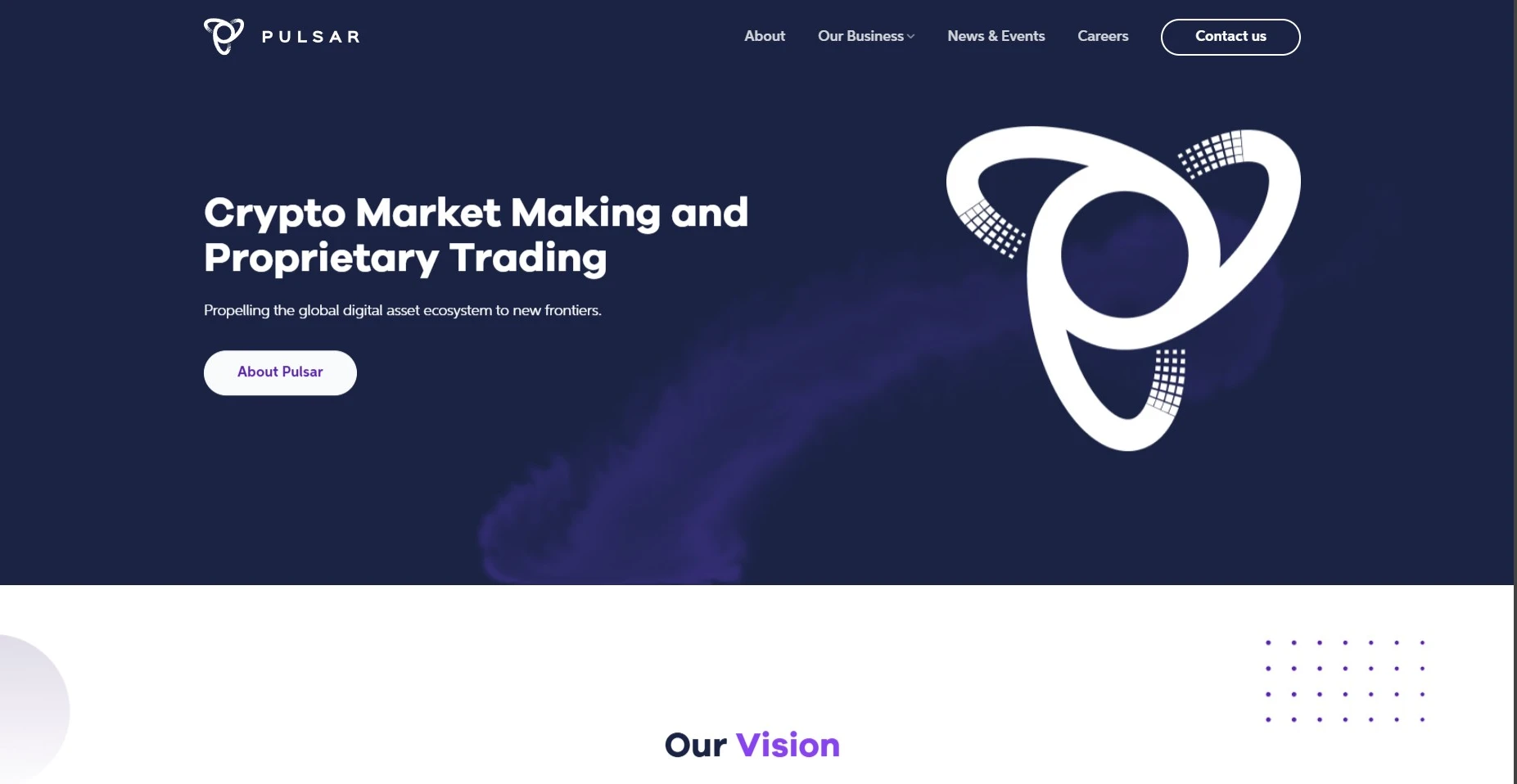
Founded in 2014, Pulsar is an algorithmic trading firm and market maker providing liquidity across more than 80 global exchanges and 650-plus assets, trading spot, perpetuals, and options with over a billion dollars in daily volume. Because it runs on low-latency infrastructure and quantitative strategies, Pulsar fits projects that need liquidity not just in spot markets but also across derivatives, where many active tokens now see significant volume.
11. EchoTrade

Best for high-volume token launches and multi-exchange liquidity
Founded in 2023, EchoTrade provides market making and liquidity management for token projects across more than 90 centralized and decentralized exchanges. Its approach is built around quantitative research and market microstructure analysis, with a team of more than 50 professionals managing client order books around the clock for over 100 active projects. Having supported more than 2,500 token launches, EchoTrade is particularly suited to early-stage projects that need coordinated liquidity across multiple venues from launch. Beyond core market making, the firm also supports exchange launches, compliance reviews, and treasury management, giving token teams a broader set of services around listing and ongoing liquidity operations.
Gravity Team vs Wintermute, DWF Labs, GSR, Flowdesk and Keyrock
Readers of this list regularly search for how Gravity Team compares with five other firms on it. Gravity Team is a crypto-native market maker trading since 2017, with an office in Riga, and it now combines token market making with exchange liquidity, an OTC desk and an execution management system. Below is how it stacks up against Wintermute, DWF Labs, GSR, Flowdesk and Keyrock, using figures each firm publishes as of October 2026.
| Firm | Active Since | Venues (Oct 2026) | Core Offer |
|---|---|---|---|
| Gravity Team | 2017 | 40+ exchanges | Market making, OTC with T+0 fiat settlement, exchange liquidity, EMS |
| Wintermute | 2017 | 70 trading venues | Algorithmic trading, OTC, token liquidity, ventures |
| DWF Labs | 2022 | 60+ exchanges (company claim) | Market making, OTC, token investment |
| GSR | 2013 | No public venue count | Market making and OTC, venture, advisory, asset management |
| Flowdesk | 2020 | 150+ exchange venues | Liquidity solutions, OTC, ventures; MiCA CASP and VARA regulated |
| Keyrock | 2017 | 85+ exchanges | Market making, OTC, options, onchain liquidity, asset management |
Gravity Team vs Wintermute
Both firms started trading in 2017, but they operate at different scales. Wintermute reports coverage of 70 trading venues, about $10 billion in daily trading volume and 110 token liquidity partners, runs a venture arm with 150 investments, and has offices in London, New York and Singapore. Gravity Team covers 40+ exchanges, reports more than $500 billion in cumulative trading volume, and publishes testimonials from Bitkub, Bitso and Bybit. Pick Wintermute for a tier-one launch that needs maximum venue coverage and a possible investor. Pick Gravity Team for mid-cap tokens and listings on emerging-market exchanges, where it focuses its exchange liquidity business.
Gravity Team vs DWF Labs
The difference is the business model. DWF Labs, founded in 2022 as the client-facing affiliate of trading firm Digital Wave Finance, pairs market making with OTC trading and token investment deals, so a project often gets liquidity and capital from the same counterparty. Gravity Team’s product line is market making, OTC, exchange liquidity and an execution management system, with no venture arm listed on its site. Teams that want liquidity without bundling an investment deal tend to prefer that separation. Teams that want capital alongside liquidity look at DWF Labs, and should set written terms on scope, custody and reporting.
Gravity Team vs GSR
GSR has been in crypto markets since 2013, longer than any other firm in this comparison, and has moved toward a full capital-markets offering: market making and OTC, venture investing, digital asset advisory and asset management, including the GSR Crypto Core3 ETF (BESO). Its $57 million acquisition of Autonomous and Architech added token launch operations and advisory. GSR’s UK entity is registered with the FCA, and its Singapore entity is authorised as a Major Payment Institution by the MAS. Gravity Team is narrower and execution-focused. Choose GSR when you want strategy, launch support and liquidity under one relationship; choose Gravity Team when you mainly need the liquidity.
Gravity Team vs Flowdesk
Regulation is the clearest split. Flowdesk, founded in 2020, is regulated as a Crypto-Asset Service Provider in Europe under MiCA and as a Virtual Asset Service Provider in Dubai under VARA, and lists 150+ exchange venues and 1,000+ asset pairs traded. Gravity Team competes on execution, 1,400+ supported pairs and emerging-market exchange coverage. If a MiCA or VARA authorization is a hard requirement for your token, Flowdesk publishes both on its homepage; confirm the equivalent in writing with any other desk before signing.
Gravity Team vs Keyrock
Keyrock, founded in Brussels in 2017, is the larger and more institutional of the two. It supports clients across 85+ exchanges and 1,400 markets, has a team of 220+, is valued at $1.1 billion and raised a Series C in 2026 from SC Ventures, Ripple and other investors. It also runs options, OTC, onchain liquidity and asset management. Gravity Team trades a similar 1,400+ pairs on 40+ exchanges with a leaner footprint. Keyrock suits issuers that want a multi-product European partner; Gravity Team suits mid-cap tokens that want focused order-book liquidity and fast OTC settlement.
If you are still deciding between a market maker and an OTC-style liquidity partner, our list of the best crypto liquidity providers covers that side, and the token launch marketing guide covers the demand work that has to be in place before any desk switches on.
How Cryptic Helps Token Projects Get Market-Ready
Choosing a market maker is only one piece of a launch. The other pieces, building an audience before listing, securing exchange relationships, coordinating KOLs, and sustaining community momentum after the token goes live, together determine whether that liquidity actually meets real demand.
Cryptic is a crypto marketing agency based in Dubai, founded in 2020 and a verified Circle Alliance Partner. To date, we have scaled 200-plus Web3 brands and worked with clients including Binance, Bybit, Algorand, OKX, and Canton. Notably, we do not provide market making. Instead, we make sure that when your market maker switches on the liquidity, there is a market there to use it: a launch audience, exchange-ready positioning, KOL distribution across 2,000-plus vetted creators, and community infrastructure that holds after listing day.
Launching a token in 2026? Book a free strategy call: our Calendly
FAQ
What is a crypto market maker?
A crypto market maker is a firm that continuously quotes buy and sell orders for a token on exchange order books. By keeping both sides quoted, it narrows the bid-ask spread and adds depth, so the token stays liquid and tradable at a fair price. For token launches, a market maker keeps the price stable and investable from the first hour of trading.
Who are the best crypto market makers in 2026?
The leading crypto market makers in 2026 include Wintermute, GSR, Keyrock, DWF Labs, Amber Group, Flowdesk, Kronos Research, Jump Crypto, Gravity Team, Pulsar, and EchoTrade. The right choice depends on your token’s stage, target exchanges, and whether you need pure liquidity or also advisory and investment support.
How much does a crypto market maker cost?
Costs vary by liquidity depth, exchange coverage, and token complexity. Two models dominate: a monthly retainer where the project keeps custody of its tokens, and a loan-and-options model where the project lends tokens to the desk in exchange for call options. Many teams prefer the retainer model for cleaner incentive alignment.
Do I need a market maker for my token launch?
For any token listing on a centralized exchange, a market maker is effectively required. Without one, the launch order book is shallow and a single trade can swing the price violently, which damages investor confidence and exchange standing. A competent desk keeps the order book deep and the price stable from day one.
What is the difference between a market maker and a liquidity provider?
A market maker focuses on continuous two-sided quoting on exchange order books, especially for token launches and price stability. An institutional liquidity provider or OTC desk focuses on executing large block trades off the order book with minimal market impact. Many firms, such as Wintermute and B2C2, do both.
Does Cryptic provide market-making services?
No. Cryptic is a crypto marketing agency, not a market maker. We handle the demand side of a launch: audience building, exchange-ready positioning, KOL distribution, and community growth, so the liquidity your market maker provides meets real trading interest. Founded in Dubai in 2020, Cryptic has scaled 200-plus Web3 brands.
Gravity Team vs Wintermute: which market maker is better?
Neither is better in general; they fit different launches. Wintermute is larger, covering 70 trading venues with about $10 billion in daily trading volume and a venture arm, so it suits tier-one launches. Gravity Team, trading since 2017, covers 40+ exchanges with a focus on emerging-market exchange liquidity and an OTC desk with T+0 fiat settlement, which suits mid-cap tokens. Figures as of October 2026.
What is the difference between Gravity Team and DWF Labs?
DWF Labs, founded in 2022, combines market making with OTC trading and token investment, so projects often receive liquidity and capital from one counterparty. Gravity Team focuses on market making, OTC, exchange liquidity and execution software, with no venture arm listed on its site. Choose based on whether you want an investor bundled with your liquidity provider, and put scope, custody and reporting terms in writing either way.
Is GSR or Gravity Team better for a token launch?
GSR is the broader option. In crypto markets since 2013, it offers market making, OTC, venture investing, advisory and asset management, and its $57 million acquisition of Autonomous and Architech added launch operations. Gravity Team is a focused liquidity and execution firm on 40+ exchanges. Teams that want strategy and liquidity from one partner usually lean toward GSR; teams that mainly need order-book depth can consider Gravity Team.
Flowdesk vs Gravity Team: which is more regulated?
Flowdesk publishes the clearer regulatory profile. It is regulated as a Crypto-Asset Service Provider in Europe under MiCA and as a Virtual Asset Service Provider in Dubai under VARA, and lists 150+ exchange venues. Gravity Team, active since 2017 on 40+ exchanges, competes on execution and emerging-market liquidity. If a MiCA or VARA authorization is a hard requirement for your token, confirm it in writing with any desk before signing.
How does Keyrock compare to Gravity Team?
Keyrock is the larger, more institutional firm. Founded in Brussels in 2017, it supports clients across 85+ exchanges and 1,400 markets, has a team of 220+ and is valued at $1.1 billion, with a Series C raised in 2026. Gravity Team, also trading since 2017, covers 40+ exchanges and 1,400+ pairs with a leaner footprint. Keyrock fits issuers that want a multi-product European partner; Gravity Team fits mid-cap tokens that want focused liquidity.
How expensive is Gravity Team compared to other market makers?
Gravity Team does not publish its prices, and neither do most firms on this list. Cost depends on the model (a monthly retainer, or a token loan paid through call options), the number of exchanges and the depth you need. Ask every desk to quote the same scope in writing so the offers can be compared.
Gravity Team vs B2C2: which is better for institutional crypto liquidity?
B2C2, founded in 2015 and headquartered in London, was acquired by Japan’s SBI in December 2020 and serves only institutions, such as funds, banks, brokers and exchanges, with OTC trading, market making and stablecoin swaps. Gravity Team, trading since 2017 on 40+ exchanges, focuses on order-book liquidity for mid-cap tokens. Institutions that want a bank-backed OTC counterparty often look at B2C2; token projects that mainly need exchange depth can consider Gravity Team.
Sources and verification
Firm details verified against company sites and reporting from The Block, CoinDesk, Kaiko, PitchBook, Crunchbase, and primary company pages (Keyrock, GSR, Flowdesk, Gravity Team, Wintermute, Pulsar, EchoTrade), re-checked in October 2026.
- Keyrock: Brussels 2017; 85+ venues; 1,400 markets; 220+ team; Series C led by SC Ventures at a $1.1B valuation (March 2026).
- Flowdesk: Paris 2020; 150+ exchange venues; 1,000+ asset pairs; MMaaS originator; MiCA CASP authorization from the AMF; VARA license in Dubai; approved LP for a Grayscale ETF.
- GSR: Active since 2013; FCA-registered UK entity; MAS Major Payment Institution in Singapore; acquired Autonomous and Architech for $57M (March 2026).
- Gravity Team: Trading since 2017; Riga office; 1,400+ pairs across 40+ exchanges; $500B+ cumulative volume; institutional OTC desk with T+0 fiat settlement (August 2026).
- Wintermute: Founded 2017; London, New York and Singapore offices; 70 trading venues; ~$10B daily trading volume; 110 token liquidity partners; 150 venture investments (October 2026).
- DWF Labs: Founded 2022 as the client-facing affiliate of Digital Wave Finance; market making, OTC and token investment.
- Pulsar: Founded 2014; 80+ exchanges; 650+ assets; spot, perps, options; $1B+ daily volume.
- EchoTrade: Founded 2023; 90+ venues; 100+ active projects; 2,500+ token launches; 50+ professionals (October 2026).