
Quick answer
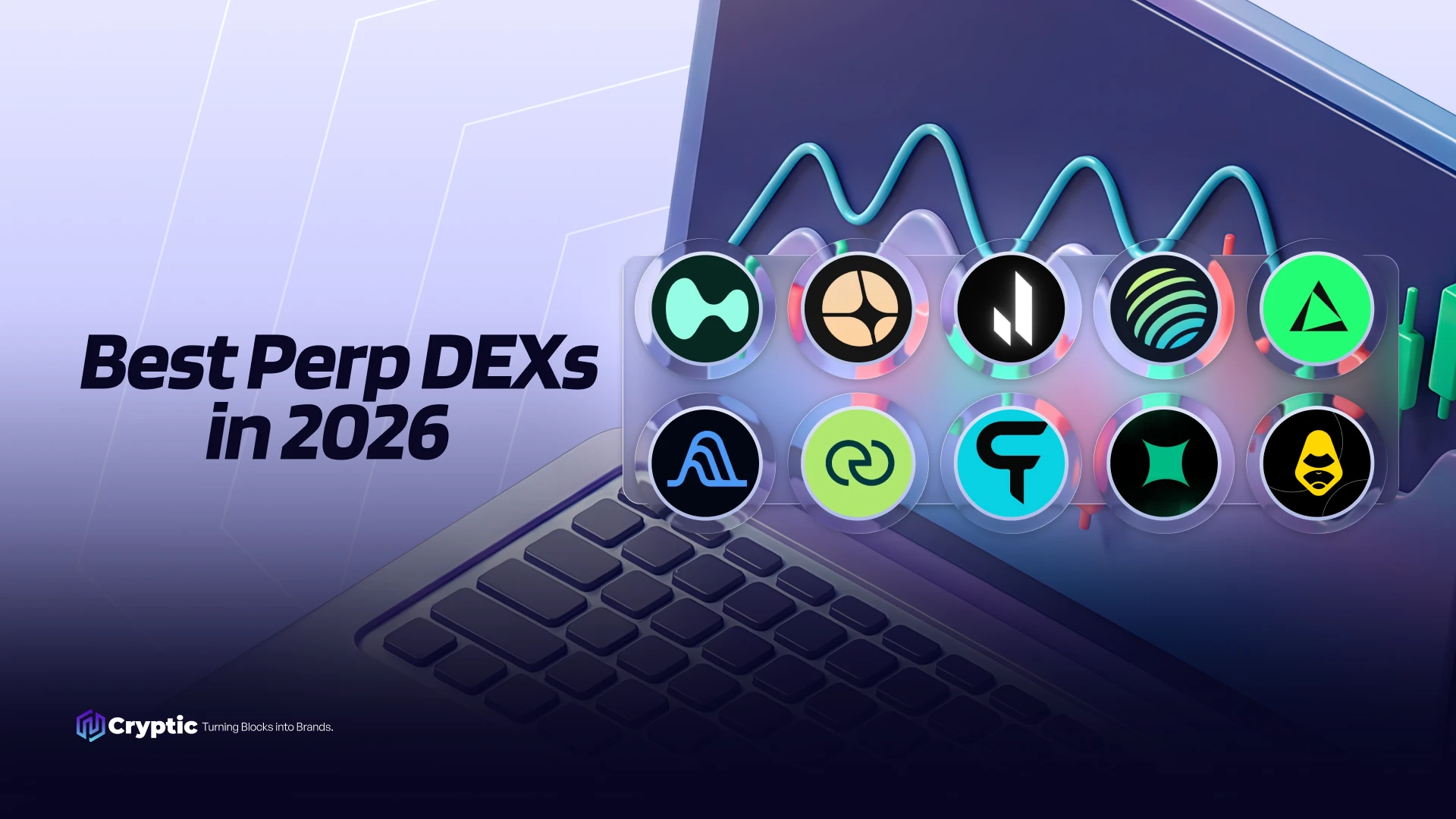
A perp DEX is a decentralized exchange for perpetual futures, where you trade leverage from your own wallet instead of depositing with a custodian. The best perp DEXs in 2026 are Hyperliquid, Aster, edgeX, Lighter, Variational, Grvt, Paradex, Extended, Jupiter, and ApeX Protocol. Hyperliquid leads with $13.28b in open interest, 59% of the entire category, and its vault absorbed both of the sector’s stress tests profitably. Ranking by raw volume is misleading, because incentive programs inflate it: the ratio of volume to open interest separates real liquidity from churn.
Perp DEXs stopped being a DeFi curiosity in 2025. The category now clears roughly $533b in monthly volume and holds $22.4b in open positions. On 10 October 2025, when $19b in liquidations tore through crypto, onchain venues absorbed the flow without breaking. They did it again on 5 February 2026.
However, that maturity created a new problem for traders. Dozens of venues now compete for the same collateral, and most of them advertise the same three things: low fees, high leverage, and self-custody. So the marketing tells you almost nothing about which one to trust with a leveraged position at 4am on a bad day.
In short, this guide ranks ten perp DEXs on liquidity that is actually there, using live data from DefiLlama pulled on 31 August 2026. If you also trade spot, our guide to the best DEXs in 2026 covers the other half of the market.
How We Ranked These Perp DEXs
Most listicles in this category rank by 30-day volume. That number is the easiest one in crypto to manufacture, because points programs and fee rebates pay people to generate it.
So we used a second number alongside it: open interest, which is the total value of positions currently open. Volume measures how often people trade. Open interest measures how much capital stays committed. Dividing one by the other gives a ratio, and the ratio is where venues separate.
Hyperliquid turns over its open interest about 15 times a month. ApeX Protocol turns over its own 291 times. Both are real venues. But one of them holds capital and the other mostly cycles it, and that difference shows up as slippage when you try to exit size.
Finally, we also weighted survivability. Two dates now define credibility here, and we cover them in detail further down.
Best Perp DEXs in 2026 At a Glance
| Perp DEX | Chain and model | Fees (maker/taker) | 30d volume | Open interest | Vol/OI |
|---|---|---|---|---|---|
| Hyperliquid | Own L1, fully onchain order book | 0.015% / 0.045% | $204.95b | $13.28b | 15 |
| Aster | Multichain, order book | 0% / 0.04% | $48.40b | $2.47b | 20 |
| edgeX | StarkEx L2, offchain matching | 0.012% / 0.038% | $33.01b | $1.19b | 28 |
| Lighter | Own zk-rollup on Ethereum | 0% retail | $42.18b | $1.30b | 32 |
| Variational | Arbitrum, RFQ network | 0% retail | $28.75b | $1.49b | 19 |
| Grvt | Own L2, order book | -0.0001% / 0.045% | $14.17b | $433m | 33 |
| Paradex | Starknet appchain, order book | 0% retail | $252m | $70m | 3.6 |
| Extended | Starknet, order book | Tiered | $6.96b | $166m | 42 |
| Jupiter | Solana, JLP pool | ~0.06% per side | $5.62b | $65m | 86 |
| ApeX Protocol | Omnichain via zkLink | 0.02% / 0.05% | $40.81b | $140m | 291 |
All figures come from DefiLlama on 31 August 2026. The category cleared $533.63b over the prior 30 days with $22.44b in open interest, down 12.74% week on week.
Best Perp DEXs in 2026 (Full Breakdown)
1. Hyperliquid

Hyperliquid runs its own Layer 1 built around a fully onchain central limit order book. Every order, cancel and fill settles on chain, which no venue at this scale had managed before.
To begin with, the numbers are not close. It holds $13.28b in open interest, 59% of the whole category, against a 38% share of volume. That gap is the point: capital stays there. In addition, base fees are 0.015% maker and 0.045% taker, with tiers on rolling 14-day volume and HYPE staking discounts of 5% to 40%. There is no gas on HyperCore. It also powers MetaMask Perps.
That said, the honest caveats are governance, not code. In March 2025 a trader manipulated JELLY, a thin memecoin, to force their own liquidation onto the HLP vault. Validators voted to delist the market and settle at $0.0095 instead of the manipulated $0.50. The intervention worked, but it showed the venue will step in. The validator set is roughly two to three dozen. Leverage on BTC caps at 40x, lower than most rivals.
Best for: Size. If your position is large enough that slippage costs more than fees, this is the venue.
2. Aster

Aster is the largest challenger by open interest, at $2.47b. It runs order-book matching across BNB Chain, Ethereum, Solana and Arbitrum, with a deposit flow that skips manual bridging.
On cost, fees are aggressive: 0% maker and 0.04% taker on USDT perps, 0.005% taker on USD1 perps, and a 5% discount for paying with ASTER. Backing comes from YZi Labs. Contracts have been audited by PeckShield, and USDF collateral sits with Ceffu.
Meanwhile, two things belong in the risk column. The founding team is pseudonymous. And roughly 80% of TVL sits on BNB Chain, which is a structural dependency the others do not carry. The advertised 1001x leverage is a liquidation risk dressed as a feature.
Best for: Traders who want multichain reach without bridging, and who size positions sensibly.
3. edgeX

edgeX was incubated by Amber Group and took strategic investment from Circle Ventures, with USDC as primary collateral. It runs offchain matching on StarkEx with onchain settlement, at sub-10ms latency.
On pricing, fees are 0.012% maker and 0.038% taker, with up to 100x leverage. Audits come from RigSec, SlowMist and PeckShield. The EDGE token launched on 31 March 2026.
It sits third here rather than fourth for one reason. Its eLP vault absorbed both the October 2025 and February 2026 stress events profitably, which only Hyperliquid also managed. The trade-off is honest: matching happens offchain, so if you need fully onchain order matching, this is not it.
Best for: Traders who want CEX-grade execution and a proven risk engine.
4. Lighter

Lighter runs a central limit order book on its own zk-rollup anchored to Ethereum. Every match is cryptographically verifiable, which no other venue at this size offers.
Retail trades free, while premium tiers pay 0.004% maker and 0.028% taker, and there is no gas. The order set is unusually complete for a DEX, with TWAP and conditional orders across more than 120 markets.
However, here is the part other guides leave out. During the February 2026 deleveraging, Lighter’s LLP vault took losses and the venue went down at the worst of it. Lighter Labs is also pseudonymous and discloses no operating jurisdiction, so there is no named counterparty. Zero fees are worth little if you cannot close a position when it matters.
Best for: Cost-sensitive traders on majors who accept the downtime record.
5. Variational

Variational is the most different venue on this list. Instead of an order book, it runs a request-for-quote network on Arbitrum. Takers get quotes from the Omni Liquidity Provider, a professional desk that aggregates flow from CEXs, DEXs and TradFi dealers.
Notably, retail pays zero fees, because revenue comes from spread rather than commission. It covers 450+ markets spanning crypto, equities, commodities, forex and pre-IPO names, from one cross-margined account. Cumulative volume has passed $225b.
Above all, the backing is the strongest in this group. Total funding is around $61.8m, including a $50m Series A in May 2026 led by Dragonfly Capital, with Bain Capital Crypto, Peak XV, Coinbase Ventures, Hack VC and Brevan Howard. Founders Lucas Schuermann and Edward Yu are named and public, which is rare here.
One practical catch: Omni is still invite-only and needs an access code.
Best for: Traders who want equities, FX and commodities perps in the same margin account.
6. Grvt

Grvt is the compliance-forward option. It runs an order book on its own L2 and positions itself closer to a regulated venue than to a permissionless protocol.
Specifically, its nine-tier fee model starts at a maker rebate of -0.0001% and a 0.045% taker fee, with leverage to 50x across 76+ perpetual contracts. It has expanded into yield and wealth products. Deposits work in USDT and USDC across six networks.
Unlike most perp DEXs, Grvt asks for an email at signup. That is either reassuring or disqualifying depending on why you are here.
Best for: Traders who want an institutional posture and are comfortable with a lighter-touch account step.
7. Paradex

Paradex has the best volume-to-open-interest ratio in the entire category, at 3.6. Almost everything on the venue is committed capital rather than churn. For comparison, Hyperliquid sits at 15 and the category median is far higher.
Structurally, it comes out of Paradigm’s institutional derivatives business and runs on a Starknet appchain with no gas. Retail trades free, while professional and API flow pays 0.002% maker and 0.02% taker.
Still, the constraint is breadth. Just over 40 markets is the narrowest coverage here, so anything outside the majors has to be traded elsewhere. Absolute volume is also small, at $252m over 30 days.
Best for: Large-cap traders who want institutional execution at retail cost.
8. Extended

Extended dominates perpetual volume on Starknet, accounting for essentially all of it. It runs an order book with a points program that has been live since April 2025, with weekly distributions and fee discounts tied to volume.
Consequently, that last detail is why it sits here rather than higher. Starknet’s 30-day chain fees have run near $186,000 against tens of billions in notional perp volume. Analysts have read that gap as incentive-driven activity rather than organic demand. Its ratio of 42 is consistent with that reading.
Best for: Starknet-native traders and points farmers who understand what they are farming.
9. Jupiter

Jupiter Perps is the default on Solana. It does not run an order book. Every trader transacts against JLP, a shared pool of SOL, ETH, BTC, USDC and USDT, in the same LP-versus-trader model GMX uses.
Notably, leverage reached 250x on select pairs in 2026, up from 100x. Fees run around 0.06% on open and close, plus funding. Network costs are a fraction of a cent. The wider Jupiter platform holds $2.6b to $3b in TVL and took $35m from ParaFi.
The ratio of 86 needs context. Pool-based venues account for open interest differently than order books, so the number is not directly comparable. The real constraint is breadth: perps concentrate on SOL, ETH and BTC.
Best for: Solana-native traders who want perps beside their swap activity.
10. ApeX Protocol

ApeX Omni runs an omnichain account model through zkLink, letting traders fund and trade across Ethereum, BNB Chain and Solana without moving assets manually. Fees are 0.02% maker and 0.05% taker, with leverage to 100x and no gas. It was built by Bybit and operates out of Singapore.
On volume, it ranks fourth in the category, at $40.81b. But it holds only $140m in open interest, which is 0.6% of the category total. That is a ratio of 291, the second-highest here.
Even so, we are including it because the volume is real and readers will look for it. Treat the depth accordingly, and check the book at your size before committing.
Best for: Cross-chain traders on majors, with position sizing that respects thin open interest.
The Two Days That Sorted the Field
Marketing decks are useless for judging a risk engine. Stress events are not.
On 10 October 2025, a tariff announcement triggered $19b in forced liquidations as Bitcoin fell from $117,000 toward $101,800. Hyperliquid absorbed $10.3b of it, more than any other single platform. Then on 5 February 2026, perp DEXs cleared more than $70b in a single day as the market deleveraged again.
Because of that, the scoreboard is public. Hyperliquid’s HLP and edgeX’s eLP absorbed the flow profitably both times. Lighter’s LLP took losses in February and the venue went offline during the worst of it. Everything else survived largely by being small enough not to be tested.
After all, liquidity provider vaults cannot spin their own results. When you pick a venue to warehouse leverage, you are picking whose risk engine you trust on the worst day of the quarter.
High Volume, Thin Books
Four venues post large volume against very little open interest. They are not scams, and some may become serious. But their numbers describe churn more than depth.
GMTrade cleared $17.89b over 30 days against $199m in open interest, a ratio of 90. Pacifica: $9.81b against $110m, a ratio of 89. StandX: $9.75b against $71m, a ratio of 138, the highest we found. Nado: $6.05b against $86m, a ratio of 70.
Moreover, public documentation for all four is thin, which is why none appear in the ranking above. If you trade them, size for the open interest, not for the volume headline.
The Veterans That Lost the Lead
Almost every competing guide still puts dYdX and GMX near the top. The live data disagrees.
dYdX cleared $1.16b over 30 days, which is 0.2% of the category. GMX cleared $2.50b, or 0.5%. Together they are under 1% of a market they once defined. Admittedly, dYdX still holds the longest clean security record in the sector, and that counts for something. But it is no longer a liquidity answer.
If a 2026 guide ranks either in its top three, it was written from memory rather than data.
How Cryptic Helps Perp DEXs Grow
Cryptic is a crypto marketing agency founded in 2020 and headquartered in Dubai, with offices in London, Amsterdam and Riyadh. We have scaled 200+ Web3 brands, including work for Binance, Bybit, Algorand and OKX.
Meanwhile, derivatives venues have a specific marketing problem. Trust is the product, and trust is won with proof rather than promises. Our work covers KOL campaigns with traders whose audiences actually trade, community programs that survive a drawdown, and PR built on verifiable numbers. Our crypto community building guide covers the playbook.
Final Thoughts
The right perp DEX depends on what you optimise for. Hyperliquid for depth, edgeX for a proven risk engine, Paradex for committed capital in the majors, Variational for cross-asset margin, Jupiter for Solana.
But none of them should be chosen on a volume headline. Check the open interest, check the ratio, and check whether the venue stayed up in February. Then size for the book you can actually see.
Finally, these numbers move weekly. This guide reflects DefiLlama data from 31 August 2026 and we revisit it quarterly.
Building a derivatives venue that needs traders to trust it? Book a free strategy call with the Cryptic team.
Frequently Asked Questions
What is a perp DEX?
A perp DEX is a decentralized exchange for perpetual futures. Perpetuals are leveraged contracts with no expiry date, kept near spot by a funding rate. You trade from your own wallet and keep custody, so there is no exchange holding your collateral.
Which perp DEX has the most liquidity in 2026?
Hyperliquid, by a wide margin. It holds $13.28b in open interest, roughly 59% of the whole category, against $22.44b across all venues. Its share of open interest runs well above its share of volume, which is the signal that capital stays rather than churns.
Is a higher trading volume always better on a perp DEX?
No. Volume is the easiest metric to inflate, because points programs and fee rebates pay traders to generate it. Compare volume against open interest instead. A venue turning over its open interest 15 times a month behaves very differently from one turning it over 291 times.
What is the cheapest perp DEX?
Several charge nothing at retail, including Lighter, Paradex and Variational. But headline fees are only part of the cost. Slippage, spread and funding usually matter more, and a deeper book often beats a lower posted fee on larger orders.
Are perp DEXs safe?
They remove exchange custody risk, since you hold your own keys. However, in exchange they add smart contract risk, oracle risk and liquidation risk. Track records differ sharply: Hyperliquid and edgeX absorbed both 2025 and 2026 stress events profitably, while some venues went offline during the same window.
What is the difference between a perp DEX and a regular DEX?
A regular DEX swaps one token for another at spot. A perp DEX lets you take leveraged long or short positions without owning the asset. Furthermore, the mechanics differ too, since perps require funding rates, margin, liquidation engines and an insurance backstop.
Which perp DEX is best for large positions?
Hyperliquid, because depth is the product at size. When your order is large enough that slippage costs more than the fee, the deepest book wins even at a higher posted rate. edgeX is the credible second on that basis.
Do perp DEXs require KYC?
Most do not, including Hyperliquid, Aster and Lighter. Grvt asks for an email at signup, and Variational’s Omni app is invite-only. Because requirements change, check the venue before depositing.