Building a successful NFT project in 2026 requires far more than minting a collection and posting a link on Twitter. The market has matured. Audiences are more discerning. As a result, the projects that achieve sustained traction are those that approach marketing with the same rigour they apply to their smart contract architecture.
This crypto NFT marketing guide covers the full stack. It explains how to build momentum before launch, how to structure demand before mint, and how to retain community value after the collection goes live.
The NFT market generates tens of billions in annual trading volume across OpenSea, Blur, Magic Eden, and a growing network of chain-specific marketplaces. However, only a small number of collections capture the majority of secondary volume. The difference is rarely the art. In practice, it is the quality of the marketing infrastructure, community architecture, and narrative positioning built before and after mint.
Whether you are launching a PFP collection, a gaming asset ecosystem, a phygital brand extension, or a utility-focused membership NFT, this guide covers the strategies, channels, and execution frameworks that determine whether your project builds momentum or disappears within 72 hours of launch.
Quick Answer
Community trust drives primary sales. KOL campaigns drive awareness. Whitelist mechanics drive urgency. PR drives legitimacy. The projects that combine all four with a coherent narrative consistently outperform those that rely on any single channel.
What Makes NFT Marketing Different in 2026
Most digital marketing frameworks do not translate cleanly to NFT projects. The audience is more technically sophisticated, more sceptical of manufactured hype, and more likely to conduct on-chain due diligence before committing capital.
In addition, NFT buyers do not only evaluate the asset itself. They evaluate the team, community, roadmap, wallet activity, and market positioning. Therefore, NFT marketing needs to be built around trust, proof, and community depth.
Five factors define the current NFT marketing environment.
Community Is the Product
In traditional e-commerce, the product exists independently of the customer community. In NFT projects, the community is the primary value driver. Floor price, liquidity, and long-term holder retention all depend on how effectively the founding team builds and retains belief.
This means marketing must do more than attract wallet addresses. It must convert attention into genuine community members. If people join only for a quick mint, they usually leave just as quickly. However, if they feel part of a real movement, they are more likely to hold, participate, and promote the project organically.
Narrative Positioning Before Visuals
The most common mistake in NFT marketing is leading with art before establishing a narrative. Collectors and traders ask specific questions before committing capital. What does this project stand for? Why does the team have the credibility to execute this? Why does this collection need to exist on-chain?
A project that answers those questions clearly has a structural advantage. Therefore, the story should come before the reveal. The art matters, but the narrative gives the art meaning.
Timing Windows Are Compressed
NFT market cycles move faster than most founders expect. The window between announcement and mint is short. The window between mint and secondary market listing is even shorter. In many cases, the difference between momentum and failure is measured in days.
As a result, launch planning must create urgency without feeling forced. Countdown events, community milestones, and whitelist mechanics can all help compress demand. However, they only work when the audience already understands why the project matters.
On-Chain Transparency Changes the Rules
Every wallet interaction, team wallet transaction, and smart contract deployment is publicly visible. Projects that inflate whitelist sizes, manipulate floor prices, or make distribution claims that do not match on-chain data get exposed quickly.
The reputational damage is often permanent within Web3 circles. Therefore, NFT marketing must be built on verifiable claims from the outset. Transparency is not just ethical. It is a competitive advantage in a market where trust is scarce.
Multi-Chain Reality
Ethereum remains the highest-value NFT chain by secondary volume. However, Solana, Base, and Polygon have each developed distinct NFT communities. These communities have different audience profiles, cost expectations, and platform preferences.
Effective NFT marketing in 2026 requires understanding where your target audience actually lives. The right chain is not always the chain your team prefers. In addition, cross-chain campaigns can unlock larger audiences, but they also require sharper messaging and more careful community management.
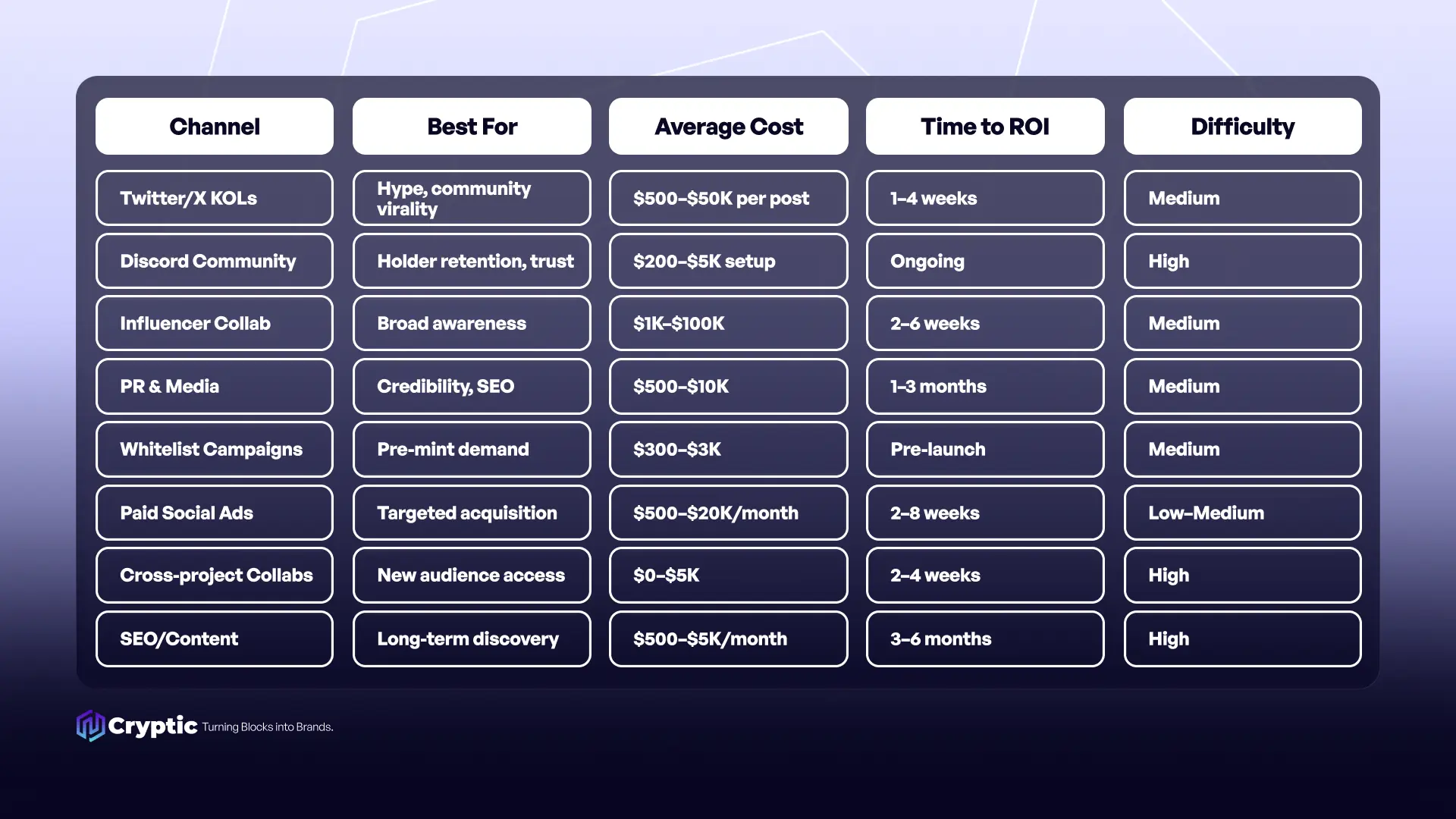
NFT Marketing Channels at a Glance
Channel effectiveness data sourced from Cryptic campaign analysis across 50+ NFT launches. Cost ranges are approximate and vary significantly by project size and audience quality.
Twitter/X KOL Strategy
Best Overall NFT Awareness Channel
Twitter/X remains the primary platform for NFT project discovery in 2026. It combines crypto-native audiences, real-time conversation, and fast algorithmic amplification. For this reason, it is still the highest-velocity channel for building initial awareness.
However, not every KOL campaign performs equally. The most effective campaigns are built around credible voices in specific niches. These can include art, gaming, DeFi, culture, or chain-specific communities. Generic crypto influencers with large but disengaged audiences usually convert worse.
How to Select the Right KOLs
KOL selection is the single most important variable in Twitter campaign performance. Engagement rate matters more than follower count. For example, a KOL with 40,000 followers and a 6% engagement rate can outperform a larger account with weak audience quality.
A crypto influencer with 400,000 followers and a 0.4% engagement rate may create visibility. However, that visibility often fails to convert into qualified whitelist sign-ups. Cryptic’s influencer database tracks engagement quality, audience overlap, and conversion history across 800+ Web3 accounts.
How to Structure the Campaign
Campaign structure should build from teaser content to reveal, and then from reveal to mint call-to-action. In most cases, a 2 to 4 week window works best.
Thread content usually outperforms pure promotional posts. This is because threads can explain the project’s narrative, team background, and on-chain mechanics. In addition, collab announcements and reveal posts help create social proof.
Giveaway campaigns can generate follower growth. However, they often produce low conversion to genuine holders. Therefore, giveaways should support a whitelist event rather than act as the main demand-generation mechanism.
Key Stats
Avg. Cost per Qualified Lead: $8 to $45, KOL campaign
Best Content Format: Threads, reveal posts, collab announcements
Optimal Campaign Length: 2 to 4 weeks pre-mint
Top KOL Tiers: Micro, 10K to 50K, highest conversion; Mid, 50K to 200K, best reach-to-cost ratio
Pitfall: Fake follower inflation. Always audit engagement before contracting.
Discord Community Architecture
Best NFT Retention Channel
Discord is where NFT communities live and die. A well-architected Discord server converts casual followers into invested community members. It also filters for genuine holders during the whitelist process.
In addition, Discord creates the social proof that drives organic word-of-mouth. A poorly managed server does the opposite. Bot-inflated member counts, absent moderation, and inactive team communication destroy trust quickly.
Build for Progressive Engagement
Server architecture should be designed for progressive engagement, not maximum access. New members should enter a curated onboarding flow. This flow should introduce the project’s narrative, team, and roadmap before they reach the main community channels.
Whitelist roles earned through engagement activity create status. They also create investment. As a result, earned access converts significantly better than random whitelist distribution.
Focus on Meaningful Channels
The most valuable Discord channels create genuine content. Examples include team AMAs, artist development threads, collector showcases, and project milestone updates.
The least valuable channels exist only to inflate engagement. Low-quality raid channels, repetitive gm or gn threads, and filler events rarely build real conviction. Ultimately, quality of engagement matters more than raw member count.
Key Stats
Optimal Launch Server Size: 2,000 to 5,000 genuine members before mint
Moderation Ratio: 1 active moderator per 500 members minimum
AMA Frequency: Weekly during pre-launch; bi-weekly post-mint
Bot Detection: Use Guild or MEE6 with aggressive anti-raid settings from Day 1
Whitelist Mechanics: Role-gated channels drive 3 to 5x higher engagement than open servers
PR and Media Coverage
Best NFT Credibility Channel
Editorial coverage in Web3 media provides credibility that paid social content cannot replicate. Publications such as CoinDesk, Decrypt, The Block, NFT Now, and vertical-specific outlets can help validate a project.
Collectors and traders often search for press coverage before minting. Therefore, a strong feature article can create more qualified demand than a multi-week KOL campaign.
What Makes NFT PR Work
Effective NFT PR is built on genuine news hooks. Press release distribution alone is not enough. Strong angles include team backgrounds, recognised partnerships, technical innovations, and cultural narratives.
Journalists covering NFTs in 2026 are sophisticated. They ignore pitches that lead with hype. However, they pay attention to specific and verifiable claims about what makes the project novel.
When PR Should Go Live
PR should land during the awareness phase, not directly at mint. Coverage published two to four weeks before launch has time to generate organic traffic. It can also be shared by community members and indexed by search engines.
Post-mint PR can then support the next phase. For example, sell-out announcements, secondary volume milestones, and partnership expansions can compound the initial coverage.
Key Stats
Best Publications: CoinDesk, Decrypt, The Block, NFT Now, BeInCrypto
Lead Time: Pitch 3 to 4 weeks before planned coverage date
Coverage Types: Feature profiles, project reviews, partnership announcements
SEO Value: Backlinks from Tier 1 crypto media significantly boost search visibility
Avoid: Paid-for editorial that is not clearly disclosed. Community members will identify it.
Whitelist Campaign Design
Best NFT Demand-Generation Mechanic
Whitelist campaigns remain one of the most effective ways to convert community interest into mint-day demand. The principle is simple. Access should be scarce, earned, and visible.
This filters out low-conviction participants. It also builds a holder base of people who feel invested before mint. As a result, whitelist mechanics can create stronger community alignment than open access alone.
How to Structure Whitelist Access
Whitelist mechanics should be tiered across channels and engagement types. Discord activity, Twitter engagement, fan art, referrals, and cross-project collaborations can all generate allocations.
The most effective campaigns allocate a meaningful proportion of supply through earned mechanics. In many cases, 20 to 40 percent of supply can be assigned this way. A smaller guaranteed allocation can reward early community members. The public mint can then preserve day-of demand.
Avoid Over-Whitelisting
Whitelist size management is critical. Over-whitelisting is one of the most common causes of mint failure and post-mint floor price collapse.
Most whitelists convert at 30 to 60 percent. Therefore, projects should model expected conversion realistically. For example, a collection of 5,000 items with a 40 percent conversion expectation requires no more than 12,500 whitelist spots to achieve a full mint.
Key Stats
Optimal WL Size: 2 to 3x expected mint conversion, model at 40% conversion
Best WL Channels: Discord activity, Twitter raids, referral programmes
WL Announcement Timing: 3 to 5 weeks before mint date
Guaranteed vs Earned: Split 20/80. Earned WL produces more engaged holders.
Avoid: Public WL databases that dilute exclusivity and attract low-quality participants.
Cross-Project Collaborations
Best NFT Audience Expansion Strategy
Collaborations with established NFT projects, brands, or Web3 protocols are among the most cost-efficient methods of audience expansion. A strong collab announcement can reach an entire holder base through Discord, Twitter, and newsletters.
This matters because these audiences are already self-selected as NFT buyers. As a result, conversion from genuine collaborations is often 3 to 5 times higher than cold KOL outreach.
Choose Partners with Narrative Alignment
The best collaborations have genuine narrative alignment. A gaming NFT collection collaborating with an on-chain gaming protocol makes sense. The audiences overlap, the content is credible, and both communities see value.
However, a generic PFP project collaborating with an unrelated DeFi protocol may perform poorly. If the only reason for the partnership is follower count, the audience will notice.
Collaboration Formats That Work
Collaboration mechanics can include co-branded NFT drops, whitelist exchanges, shared events, and co-authored content.
Whitelist exchanges are the simplest to execute. Each project allocates a fixed number of spots to the other community. This makes conversion easy to measure. Meanwhile, co-branded drops with genuine artistic integration can generate stronger secondary volume and better media coverage.
Key Stats
Best Collab Partners: Projects with 1,000 to 10,000 active Discord members and strong secondary volume
WL Exchange Ratio: Typically 50 to 200 spots per partner, depending on collection sizes
Announce Timing: 2 to 3 weeks before mint for maximum impact
Alignment Test: Would both communities genuinely care about the other project?
Avoid: Collab farms with 20+ bulk WL exchanges. They dilute exclusivity.
Content Marketing and SEO
Best Long-Term NFT Discovery Channel
Content marketing is chronically underused in NFT project marketing. This is because it works on a longer time horizon than most launch cycles. Many projects focus only on the 30-day pre-mint window.
However, content can build a durable discovery layer. Detailed project explainers, artist background features, on-chain mechanism breakdowns, and market context pieces can support secondary sales long after mint.
What NFT Buyers Search For
Effective NFT content targets questions buyers actually ask during due diligence. They want to know how the smart contract works, what the roadmap includes, who is on the team, and how the project compares to similar collections.
Content optimised for these queries captures buyers at a high-intent moment. Therefore, it can convert better than broad social impressions.
Where to Publish NFT Content
Medium, Mirror, and Paragraph are strong long-form content platforms for Web3 audiences. In addition, the project website should host core explainers and roadmap content.
A project with five to eight well-structured articles before mint has an SEO advantage over projects with no editorial content. Guest contributions in crypto media can also combine PR credibility with search value.
Key Stats
Content Volume: 5 to 8 articles published pre-mint minimum
Best Platforms: Mirror, Medium, Paragraph, project website blog
SEO Lead Time: Publish 8 to 12 weeks before mint for indexed traffic
Top Content Types: Team profiles, smart contract explainers, roadmap breakdowns, market context
Distribution: Always cross-post to Discord, Twitter threads, and email
Paid Social and Targeted Advertising
Best NFT Volume Channel
Paid social advertising for NFT projects has become more viable in 2026. Platform policies around crypto advertising have become clearer. Twitter/X Ads, Reddit Ads, and Google Display campaigns can all support scalable acquisition.
For projects with enough budget, paid social fills an important gap. It helps bridge organic community growth and the audience size required for a successful mint.
Creative Strategy for NFT Ads
Creative strategy for NFT paid social differs from traditional digital advertising. Static images of the NFT art often underperform. Short-form video usually works better because it can show art generation, team background, or community activity.
Ads should not lead with price growth potential. This can create compliance issues and attract weak holders. Instead, ads should focus on community, culture, utility, and the reason the project exists.
Budget and Retargeting
Budget should be weighted toward the two weeks before mint. However, a smaller sustained spend should run across the full pre-launch period.
Daily budget floors of $500 provide enough impression volume for meaningful A/B testing. Projects below this threshold may struggle to generate useful optimisation data. Therefore, smaller budgets may perform better when allocated to KOL partnerships.
Retargeting is especially important. Audiences who visited the project website or interacted with organic content usually convert at three to four times the rate of cold audiences.
Key Stats
Best Platforms: Twitter/X Ads, Reddit Ads, Google Display
Minimum Daily Budget: $500 for meaningful test volume
Best Creative Format: Short-form video, 15 to 30 seconds
Retargeting Multiplier: 3 to 4x conversion rate vs cold audiences
Timing: Weight 60% of budget to final 2 weeks pre-mint
Email and Newsletter Campaigns
Best NFT Owned-Channel Strategy
Email lists are rare in NFT marketing because most projects do not invest in building them. This creates a major advantage for projects that do.
An email list of 5,000 engaged subscribers gives the team direct access to a qualified audience. It is not dependent on platform algorithms, account reach, or Discord activity. For projects with longer roadmaps, owned email compounds in value over time.
How to Build the List
List-building mechanics for NFT projects differ from traditional e-commerce. Generic newsletter prompts do not perform well. Instead, projects should offer early whitelist consideration, exclusive content, or access to a private update list.
Paragraph and Substack both provide Web3-native newsletter tools. Wallet Connect functionality also allows subscriber segmentation by holder status. This is especially useful after mint.
When to Send Emails
Email frequency should follow the news cycle, not a fixed calendar. Sending without meaningful updates trains subscribers to ignore future emails.
Instead, send when there is something worth communicating. Examples include team announcements, roadmap milestones, partnership reveals, mint countdown events, and post-mint holder updates. As a result, well-curated lists can achieve open rates of 35 to 55 percent.
Key Stats
Optimal List Size at Mint: 2,000 to 10,000 genuinely opted-in subscribers
Best Capture Tools: Paragraph, Substack, Mailchimp with Wallet Connect
Target Open Rate: 35 to 55% for well-curated lists
Send Frequency: News-driven, not calendar-driven. Aim for 1 to 3 emails pre-mint.
Avoid: Purchased email lists. Deliverability damage is difficult to reverse.
How to Build Your NFT Marketing Plan in 2026
No single channel is optimal for every NFT project. The right marketing mix depends on collection size, budget, timeline, chain, and target audience.
Therefore, founders should not copy another project’s launch plan directly. Instead, they should build a plan around their specific market position.
NFT Marketing Plan by Budget
Under $5,000
Focus on Discord architecture, Twitter organic content, and 2 to 3 targeted micro-KOL partnerships. Earned media and community quality matter more than paid reach at this budget level.
$5,000 to $25,000
Add a PR push with 2 to 3 targeted publications. In addition, run a structured whitelist campaign across Discord and Twitter. This budget can also support 5 to 8 mid-tier KOL activations and early email list-building.
$25,000 to $100,000+
Activate all core channels. Layer paid social on top of organic and KOL campaigns. Invest in Tier 1 media placements, brand collaborations with established collections, and a sustained post-mint content programme.
NFT Marketing Plan by Collection Type
PFP Collections
Community architecture and KOL reach are the primary drivers. Discord quality and whitelist mechanics determine floor price stability after mint.
Gaming Assets
Ecosystem PR, on-chain utility demonstrations, and cross-project collaborations with gaming protocols generate the highest-quality buyer audiences.
Phygital and Brand NFTs
Traditional PR channels, brand partnership announcements, and email marketing to existing brand audiences often outperform crypto-native KOL campaigns.
Utility Memberships
Education-focused content marketing, community building, and targeted paid social work best. The audience must understand the underlying utility before they commit.
NFT Marketing Plan by Timeline
12+ Weeks Out
Focus on brand positioning, website structure, Discord architecture, content planning, and team PR.
8 to 12 Weeks Out
Select KOL partners, begin collaboration outreach, start PR pitching, and build the email list.
4 to 8 Weeks Out
Launch whitelist campaigns, activate KOLs, test paid social, and secure media coverage.
0 to 4 Weeks Out
Run countdown events, execute the final KOL push, activate the mint-day community plan, and prepare post-mint holder communication.
Final Thoughts on Crypto NFT Marketing in 2026
The crypto NFT marketing landscape in 2026 rewards projects that invest in genuine community infrastructure. It does not reward teams that only optimise for short-term mint velocity.
The collections that build lasting secondary market presence usually have three things in common. They maintain active holder communities. They communicate clearly after mint. They also treat marketing as an ongoing programme rather than a pre-mint sprint.
Twitter/X KOL campaigns drive awareness. Discord communities drive retention. PR drives credibility. Whitelist mechanics drive urgency. Content marketing drives discovery. However, no single channel delivers all of these outcomes alone.
Ultimately, the most important decision is not which platform to prioritize. The most important decision is what narrative your project stands for and who specifically you are building it for. A clear and verifiable answer to those two questions is the foundation of every successful NFT marketing strategy.
For crypto projects looking to build a complete NFT marketing program, from Discord architecture and KOL campaign management to PR strategy and go-to-market execution, connect with Cryptic. We have run campaigns with Binance, Bybit, OKX, and NEAR, and understand how to position NFT projects effectively across every major channel and community ecosystem.
FAQ
How much should an NFT project spend on marketing?
Budget ranges vary significantly by collection size and target audience. A 5,000-piece PFP collection targeting a global Web3 audience typically requires $15,000 to $50,000 in marketing spend for a successful launch.
However, projects with strong existing communities can achieve good results at lower budgets. Projects in competitive categories usually require higher spend to break through.
What is the most important NFT marketing channel?
Discord community architecture is the most important long-term channel. It determines holder retention and floor price stability after mint.
For short-term awareness, Twitter/X KOL campaigns generate the fastest reach. Therefore, the most successful projects usually invest in both.
How early should NFT marketing start?
Effective NFT marketing begins 10 to 12 weeks before mint. The first 4 to 6 weeks should focus on brand positioning, Discord architecture, and content creation.
KOL campaigns and whitelist mechanics should activate 4 to 6 weeks before mint. Projects that begin marketing two weeks before mint usually cannot build enough community depth.
Do NFT projects still need Twitter/X in 2026?
Yes. Despite platform volatility, Twitter/X remains the primary real-time communication channel for the NFT collector community.
Farcaster has gained meaningful traction among crypto-native users. However, Twitter/X still provides much larger reach for most NFT categories.
What is the biggest NFT marketing mistake?
The biggest mistake is leading with price growth potential instead of genuine community value. This attracts short-term buyers who are likely to sell quickly after mint.
Projects that build around community identity, utility, and long-term roadmap vision attract stronger holders. As a result, they usually have healthier secondary markets.
How do you measure NFT marketing success?
Primary metrics include whitelist conversion rate, mint sellout rate, and day-one secondary volume.
Secondary metrics include Discord member retention at 30 days post-mint, floor price stability at 7 and 30 days, and organic social share of voice versus paid share. Projects that maintain 40 percent or more of mint price as floor at 30 days have typically built genuine community value.