Real world asset marketing in 2026 is a discipline that did not exist in any meaningful form three years ago. The tokenisation of bonds, real estate, private credit, commodities, and infrastructure has moved from whitepaper concept to live, on-chain product, and the firms behind these assets now face a marketing problem that is unlike anything in either traditional finance or crypto native markets.
RWA is not DeFi. You are not marketing to yield-hunters who rotate between liquidity pools. You are marketing regulated financial products to institutional allocators, accredited investors, and increasingly to retail participants in jurisdictions that permit on-chain asset exposure. The audience is different. The compliance constraints are different. The trust dynamics are different. And the narratives that work are different.
This guide covers how RWA marketing works in 2026, the channels, the audiences, the content frameworks, and the go-to-market strategies that have produced results for tokenised asset issuers, RWA infrastructure platforms, and the protocols that underpin them.
Quick answer: Effective RWA marketing in 2026 combines institutional-grade content with crypto-native distribution. Trust is built through transparency and compliance signalling. Demand is generated through targeted KOL campaigns, data-led content, and structured institutional outreach.
What Makes RWA Marketing Different in 2026
Most Web3 marketing frameworks were built for fungible tokens, NFT collections, and DeFi protocols. The assumption was a retail audience that responds to yield numbers, tokenomics, and community momentum. RWA marketing requires a different model for three reasons.
Dual Audience Architecture
RWA projects simultaneously address two fundamentally different audiences: institutional capital allocators who require regulatory certainty, audited financials, and conservative yield narratives, and crypto-native participants who evaluate projects on protocol credibility, on-chain transparency, and integration within existing DeFi ecosystems. Marketing that over-indexes on either audience alienates the other. The most effective RWA campaigns in 2026 maintain separate messaging tracks, an institutional layer built on compliance and documentation, and a crypto layer built on technical credibility and composability.
Compliance as Marketing Signal
In conventional finance, regulatory compliance is the minimum requirement to operate. In RWA, compliance status is itself a marketing asset. Projects that publish legal opinions, regulatory licences, prospectus documentation, and jurisdiction-by-jurisdiction legal assessments attract institutional interest that undifferentiated “tokenised yield” messaging cannot reach. The presence or absence of a clearly stated legal structure is frequently the single most important factor institutional allocators use to distinguish credible projects from noise.
Trust Timelines Are Longer
Retail DeFi engagement can move from awareness to capital deployment in hours. Institutional RWA allocation timelines operate across months or quarters. This changes the structure of the marketing funnel entirely. Top-of-funnel awareness through KOLs and conferences generates interest, but the conversion pipeline runs through due diligence calls, legal review, and compliance committee approvals. Marketing for RWA must therefore sustain engagement across a longer timeline, through consistent content publishing, regular product updates, and relationship-based outreach rather than campaign-driven launches alone.
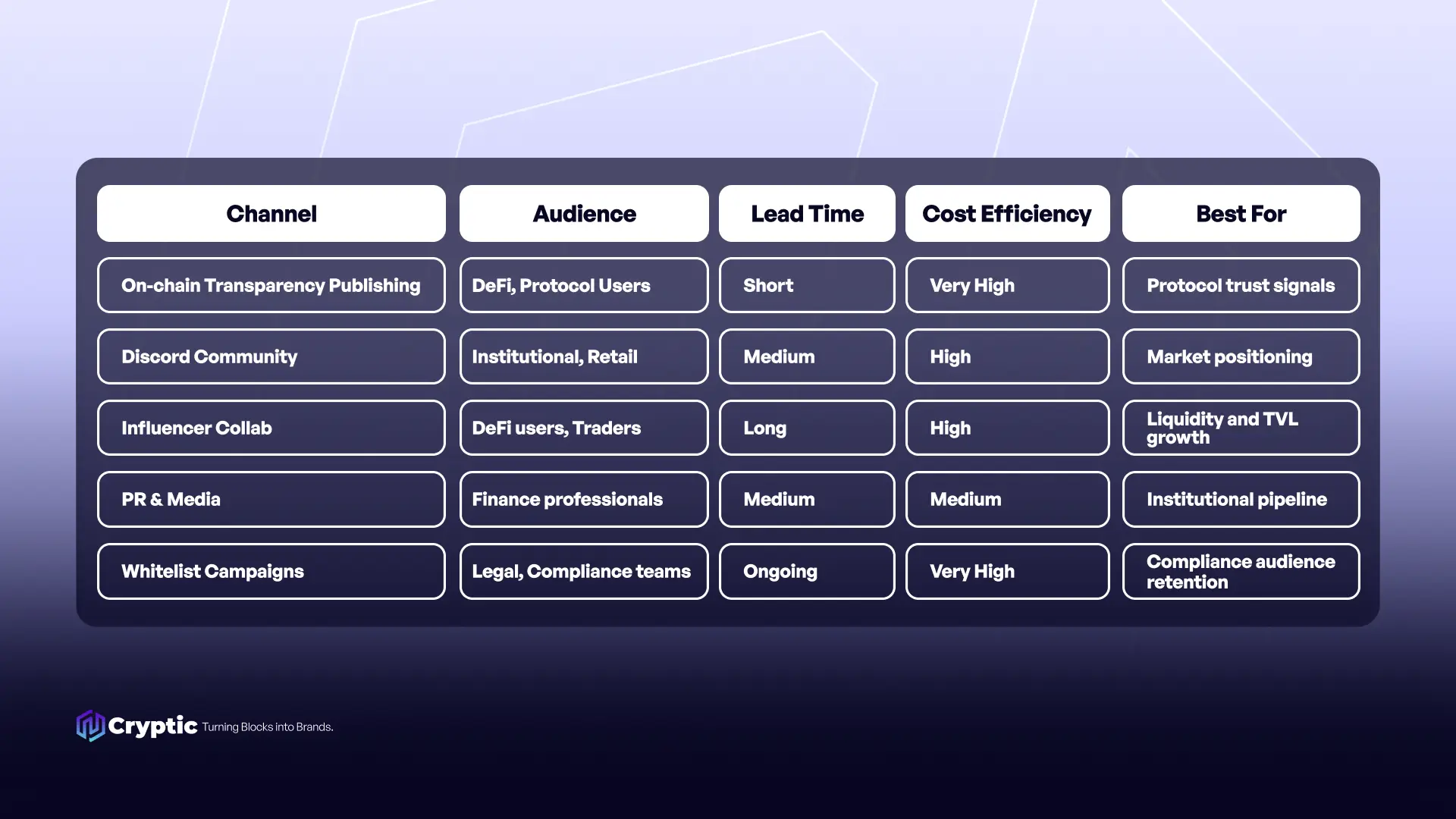
RWA Marketing Channel Comparison: What Works in 2026
Channel performance varies significantly depending on whether the target is institutional capital, crypto-native liquidity, or retail participants. The table below reflects observed performance patterns across active RWA campaigns.
Marketing by RWA Asset Category
The RWA market in 2026 encompasses a wide range of asset classes, each with distinct marketing requirements. What converts an allocator interested in tokenised US Treasuries is structurally different from what drives adoption of tokenised private credit or real estate.
Government Securities and Bonds
Largest by TVL, institutional-first marketing strategy
Tokenised government securities represent the largest segment of the RWA market by total value locked, led by products from BlackRock, Franklin Templeton, and a growing cohort of protocol-native issuers. Marketing in this category is almost entirely institutional. The investor base consists of family offices, DAOs seeking yield on treasury holdings, and crypto-native funds seeking low-risk yield denominated in on-chain assets.
The marketing framework for this category prioritises yield transparency, custodian credibility, and legal structure clarity over brand awareness. Effective campaigns lead with attestations, audit reports, and custodian relationships. Content strategy focuses on regulatory update newsletters, whitepaper publishing, and direct outreach through prime brokerage and digital asset banking relationships.
Key Stats
- Primary Audience: Institutional allocators, DAO treasuries, crypto-native funds
- Key Channels: Direct institutional outreach, compliance content, legal documentation publishing
- Decision Cycle: 3–6 months for institutional allocation
- Conversion Triggers: Custodian name recognition, regulatory licence disclosure, yield attestation
- Strengths: Largest addressable capital pool, lower retail compliance exposure
Real Estate
Broadest retail accessibility, dual marketing model required
Tokenised real estate spans a spectrum from premium commercial properties accessed via accredited investor platforms to fractional residential exposure available to retail participants in permissive jurisdictions. This breadth demands a dual marketing architecture: an institutional channel built on property fundamentals, yield history, and legal structure, and a retail channel built on accessibility narrative, “own a fraction of a Dubai office tower for $100”, that engages participants who have never held traditional real estate exposure.
Distribution partnerships are the highest-leverage channel in this category. Integration with existing DeFi protocols, yield aggregators, and crypto wallets creates persistent distribution that outlasts any individual campaign. PR in both mainstream property media and crypto-native outlets builds cross-audience awareness. KOL campaigns targeting the Web3 wealth-building narrative perform well for retail acquisition.
Key Stats
- Primary Audience: Accredited investors, retail participants in accessible jurisdictions, DeFi yield seekers
- Key Channels: KOL campaigns, DeFi protocol integration, property media PR, retail social
- Decision Cycle: Days (retail) to months (institutional)
- Conversion Triggers: Yield vs rental yield comparisons, liquidity claims, property name recognition
- Strengths: Universally understood asset class, strong retail narrative potential
Private Credit
Fastest growing, sophisticated audience, compliance-intensive marketing
Private credit tokenisation has grown significantly in 2026, driven by platforms that package trade finance, SME lending, and receivables into on-chain instruments. The investor base for this category is among the most sophisticated in the RWA ecosystem, credit analysts, alternative investment managers, and high-net-worth individuals with prior exposure to private debt instruments. Marketing must meet a correspondingly high standard of documentation and transparency.
The channel mix for private credit skews heavily toward long-form content: credit memoranda, borrower profile publishing, default and recovery rate disclosure, and regular portfolio updates. Partnerships with established credit rating frameworks or recognised due diligence providers significantly reduce institutional friction. Conference presence at credit and alternative investment events, not solely crypto conferences, reaches the allocator base most likely to convert.
Key Stats
- Primary Audience: Alternative investment managers, credit analysts, HNW investors, DeFi yield funds
- Key Channels: Long-form credit content, institutional conferences, credit rating partnerships
- Decision Cycle: 4–8 weeks for DeFi integration, 3–6 months for institutional allocation
- Conversion Triggers: Default rate disclosure, yield vs benchmark comparisons, originator credibility
- Strengths: High yield relative to alternatives, DeFi composability
Commodities and Infrastructure
Niche but growing, narrative-driven marketing with institutional depth
Tokenised commodities, gold, carbon credits, energy assets, and increasingly infrastructure projects, represent a smaller but strategically important segment of the RWA market. Marketing for commodity-backed tokens leverages tangible asset familiarity: gold tokenisation in particular benefits from decades of established gold investment marketing that can be adapted for an on-chain context.
Infrastructure tokenisation is newer and requires a more educational marketing approach. Investors need to understand both the underlying asset economics and the smart contract mechanics that govern token rights. Long-form explainer content, detailed technical documentation, and direct institutional relationship management are the primary marketing tools. Liquidity remains a challenge that must be addressed in marketing materials rather than obscured.
Key Stats
- Primary Audience: Institutional investors, sustainability-focused allocators, commodity traders
- Key Channels: Commodity media PR, institutional direct outreach, educational content series
- Decision Cycle: Variable by asset class and jurisdiction
- Conversion Triggers: Asset custody transparency, benchmark tracking accuracy, redemption mechanism clarity
- Strengths: Established asset familiarity, hedge properties, institutional recognition
Building an RWA Marketing Strategy in 2026
No single RWA marketing framework applies across every project stage, asset class, or target market. The right approach depends on what stage the project is at, which audiences it needs to reach, and what trust signals are currently available to deploy.
By Project Stage
- Pre-launch: Focus entirely on institutional credibility building. Publish legal opinions, custodian agreements, and audit commitments before any promotional activity. The first impression on institutional allocators is permanent.
- Launch phase: Coordinate PR, KOL deployment, and exchange or protocol integration announcements simultaneously. Narrative consistency across channels matters, a single confusing message across multiple outlets damages credibility harder than silence.
- Growth phase: Prioritise distribution channel expansion. Integrate with the DeFi protocols and wallets where your target users already hold assets. Build a content engine that sustains engagement between product updates.
- Maturity phase: Shift investment toward institutional pipeline development, regulatory update leadership, and secondary market liquidity building. Brand authority compounds over time when consistently maintained.
By Asset Focus
- Government securities and bonds: Build an institutional-first content programme. Prioritise compliance signals and direct relationship development over public-facing campaigns.
- Real estate and retail-accessible assets: Invest in KOL campaigns and DeFi protocol integrations. Narrative clarity around accessibility and yield comparison is the primary conversion driver.
- Private credit: Lead with long-form credit documentation. Conference presence at non-crypto alternative investment events reaches the highest-value allocator segment.
- Commodities and infrastructure: Educational content series build the understanding required for conversion. Institutional media partnerships accelerate credibility with traditional allocators.
By Target Market
- United States: Accredited investor restrictions shape every channel decision. Content marketing and institutional direct outreach are the primary legal options. Retail-facing campaigns require careful jurisdiction scoping.
- Europe (EEA/MiCA jurisdictions): MiCA compliance documentation is now a prerequisite for serious institutional consideration. Marketing materials that reference MiCA status perform significantly better with European allocators.
- Middle East and Asia-Pacific: Regulatory postures vary significantly by jurisdiction. On-the-ground relationship development and regional conference presence remain critical conversion channels in markets where digital trust infrastructure is still developing.
- Global DeFi-native audience: Technical documentation quality, on-chain transparency, and protocol integration announcements drive engagement. Traditional marketing channels have low reach into this segment.
Final Thoughts on Real World Asset Marketing in 2026
Real world asset marketing in 2026 is at an inflection point. The infrastructure has matured, the institutional appetite has expanded, and the regulatory frameworks in major jurisdictions have provided the clarity that early-stage projects could not access. The challenge is no longer whether tokenised assets can be issued compliantly, it is whether teams behind them can communicate their value proposition clearly enough to reach the capital they need.
The projects that lead in this market are not necessarily those with the highest yields or the most technically sophisticated contracts. They are the ones that have invested in building institutional trust through documentation quality and consistent transparency, in reaching crypto-native liquidity through protocol integrations and community development, and in sustaining both tracks simultaneously over the long marketing timelines that institutional asset allocation requires.
The key differentiator is not marketing spend, it is marketing sophistication. A whitepaper read by the right twenty allocators converts more capital than a KOL campaign seen by a hundred thousand retail participants who cannot legally access the product. Channel selection, audience segmentation, and message calibration matter more in RWA than in any other segment of the Web3 market.
For RWA projects looking to build institutional pipelines, run targeted KOL campaigns, develop compliance-grade content, and execute go-to-market strategy across tokenized asset categories, connect with Cryptic. We have run campaigns for RWA protocols, tokenised asset issuers, and the infrastructure providers that underpin the sector, and we understand what institutional and crypto-native audiences in this market actually respond to.
FAQ