
Quick answer
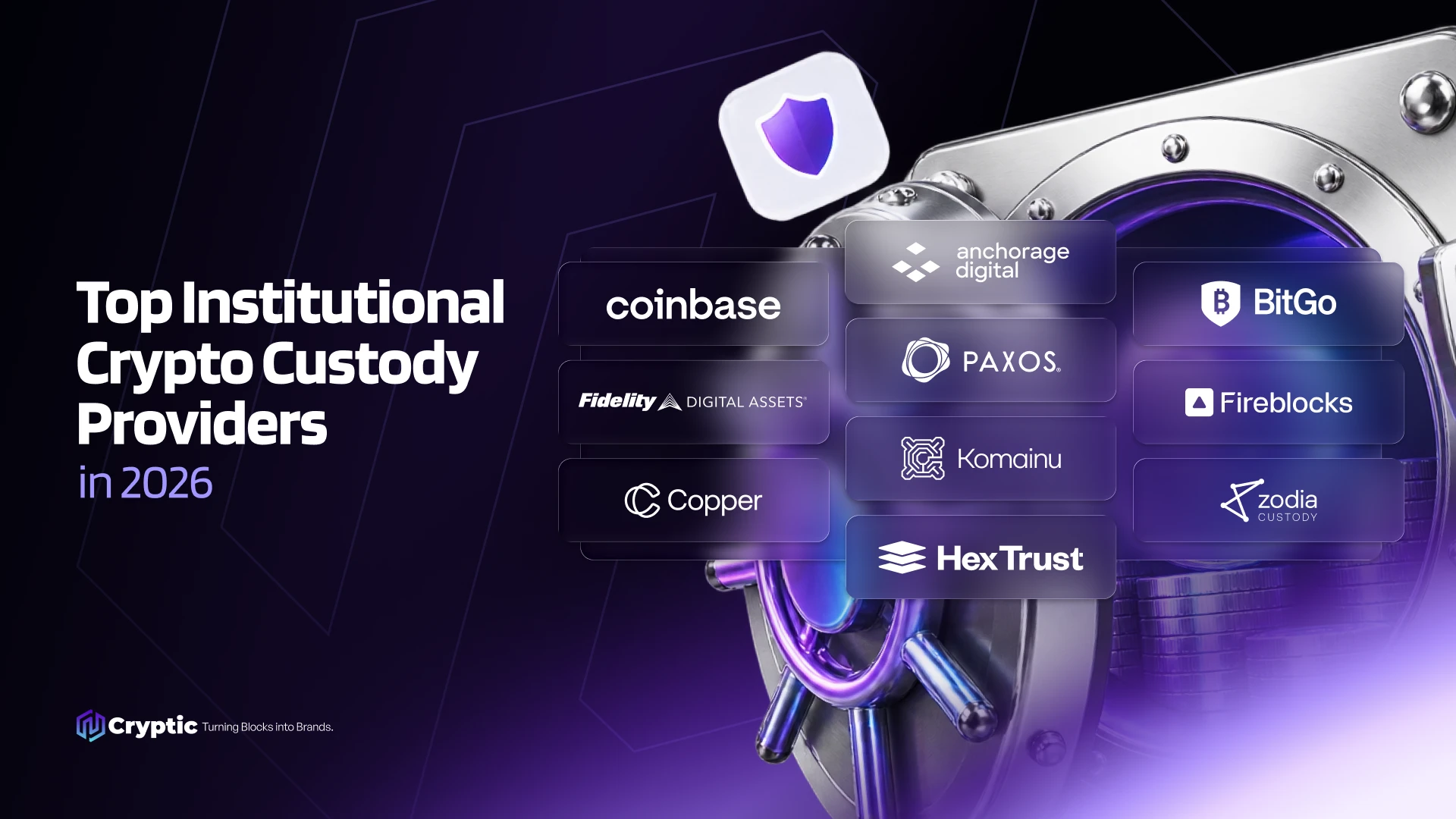
Institutional crypto custody is the regulated safekeeping of digital assets for funds, asset managers, corporates and fintechs. The leading providers in 2026 are Coinbase Prime, Anchorage Digital, BitGo, Fidelity Digital Assets, Paxos, Fireblocks, Copper, Komainu, Zodia Custody and Hex Trust. The biggest change this year is regulatory. In short, several crypto custodians now hold or are converting to US national trust charters from the OCC.
Custody used to be the bottleneck for institutional crypto. In 2026, however, it has become a regulated, competitive market. The SEC rescinded SAB 121 in January 2025. That rule had forced custodians to carry client crypto on their own balance sheets. In December 2025 the OCC conditionally approved five national trust bank applications in a single day, including BitGo, Fidelity Digital Assets and Paxos. Paxos says it completed its conversion that month, and BitGo says its approval was full and unconditional. Meanwhile, Circle, approved in the same group, received final OCC approval for its trust bank in July 2026. In addition, in the January 2026 EY-Parthenon and Coinbase survey of 351 institutional investors, 73% said they planned to increase their digital asset allocations in 2026.
This guide ranks the custody providers institutions use today. It also explains what kind of regulated entity each one is, and then lists the trade-offs your due diligence team should ask about.
What Is Institutional Crypto Custody?
Institutional crypto custody is the safekeeping of private keys and digital assets on behalf of professional clients, under a regulatory licence. It also comes with controls such as segregation of client assets, multi-party approval policies, audits and insurance. The custodian protects the keys. The client keeps ownership of the assets.
For US investment advisers and funds, the key concept is the qualified custodian. Under the SEC Custody Rule, that generally means a bank or trust company, a registered broker-dealer, a futures commission merchant or certain foreign financial institutions. For example, in September 2025 the SEC confirmed through a no-action letter that advisers can use state-chartered trust companies as qualified custodians for crypto, under conditions. Then, on 1 October 2026, the SEC went further and proposed crypto custody rules that would codify certain state trust companies as qualified custodians. Where no qualified custodian will hold an asset, the proposal would also let advisers self-custody it under conditions. As of October 2026 the proposal is open for comment and is not yet final.
How We Picked These Providers
We included institutional crypto custody providers that hold assets for institutional clients under a named licence or charter. We also included firms that supply the custody technology regulated institutions run themselves. Every licence and figure below comes from the provider’s own disclosures, regulator documents or tier-1 crypto and financial media. Where a provider does not publish a dated figure, we do not quote one. We cover traditional banks entering custody in a separate guide.
Institutional Crypto Custody Providers at a Glance
| Provider | Type | Main Regulator | Best For |
|---|---|---|---|
| Coinbase Prime | National trust bank (final OCC approval, November 2026) plus NYDFS trust company | OCC; NYDFS | ETF issuers and large US institutions |
| Anchorage Digital | National trust bank | OCC | Institutions that want a federally chartered crypto bank |
| BitGo | National trust bank (BitGo says OCC approval unconditional) | OCC | Multi-asset custody from a listed US custodian |
| Fidelity Digital Assets | National trust bank (per Fidelity) | OCC | Traditional asset managers |
| Paxos | Trust company (conditional OCC approval; Paxos says conversion complete) | OCC; MAS; ADGM | Fintechs embedding crypto and stablecoins |
| Fireblocks | MPC technology plus trust company | NYDFS (Fireblocks Trust Company) | Firms that want to run their own wallets |
| Copper | Off-exchange settlement plus US qualified custodian | SEC and FINRA (US entity) | Active traders using off-exchange settlement |
| Komainu | Regulated custodian | JFSC; VARA; FCA registration | Institutions in Europe and the Middle East |
| Zodia Custody | Bank-backed custodian | CSSF (MiCA); FCA registration | EU institutions wanting bank backing |
| Hex Trust | Regulated custodian | MAS; Hong Kong; Dubai | Asian and Middle Eastern institutions |
The Top Institutional Crypto Custody Providers in 2026
1. Coinbase Prime (Coinbase Custody)

NYDFS has regulated Coinbase Custody Trust Company as a New York trust company since 2018. According to the company, 8 of the 11 original US spot bitcoin ETFs chose it as custodian at their launch in January 2024. As a result, it is the default choice for ETF issuers. In April 2026, Coinbase received conditional approval for an OCC national trust charter. Then, on 6 November 2026, the OCC granted final approval for Coinbase National Trust Company, a national trust bank that will take over the custody business over a three-year period.
Coinbase says it stores the most crypto in the world. It reported $377 billion in assets on platform as of September 2026 (end of Q3 2026), equal to 12.5% of total crypto market capitalisation. However, that figure includes retail balances, so it is not a pure institutional custody number.
Trade-off: concentration risk. Coinbase was custodian for 8 of the 11 original spot bitcoin ETFs at launch, so many issuers rely on one custodian. Therefore, weigh whether your investment committee wants a second provider.
Best for: ETF issuers, large asset managers and institutions that also want Coinbase’s trading and financing.
Website: coinbase.com/prime
2. Anchorage Digital
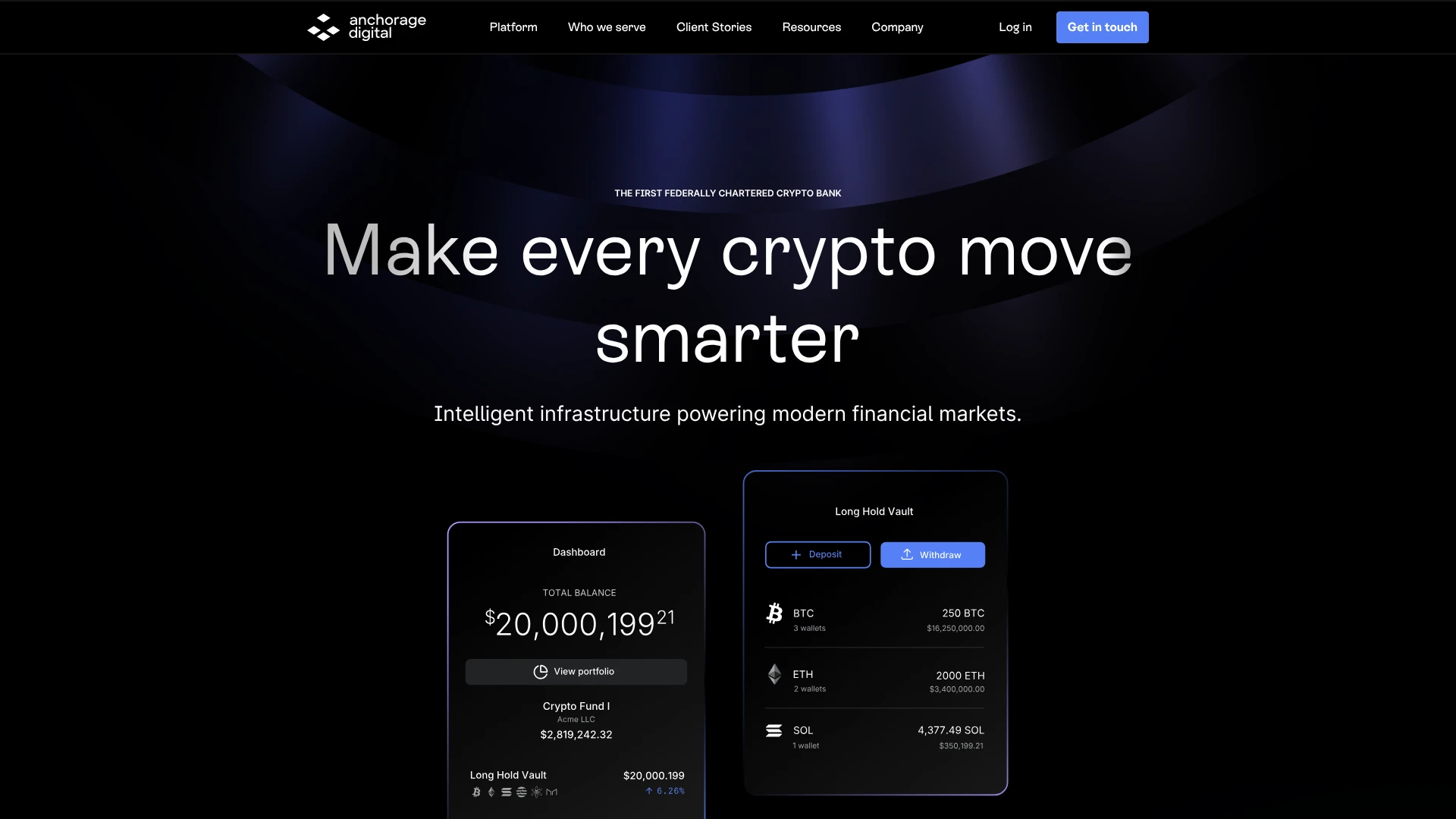
Anchorage Digital Bank N.A. was the first federally chartered crypto bank in the US. In August 2025 the OCC lifted the consent order it had placed on Anchorage in 2022. Then, in February 2026, Tether invested $100 million at a $4.2 billion valuation.
Trade-off: Anchorage is no longer the only federally chartered option. As of November 2026, Circle and Coinbase hold final OCC trust bank approvals, Paxos says it has completed its conversion, and BitGo says its approval is unconditional. Fidelity Digital Assets operates through a national trust bank entity after a conditional OCC approval, and Morgan Stanley holds a conditional approval. As a result, Anchorage’s regulatory edge is narrower than it was.
Best for: institutions that want custody, staking and stablecoin services from an OCC-supervised bank.
Website: anchorage.com
3. BitGo
BitGo, founded in 2013, became a public company when it listed on the NYSE as BTGO on 22 January 2026 in a $212.8 million IPO at a valuation of about $2 billion. Earlier, in December 2025, it said it received full OCC approval to convert its South Dakota trust company into a national trust bank, BitGo Bank & Trust, N.A.
BitGo’s Q3 2026 results showed $59.9 billion in assets on platform and 6,640 clients as of September 2026. The company also says it insures assets in its qualified custody for up to $250 million.
Trade-off: as a listed company, its financials are public. In Q3 2026 it reported net income of $44.1 million, but that came from a $71.5 million unrealised gain on digital assets, and the operating loss was $19.2 million. So review counterparty health as part of due diligence.
Best for: institutions that need broad asset support from a publicly listed custodian.
Website: bitgo.com
4. Fidelity Digital Assets

Fidelity Digital Assets serves institutional clients from offices in Boston, London and Dublin. In December 2025 the OCC conditionally approved its conversion from a state trust company to a national trust bank. Fidelity now provides custody through Fidelity Digital Assets, National Association, which it describes as a national trust bank. For traditional asset managers, the main attraction is therefore the Fidelity name.
Trade-off: ask for the full list of supported assets and the insurance terms during due diligence, as with any custodian.
Best for: pension funds, wealth managers and asset managers that want a traditional financial brand.
Website: fidelitydigitalassets.com
5. Paxos
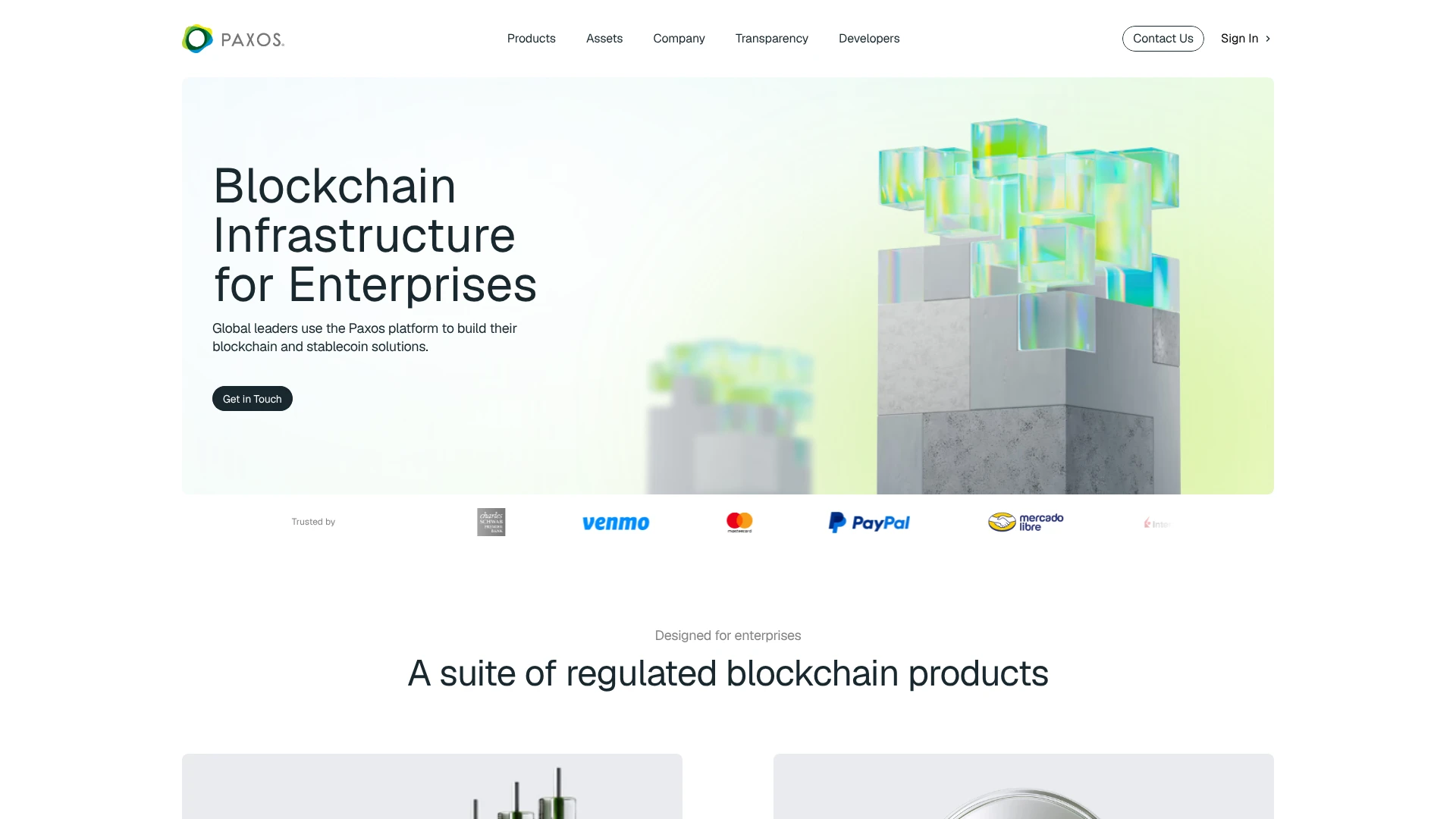
Paxos has held a New York trust charter since 2015 and says it received OCC approval to convert to Paxos Trust Company, N.A. in December 2025. The Monetary Authority of Singapore and Abu Dhabi’s FSRA also regulate it.
Paxos is less a stand-alone custodian and more the regulated infrastructure behind consumer brands. It issues PYUSD, USDG and PAXG, and has listed PayPal, Interactive Brokers, Mastercard, Mercado Libre and Nubank among its clients.
Trade-off: its model centres on embedded custody and brokerage for fintechs, so it is a weaker fit for a fund simply looking for cold storage.
Best for: fintechs, brokers and banks that want to offer crypto or stablecoins inside their own apps.
Website: paxos.com
6. Fireblocks
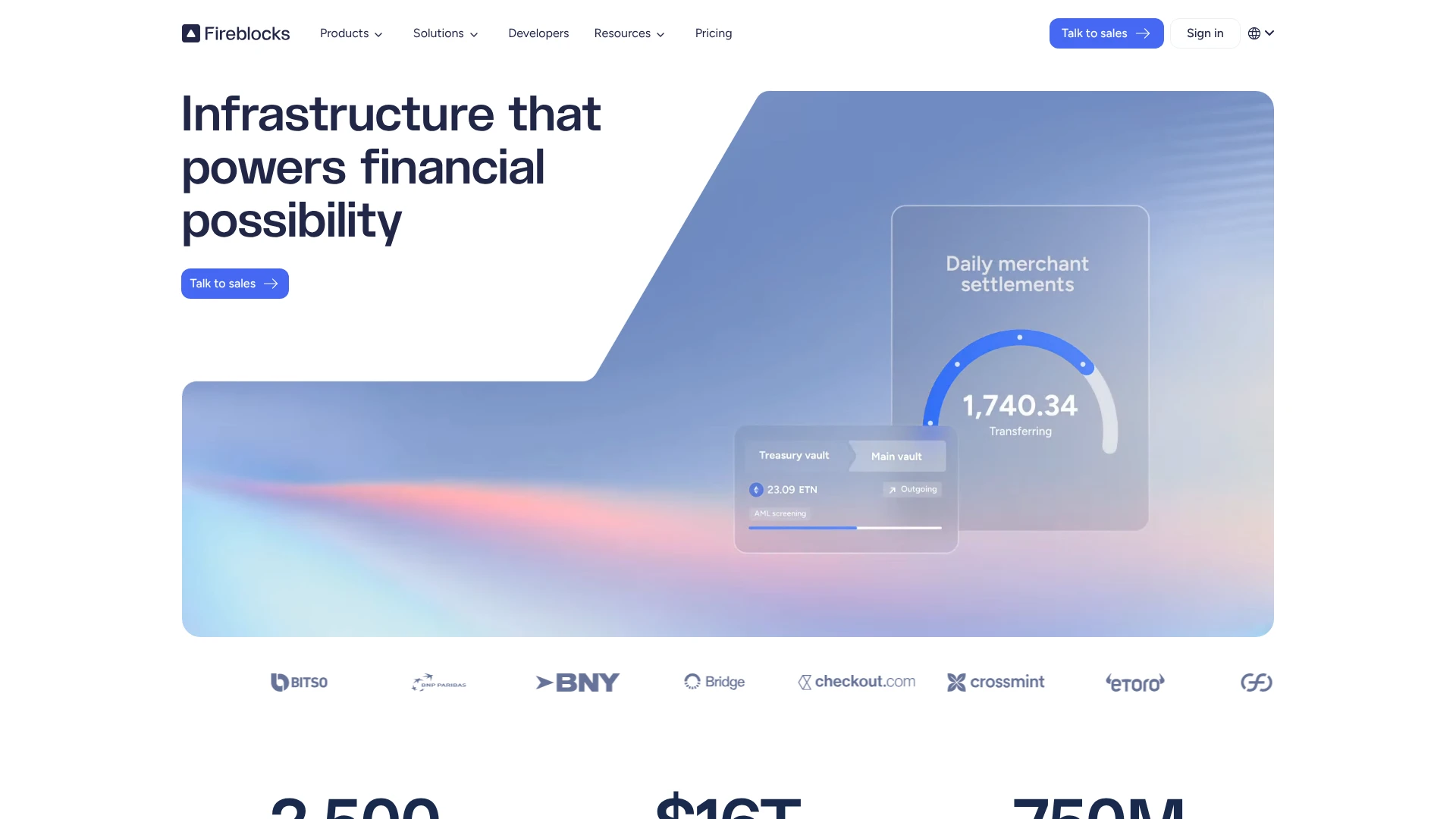
Fireblocks is best known for its MPC (multi-party computation) wallet platform, the software many exchanges, fintechs and banks use to run their own digital asset operations. In May 2024 it added a regulated layer: NYDFS authorised Fireblocks Trust Company as a qualified custodian. Since then, FalconX integrated the trust company in February 2026. Fireblocks also contributed to DTCC’s first live tokenized securities pilot trades in July 2026.
Trade-off: with the core MPC product, your firm operates the wallets itself, so it is not the same as handing assets to a qualified custodian. The trust company, by contrast, is a newer, separate offering.
Best for: firms that want to control their own wallet infrastructure, with the option of regulated custody.
Website: fireblocks.com
7. Copper
Copper, founded in 2018, is best known for ClearLoop, its off-exchange settlement network that lets institutions trade on exchanges while their assets stay with the custodian. In August 2026, Copper established a regulated US presence through Copper Markets (US), an SEC-registered broker-dealer and FINRA member acting as a qualified custodian.
Trade-off: ownership may change. CoinDesk reported in May 2026 that Copper was exploring a sale at about $500 million. Then, in September 2026, chief executive Amar Kuchinad left while the sale process continued. As of October 2026, no buyer has been announced.
Best for: trading firms and funds that want to reduce exchange counterparty risk.
Website: copper.co
8. Komainu
Nomura, CoinShares and Ledger founded Komainu as a joint venture. The Jersey Financial Services Commission regulates it, and it holds a VARA licence in Dubai for custody, staking and collateral wallets. It also has a UK FCA registration for anti-money laundering purposes. In July 2026, Aviva Investors selected Komainu as the digital asset infrastructure partner for a tokenized share class of its US Dollar Liquidity Fund on the XRP Ledger.
Trade-off: Komainu does not list a US entity on its entities page. As a result, it is a limited option for US advisers and funds.
Best for: institutions in Europe and the Middle East, especially those using crypto as collateral.
Website: komainu.com
9. Zodia Custody
Luxembourg’s CSSF authorised Zodia Custody as a MiCA crypto-asset service provider in December 2025. It also holds registrations with the UK FCA and in Abu Dhabi and Hong Kong. In October 2026, Standard Chartered signed definitive agreements to acquire all of Zodia Custody and move its custody business into the bank’s Securities Services division. This came after Zodia’s shareholders accepted a non-binding offer in May 2026. As of October 2026, completion is still subject to regulatory approvals.
Trade-off: the business is in transition. When the acquisition closes, a global bank will serve Zodia’s custody clients. That changes contracts, onboarding and service models.
Best for: EU institutions that want MiCA authorisation and the backing of a large bank.
Website: zodia-custody.com
10. Hex Trust
Hex Trust, founded in 2018, is one of the main custodians serving Asia. It received a Major Payment Institution licence from the Monetary Authority of Singapore in March 2025 . According to the same report, it also holds licences in Hong Kong, Dubai, France and Italy.
Trade-off: Hex Trust operates at a smaller scale than the US leaders, and it focuses on Asia and the Middle East.
Best for: institutions and token foundations in Asia and the Middle East.
Website: hextrust.com
Custody Technology Providers Worth Knowing
Some institutions, especially banks, prefer to run custody in-house with licensed technology rather than use a third-party custodian. In that case, the main vendors are:
- Taurus: a FINMA-supervised Swiss firm. According to the company, more than 40 institutions use its custody software, including State Street, Deutsche Bank and CACEIS.
- Ledger Enterprise: hardware security module (HSM) based multisig governance from Ledger. According to the company, more than 100 enterprise clients have used it since 2019.
- Cobo: MPC and custodial wallet infrastructure covering 80+ chains, according to the company, with Deribit and Antalpha among its named users.
Why Banks Are Entering Custody Now
The rescission of SAB 121 removed the accounting penalty that kept US banks out of crypto custody for almost three years. Since then, the line between crypto custodians and banks has started to blur. In other words, institutional crypto custody is no longer a crypto-native niche. Morgan Stanley received conditional OCC approval for a digital asset trust bank in June 2026 and had not yet opened it as of October 2026. Standard Chartered signed definitive agreements in October 2026 to acquire Zodia Custody. Meanwhile, BNY has offered bitcoin and ether custody since 2022. We cover the banks in detail in our upcoming guide to banks offering crypto services in 2026.
How to Choose an Institutional Crypto Custodian
Use this checklist to compare institutional crypto custody providers side by side. Each point matters because it changes who carries the risk:
- Charter and regulator: an OCC national trust bank, a state trust company and an offshore licence carry different protections. Match the charter to your investors’ expectations.
- Qualified custodian status: if you are a US adviser or fund, confirm the provider meets the SEC Custody Rule for your structure.
- Segregation: confirm client assets are held separately from the custodian’s own assets and from exchange balances.
- Insurance: FDIC and SIPC generally do not cover custody assets. So ask for the private policy limit, the insurer and the exclusions.
- Financial health: review the custodian’s own financial statements, especially for listed or recently acquired providers, because weak finances can affect the assets they hold.
- Operational security: the $1.5 billion Bybit hack in February 2025 came through a compromised multisig interface, not a stolen key. Therefore, ask how the provider protects the signing workflow, not just the keys.
For self-custody options for individuals, see our guide to the best crypto wallets. For execution, see the best crypto liquidity providers.
How Cryptic Helps Institutional Crypto Brands
Institutional buyers do their research long before they take a sales call. Because of that, custodians, infrastructure providers and the banks moving into digital assets win those deals with credibility. That means clear positioning, coverage in the publications allocators read, and thought leadership from their own executives.
Cryptic is a crypto marketing agency founded in 2020 and based in Dubai, with offices in London, Amsterdam and Riyadh. We have worked with Binance, Bybit, OKX, Algorand and Canton Network. We have also supported regulated market entries such as Bybit’s EU launch and OKX’s MiCA transition in Europe. For institutional brands, we build the crypto PR, content and executive presence that turns a licence into trust.
Book a strategy call with our team to plan your institutional go-to-market.
Final Thoughts
Institutional crypto custody in 2026 is defined by regulation. OCC charters, MiCA authorisations and SEC guidance have given allocators more regulated choices than ever. At the same time, bank-backed providers and new US entrants are raising the bar for everyone else. Choose on charter, segregation, insurance and the provider’s own financial strength. Finally, split assets across custodians if concentration risk matters to your investment committee. To position your own institutional crypto brand, talk to Cryptic.
FAQ
What is a qualified custodian for crypto?
A qualified custodian is an entity that US investment advisers can use to hold client assets under the SEC Custody Rule. It is generally a bank or trust company, a registered broker-dealer, a futures commission merchant or certain foreign financial institutions. In September 2025 the SEC confirmed through a no-action letter that state-chartered trust companies can act as qualified custodians for crypto, under conditions. Then, in October 2026, it proposed rules that would codify that position.
Who are the largest institutional crypto custodians?
Coinbase says it stores the most crypto in the world. It reported $377 billion in assets on platform as of September 2026, and it served as custodian for 8 of the 11 original US spot bitcoin ETFs at launch. Other major providers include Anchorage Digital, BitGo, Fidelity Digital Assets and Paxos, all of which now hold or are converting to OCC national trust charters.
What is the difference between MPC, multisig and cold storage?
MPC splits a private key into shares held by different parties, so the full key never exists in one place. Multisig requires several separate keys to approve a transaction onchain. Cold storage keeps keys offline. Most institutional custodians combine these methods, for example keeping most assets cold while using MPC or multisig for operational wallets.
What was SAB 121 and why does it matter?
SAB 121 was SEC staff guidance that required companies safeguarding crypto for clients to record those assets as a liability on their own balance sheet. As a result, custody became very expensive for banks. The SEC then rescinded it in January 2025 through SAB 122, which opened the door for banks and trust companies to expand crypto custody.
Is crypto held by a custodian insured?
FDIC deposit insurance and SIPC protection generally do not cover crypto held by a custodian. Some custodians buy private insurance instead: for example, BitGo states coverage of up to $250 million for assets in its qualified custody. So ask any provider for the policy limit, the insurer, which events the policy covers and whether the limit is shared across clients.
How does Cryptic help institutional crypto companies?
Cryptic is a crypto marketing agency founded in 2020 and based in Dubai. It helps custodians, infrastructure providers and financial institutions build credibility with institutional buyers through PR, thought leadership, content and executive positioning. For example, Cryptic has worked with Binance, Bybit, OKX, Algorand and Canton Network, including regulated market entries in Europe.