
Quick answer
The best crypto ETFs to compare in 2026 are the US spot funds with the most assets and the lowest fees in each coin: BlackRock’s IBIT for bitcoin and ETHA for ether, Bitwise’s BSOL for Solana, and the Bitwise and Franklin funds for XRP. On fees, Morgan Stanley’s MSBT charges 0.14%, the lowest bitcoin ETP fee at its April 2026 launch. Figures below are from each issuer, as of October 2026 unless marked.
BlackRock’s iShares Bitcoin Trust held about $64.7 billion in net assets as of 26 October 2026. That is more than eight times the size of the largest spot ether fund. Yet it is not the cheapest bitcoin ETF, and two years after the first approvals the US market now has spot funds for ether, Solana, XRP, Hyperliquid, Chainlink and baskets of the largest coins.
This guide compares the leading US spot crypto ETFs fund by fund: what each one holds, what it charges, how large it is, who stands behind it and whether it stakes. It is written for readers and teams who want the facts on one page. It is information, not investment advice, and it does not tell anyone what to buy.
If you are looking for the institutional money flowing into these products, we cover that separately in how institutional capital is reshaping crypto markets. This page is about the funds themselves.
How We Compared These Crypto ETFs
A spot crypto ETF is an exchange-traded product that holds the coin itself, so its value follows the market price of that coin minus the fund’s fee. We included only US-listed spot funds and compared them on four criteria: net assets, sponsor fee, the issuer behind the fund and, for proof-of-stake coins, whether the fund stakes. Within each coin, funds are ordered by net assets.
Every fee and asset figure comes from the issuer’s own product page, fact sheet or press release, with the date the issuer shows. When an issuer page did not publish a dated figure we could confirm, we say so instead of borrowing a number from a data aggregator. Futures-based and leveraged products are left out, because they do not hold the coin.
Best Crypto ETFs at a Glance
| Fund (Ticker) | Asset | Sponsor Fee | Net Assets (As Of) | Issuer Page |
|---|---|---|---|---|
| iShares Bitcoin Trust (IBIT) | Bitcoin | 0.25% | $64.7B (26 Oct 2026) | ishares.com |
| Fidelity Wise Origin Bitcoin Fund (FBTC) | Bitcoin | 0.25% | Not shown on the issuer page we could access | fidelity.com |
| Bitwise Bitcoin ETF (BITB) | Bitcoin | 0.20% | $2.96B (25 Oct 2026) | bitbetf.com |
| ARK 21Shares Bitcoin ETF (ARKB) | Bitcoin | 0.21% | $2.46B (26 Oct 2026) | 21shares.com |
| Morgan Stanley Bitcoin Trust (MSBT) | Bitcoin | 0.14% | Over $381M (16 Jul 2026) | morganstanley.com |
| iShares Ethereum Trust (ETHA) | Ether | 0.25% | $7.55B (26 Oct 2026) | ishares.com |
| iShares Staked Ethereum Trust (ETHB) | Ether, staked | 0.25% (0.12% with waiver) | $1.00B (26 Oct 2026) | ishares.com |
| Bitwise Ethereum ETF (ETHW) | Ether | 0.20% | $253M (25 Oct 2026) | ethwetf.com |
| Bitwise Solana Staking ETF (BSOL) | Solana, staked | 0.20% | $1.07B (25 Oct 2026) | bsoletf.com |
| Fidelity Solana Fund (FSOL) | Solana, staked | 0.25% | $239.3M (30 Sep 2026) | fidelity.com |
| Bitwise XRP ETF (XRP) | XRP | 0.34% | $535.2M (25 Oct 2026) | bitxrpetf.com |
| Franklin XRP ETF (XRPZ) | XRP | 0.19% | $437.0M (30 Sep 2026) | franklintempleton.com |
| Bitwise Hyperliquid ETF (BHYP) | Hyperliquid (HYPE) | 0.34% | $150.9M (25 Oct 2026) | bhypetf.com |
| Bitwise 10 Crypto Index ETF (BITW) | Index of 10 coins | 0.75% | $691.3M (25 Oct 2026) | bitwiseinvestments.com |
| Hashdex Nasdaq CME Crypto Index ETF (NCIQ) | Index of 9 coins | 0.25% | $461.45M (26 Oct 2026) | hashdex-etfs.com |
1. iShares Bitcoin Trust (IBIT)
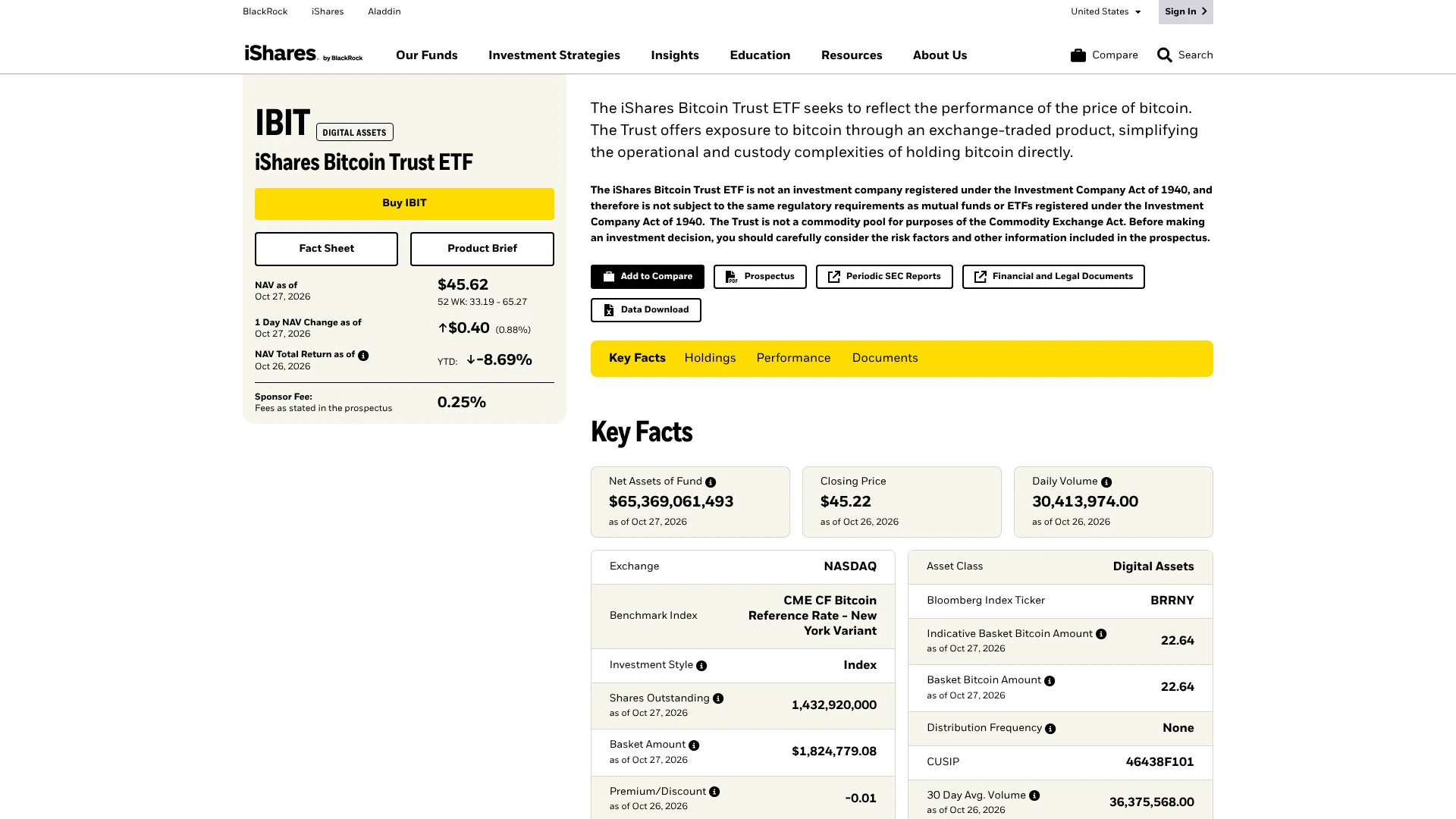
IBIT is BlackRock’s spot bitcoin fund and the largest fund on this page. It held about $64.7 billion in net assets as of 26 October 2026, according to iShares. It trades on Nasdaq, launched in January 2024 and charges a 0.25% sponsor fee.
The fund’s prospectus names Coinbase Custody as the bitcoin custodian, with Anchorage Digital as an alternative custodian. Its size is the main reason it shows up first in most comparisons; on price alone, several funds below charge less.
Best for: readers who want the largest spot bitcoin fund as a reference point.
Website: ishares.com
2. Fidelity Wise Origin Bitcoin Fund (FBTC)
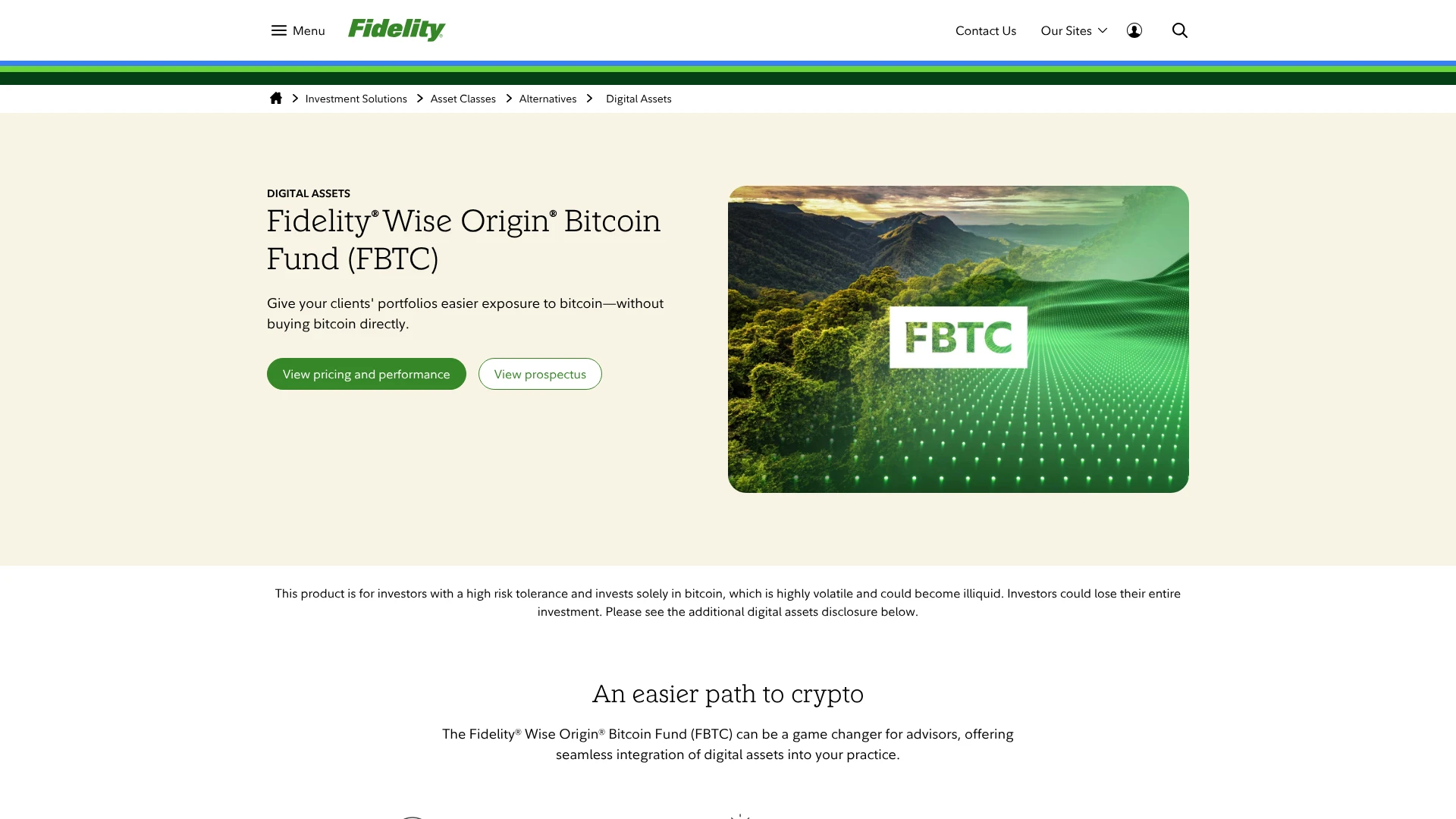
FBTC is Fidelity’s spot bitcoin fund. It began trading on Cboe BZX in January 2024 and charges a 0.25% fee, according to its prospectus. What sets it apart is custody: the bitcoin is held by Fidelity Digital Assets, Fidelity’s own custodian, while most rivals use Coinbase.
Fidelity’s institutional fund page does not show a dated net asset figure, and its retail fund page could not be opened for this review, so we do not quote one. Check the current figure on Fidelity’s site.
Best for: readers who prefer a fund whose sponsor also runs the custody.
Website: fidelity.com
3. Bitwise Bitcoin ETF (BITB)
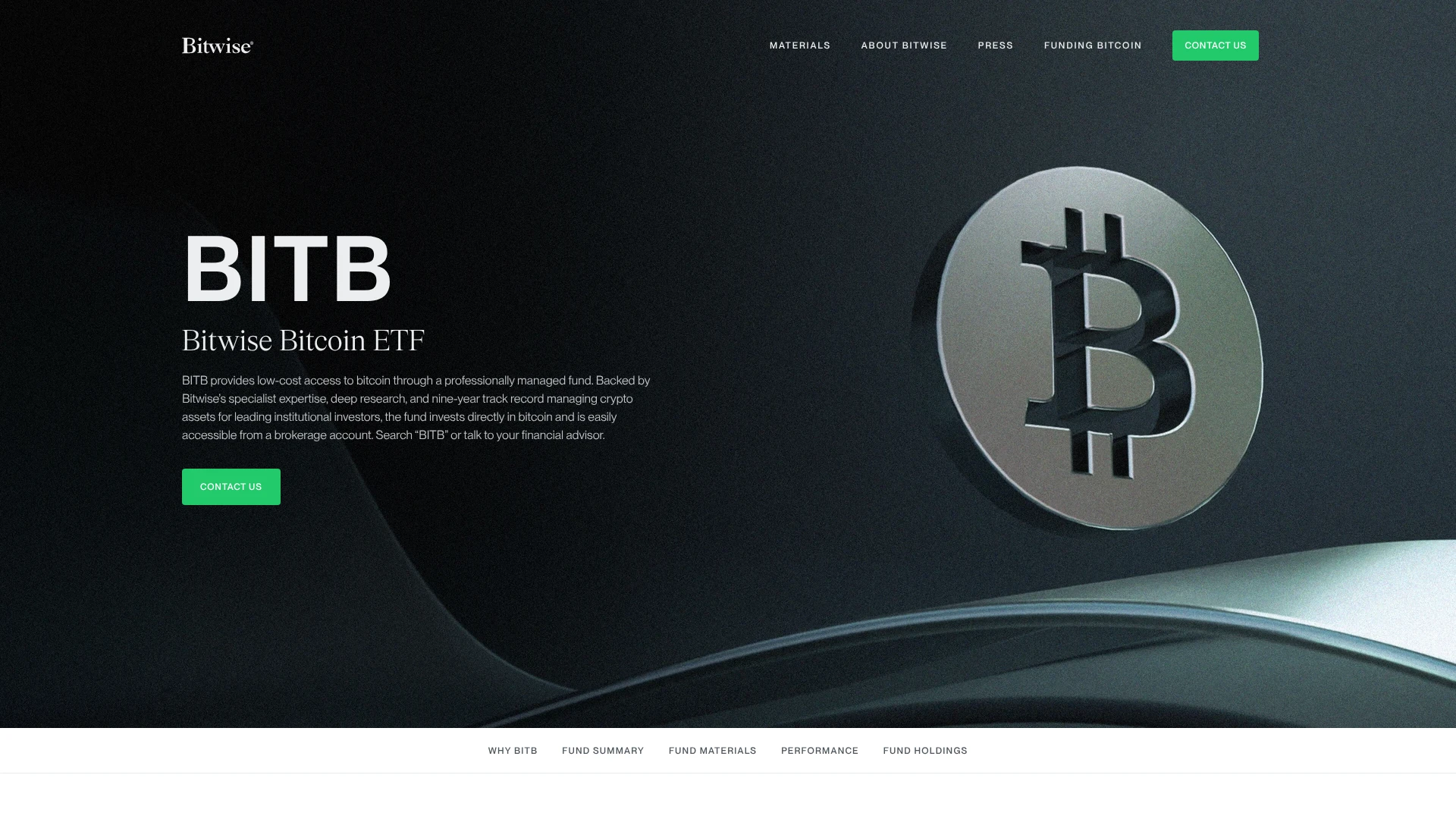
BITB is Bitwise’s spot bitcoin fund on NYSE Arca. It held about $2.96 billion in net assets, or roughly 37,085 BTC, as of 25 October 2026, according to Bitwise. The sponsor fee is 0.20%, below IBIT and FBTC.
Bitwise launched BITB in January 2024 and uses Coinbase Custody for the bitcoin. Bitwise also runs the ether, Solana, XRP, Hyperliquid and 10-coin index funds in this list.
Best for: readers comparing a lower fee from a crypto-native issuer.
Website: bitbetf.com
4. ARK 21Shares Bitcoin ETF (ARKB)
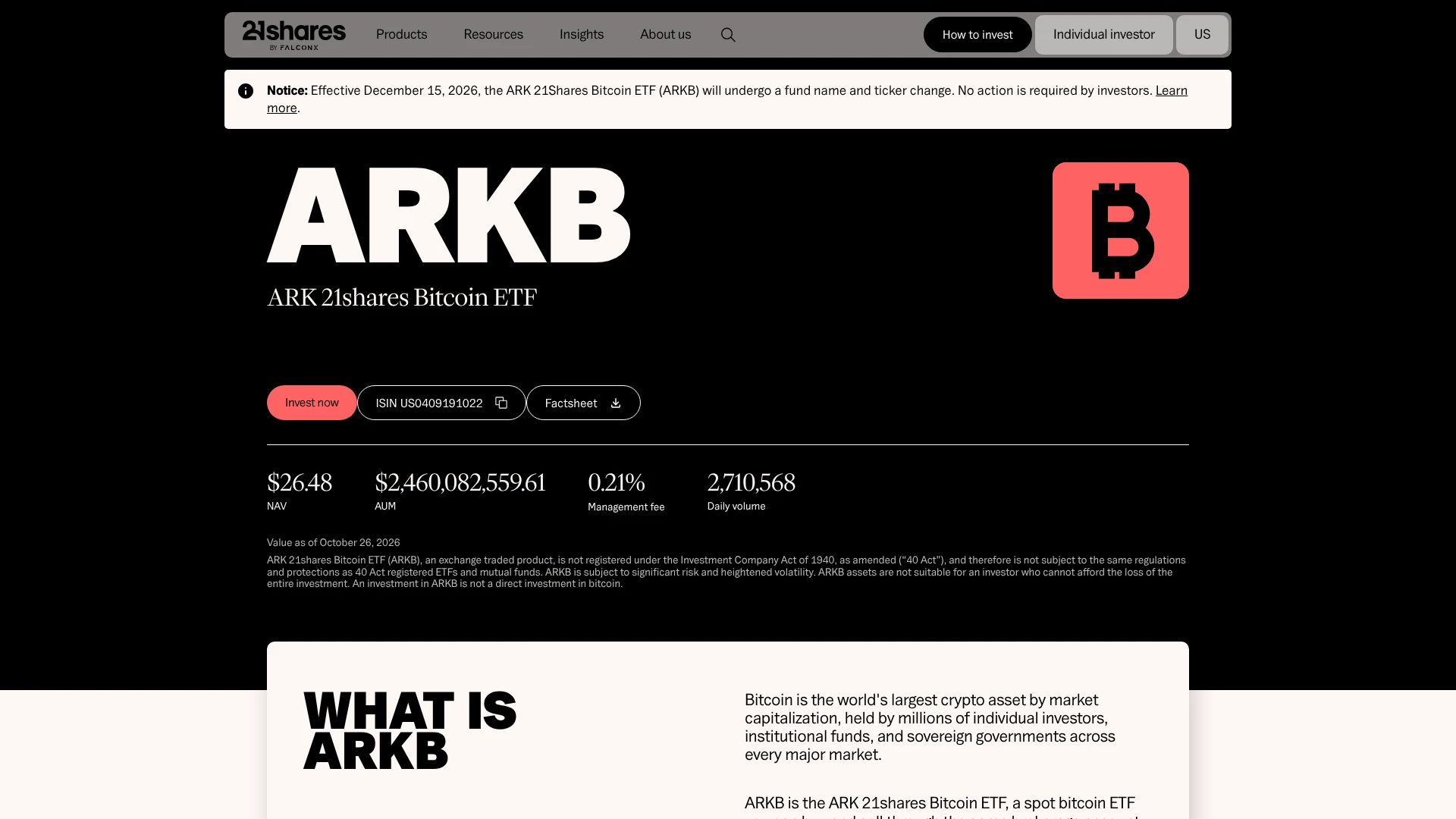
ARKB is sponsored by 21Shares, with ARK Investment Management as sub-adviser. It trades on Cboe BZX, charges 0.21% and held about $2.46 billion in net assets as of 26 October 2026, according to 21Shares.
ARKB spreads its bitcoin across three qualified custodians: Anchorage Digital, BitGo and Coinbase Custody International. For readers who care about custody concentration, that is a real structural difference from single-custodian funds.
Best for: readers who want custody split across more than one provider.
Website: 21shares.com
5. Morgan Stanley Bitcoin Trust (MSBT)
MSBT launched on NYSE Arca in April 2026. Morgan Stanley describes itself as the first US bank-affiliated asset manager to offer a crypto ETP, and set the fee at 0.14%, which it called the lowest bitcoin ETP sponsor fee at launch. Coinbase and BNY provide custody, according to the launch announcement.
Morgan Stanley said MSBT held more than $381 million as of 16 July 2026. The firm added ether (MSSE) and Solana (MSOL) trusts on 28 July 2026, also at 0.14%, which plan to stake part of their holdings.
Best for: fee-sensitive readers comparing the lowest-cost bitcoin option.
Website: morganstanley.com
6. iShares Ethereum Trust (ETHA)
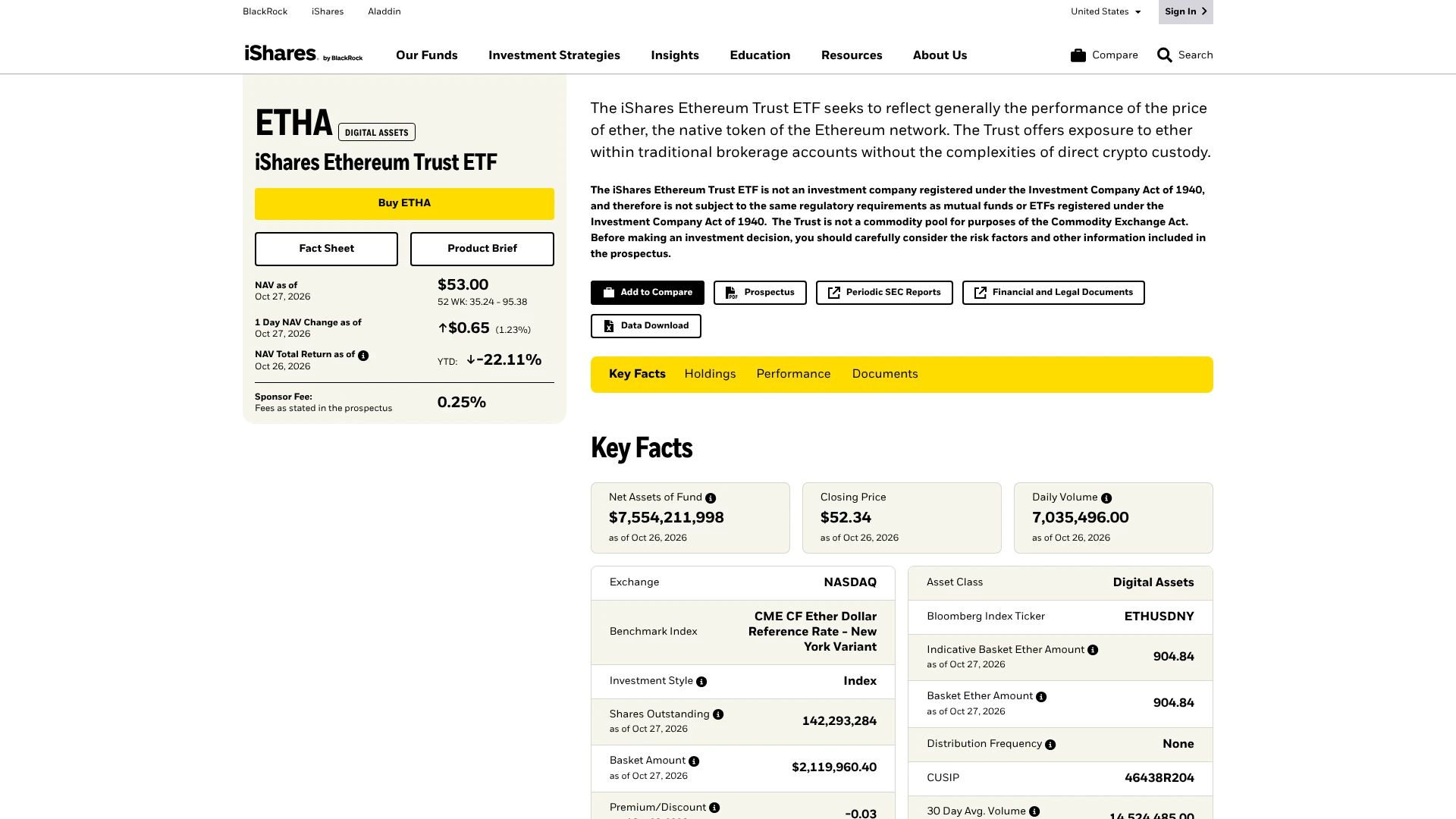
ETHA is the largest spot ether fund we checked, with about $7.55 billion in net assets as of 26 October 2026, according to iShares. It charges 0.25%. Spot ether ETFs started trading in July 2024.
ETHA does not stake. BlackRock chose to offer staking through a separate fund, ETHB, so investors pick between plain ether exposure and ether plus staking rewards.
Best for: readers who want the largest plain spot ether fund.
Website: ishares.com
7. iShares Staked Ethereum Trust (ETHB)
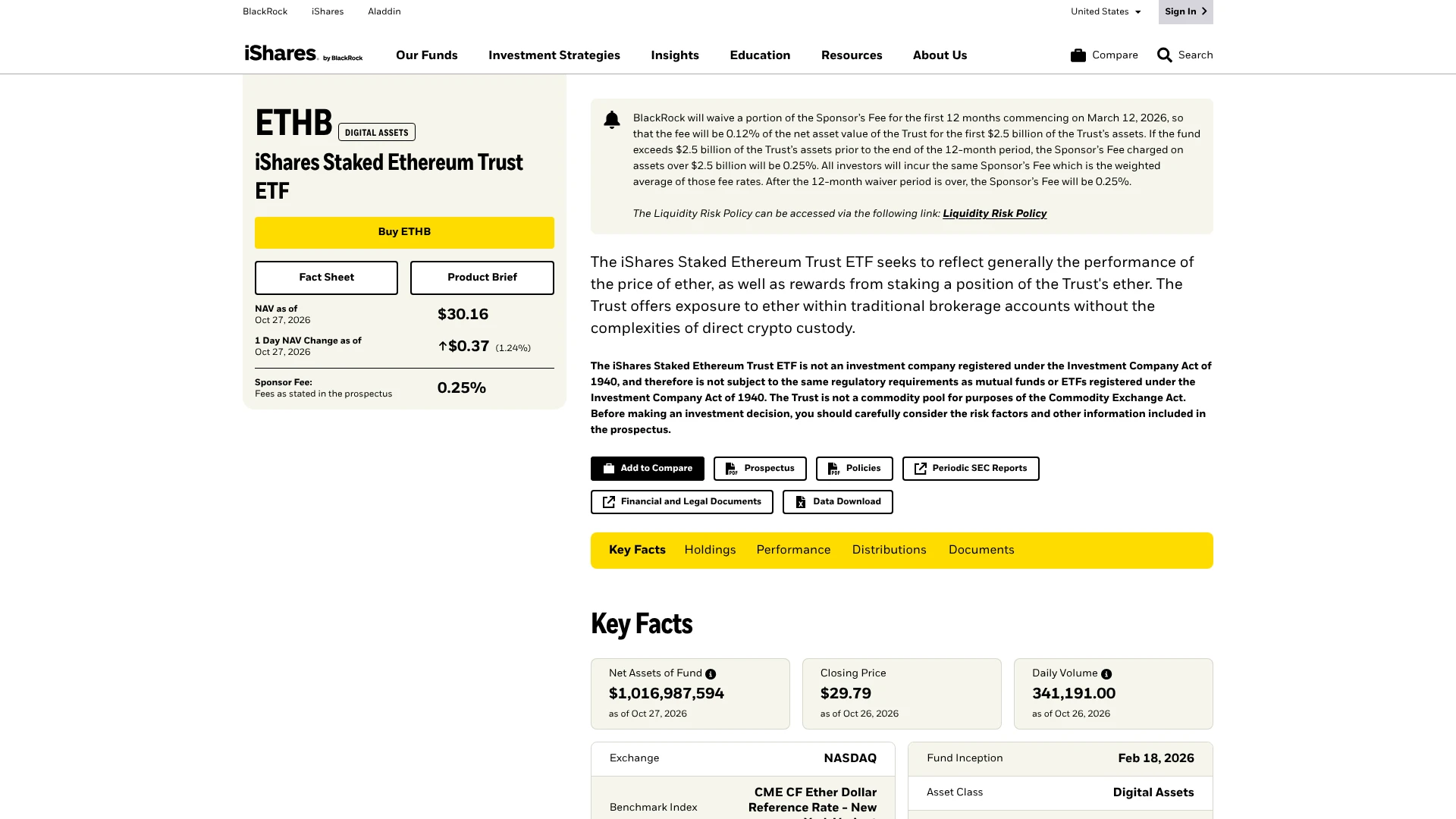
ETHB holds ether and stakes it. It had about $1.00 billion in net assets as of 26 October 2026, according to iShares, with about 76% of holdings staked as of 30 September 2026 and a 30-day staking rewards rate of 1.63% as of 26 October 2026.
The sponsor fee is 0.25%, waived to 0.12% on the first $2.5 billion for 12 months from 12 March 2026. On top of that, the sponsor and its execution agent take 10% of gross staking rewards, per the prospectus. Both costs matter when comparing staked funds.
Best for: readers comparing ether funds that pass on staking rewards.
Website: ishares.com
8. Bitwise Ethereum ETF (ETHW)
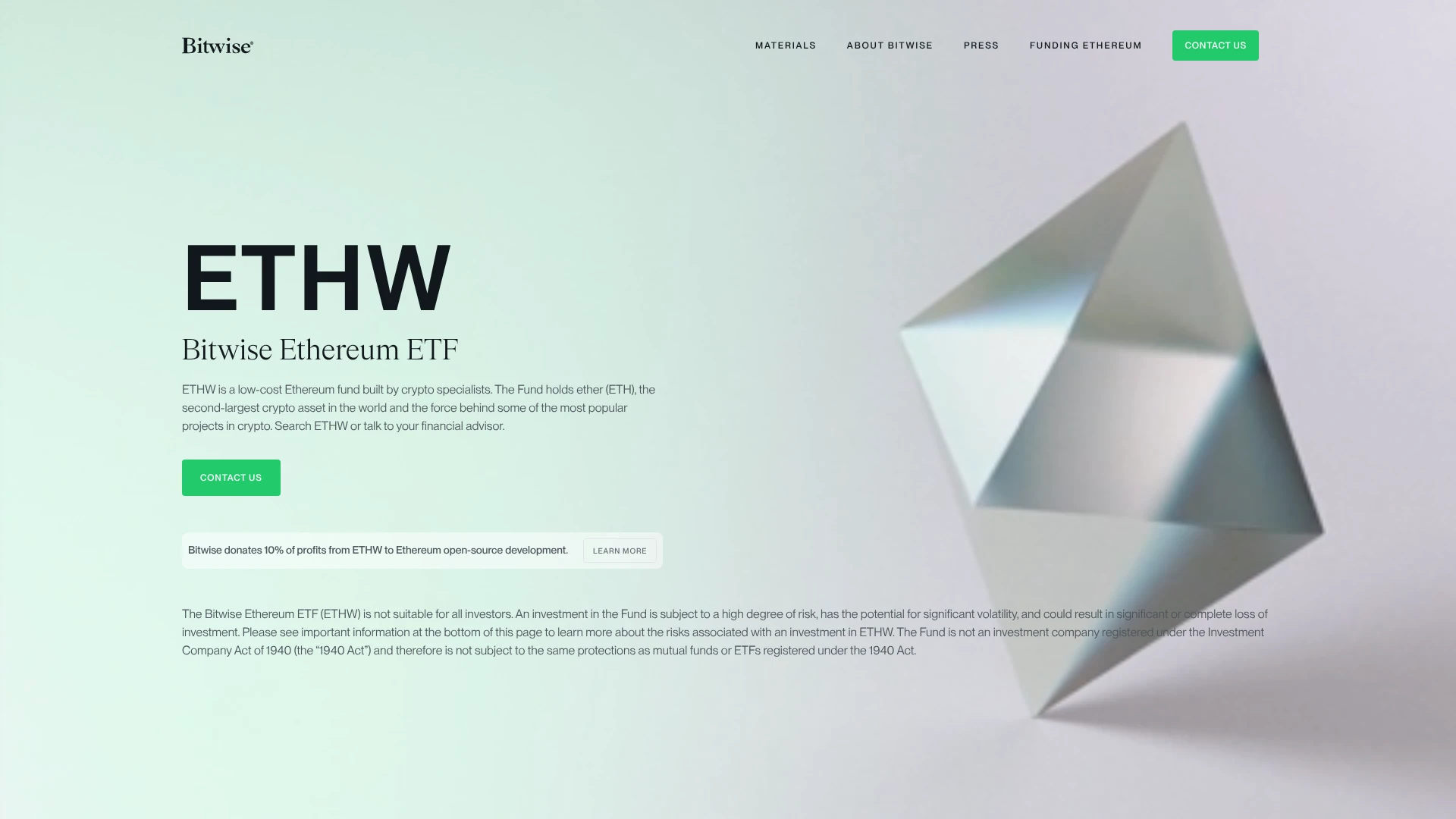
ETHW charges 0.20% and held about $253 million as of 25 October 2026, according to Bitwise. It launched in July 2024 alongside the first spot ether funds.
Bitwise states that ETHW will not take part in proof-of-stake validation, so it is a plain ether fund. Among non-staking ether funds, Franklin’s EZET is cheaper at 0.19% but much smaller, at about $59.7 million as of 30 September 2026.
Best for: readers comparing a lower fee on plain ether exposure.
Website: ethwetf.com
9. Bitwise Solana Staking ETF (BSOL)
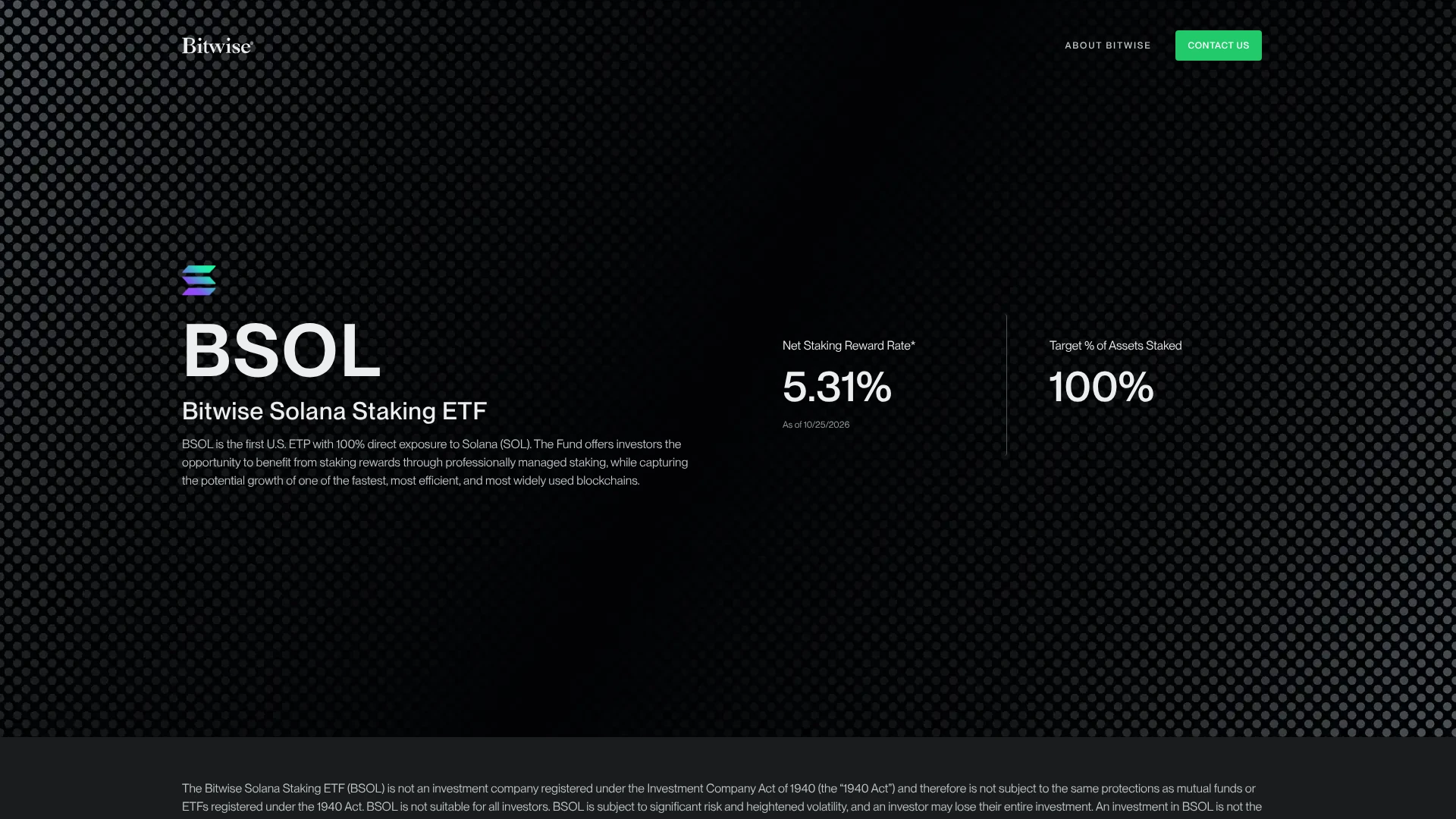
BSOL began trading on NYSE on 28 October 2025, and Bitwise announced it as the first spot Solana ETP in the US. It held about $1.07 billion in net assets as of 25 October 2026, according to Bitwise, which makes it the largest Solana fund we checked by a wide margin.
The fee is 0.20% and the fund targets 100% of assets staked. Bitwise shows a net staking reward rate of 5.32% as of 25 October 2026 (90-day average).
Best for: readers who want the largest spot Solana fund with staking.
Website: bsoletf.com
10. Fidelity Solana Fund (FSOL)
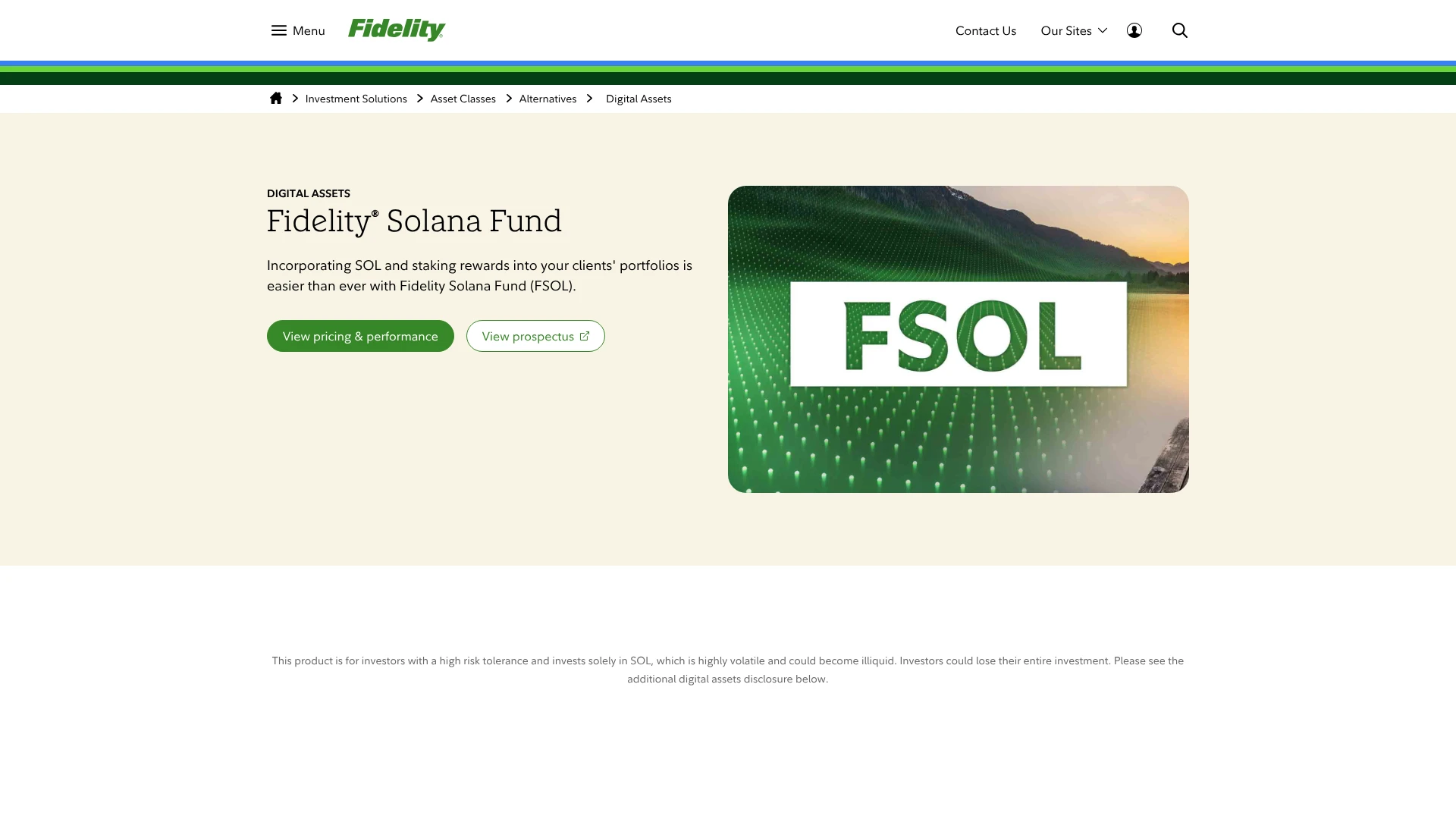
FSOL launched on NYSE Arca in November 2025 and charges 0.25%. Fidelity’s fact sheet shows $239.3 million in portfolio assets as of 30 September 2026 and 100% of holdings staked (30-day average).
Cheaper Solana funds exist: Franklin’s SOEZ charges 0.19% and Morgan Stanley’s MSOL 0.14%, but SOEZ held about $17.3 million as of 30 September 2026 and we could not confirm an issuer asset figure for MSOL. 21Shares has waived the full 0.21% fee on its TSOL until 27 July 2027.
Best for: readers comparing a Solana fund from a large traditional asset manager.
Website: fidelity.com
11. Bitwise XRP ETF (XRP)
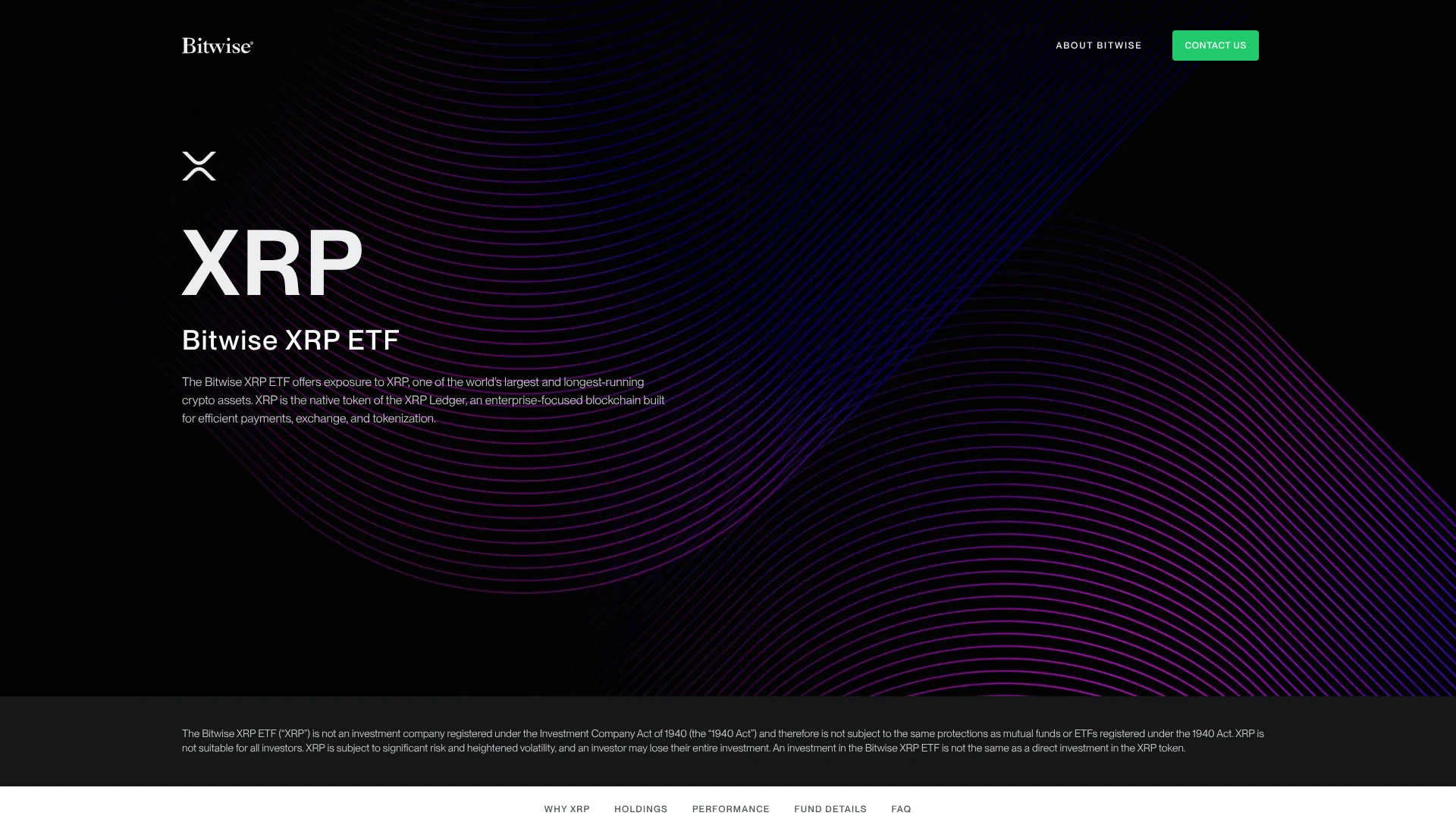
The Bitwise XRP ETF trades on NYSE Arca under the ticker XRP and launched in November 2025. It held about $535.2 million in net assets as of 25 October 2026, according to Bitwise, the largest XRP fund we checked. The fee is 0.34%.
Canary’s XRPC was the first US spot XRP ETF structured under the Securities Act of 1933, trading on Nasdaq from 13 November 2025 (REX-Osprey’s XRPR, a 1940 Act fund, came earlier). It charges a 0.50% sponsor fee, according to Canary.
Best for: readers who want the largest spot XRP fund.
Website: bitxrpetf.com
12. Franklin XRP ETF (XRPZ)
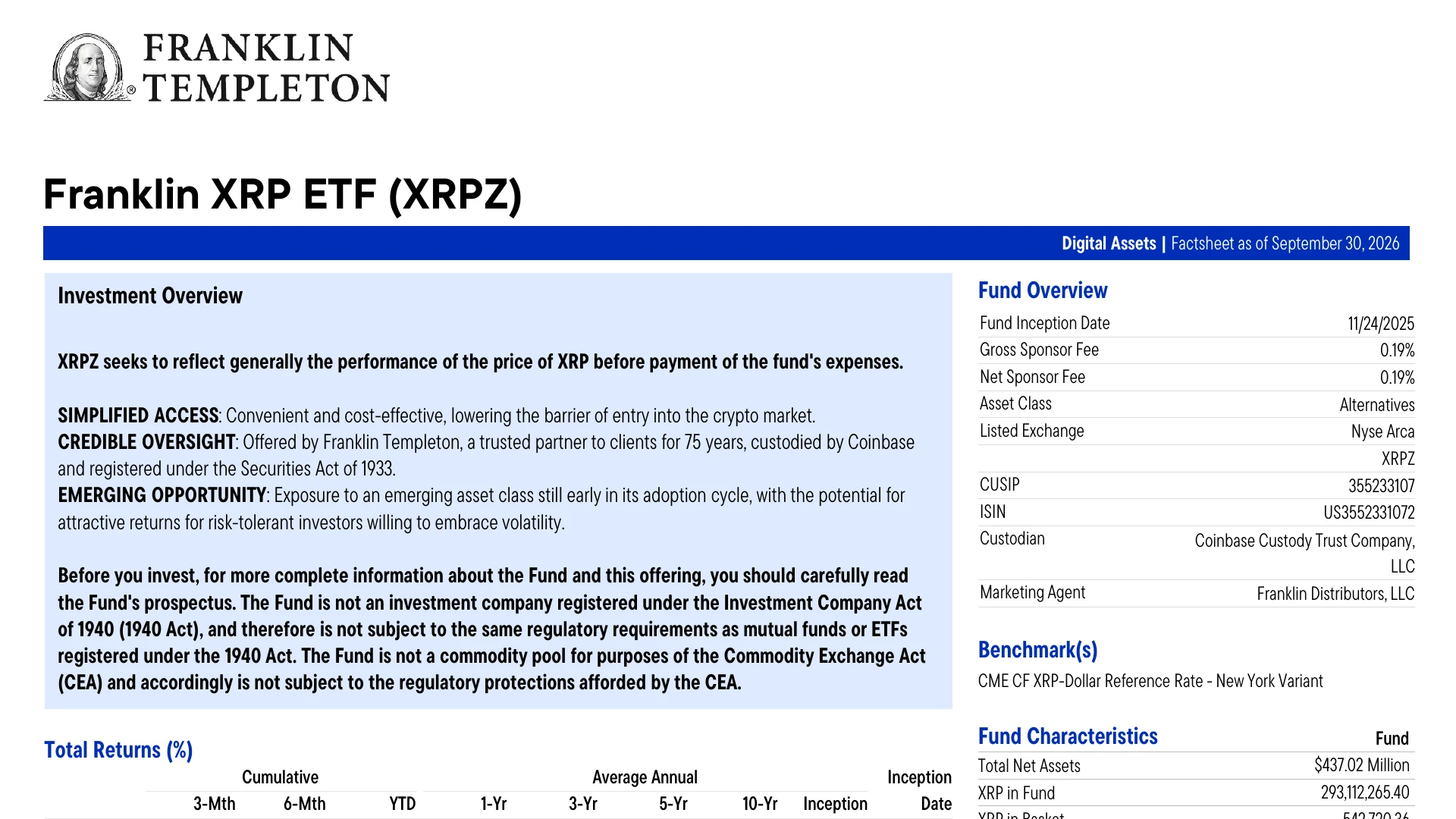
XRPZ is Franklin Templeton’s spot XRP fund, launched in November 2025. At 0.19% it has the lowest standing fee among the XRP funds we checked, and it held $437.0 million in net assets as of 30 September 2026, according to its fact sheet.
Franklin applies the same 0.19% fee to its bitcoin (EZBC), ether (EZET) and Solana (SOEZ) funds, which makes it one of the more consistent low-fee issuers across coins.
Best for: fee-sensitive readers comparing XRP funds.
Website: franklintempleton.com
13. Bitwise Hyperliquid ETF (BHYP)
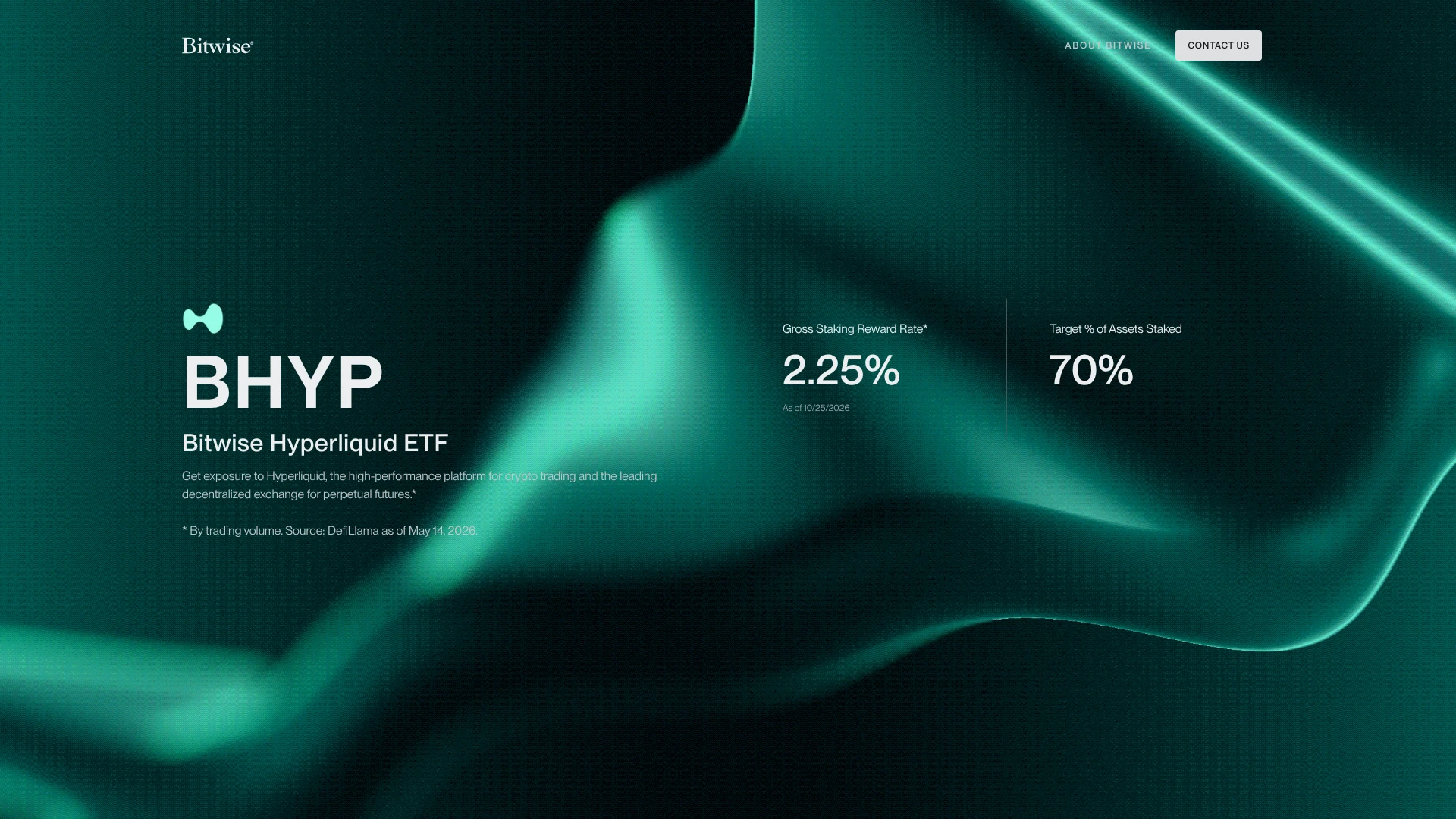
BHYP holds HYPE, the token of the Hyperliquid perpetuals exchange. It launched on 14 May 2026, charges 0.34% and held about $150.9 million as of 25 October 2026, according to Bitwise.
It is the largest of the newer single-coin funds we could confirm on an issuer page. Others in the same wave include Bitwise’s Chainlink (CLNK, $57.1 million), Avalanche (BAVA, $23.8 million) and NEAR (NRR, $80.1 million) funds, all as of 25 October 2026. These are small funds on volatile assets.
Best for: readers tracking ETF access beyond the four largest coins.
Website: bhypetf.com
14. Bitwise 10 Crypto Index ETF (BITW)
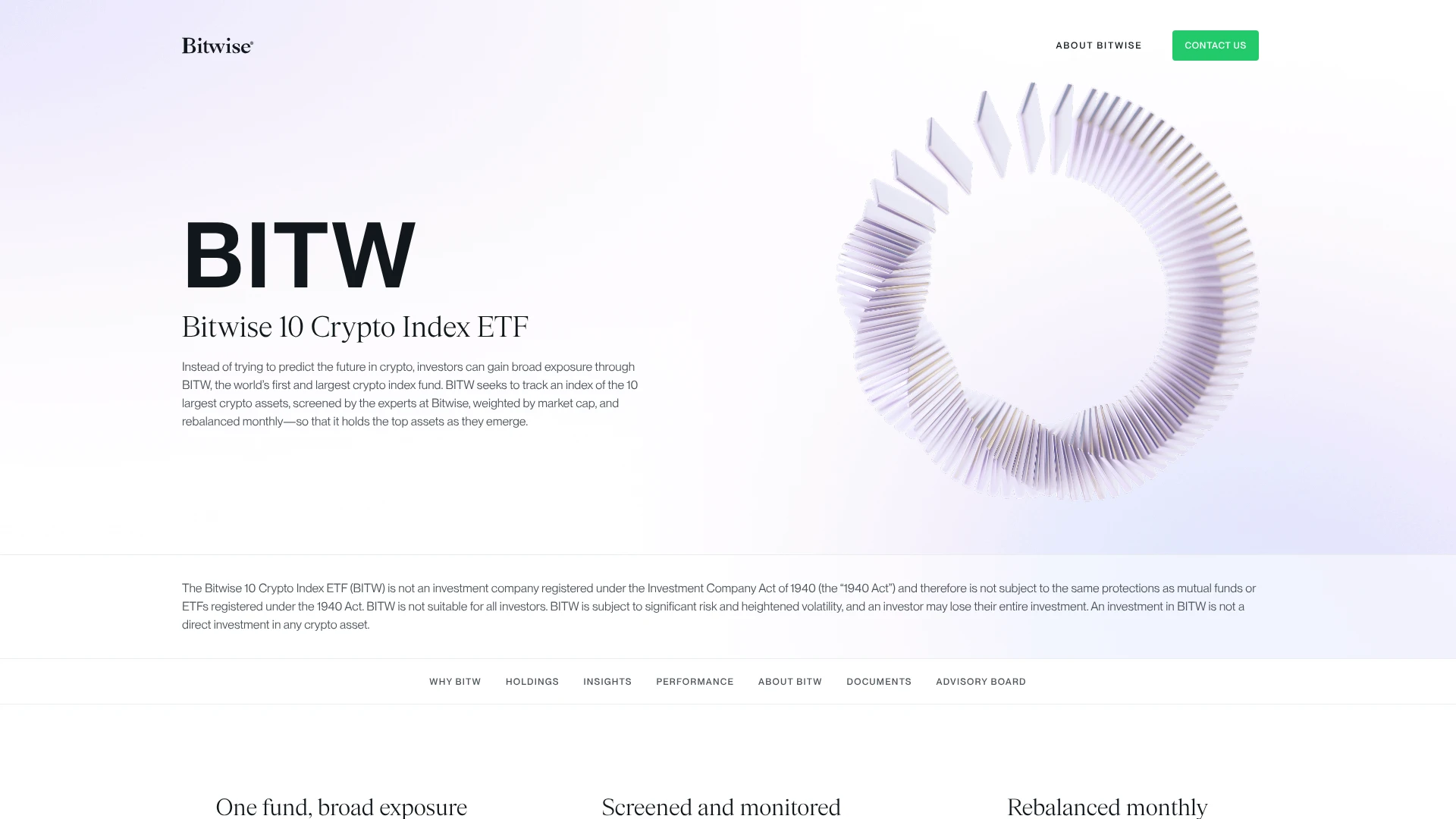
BITW tracks the 10 largest crypto assets, weighted by market cap and rebalanced monthly. It held about $691.3 million as of 25 October 2026, according to Bitwise, and charges 0.75%.
The fund dates to 2017 and listed on NYSE Arca on 9 December 2025. Bitcoin made up 76.67% and ether 13.51% of the portfolio as of 25 October 2026, so a “10 coin” fund is still mostly bitcoin.
Best for: readers who want one fund holding several large coins.
Website: bitwiseinvestments.com
15. Hashdex Nasdaq CME Crypto Index ETF (NCIQ)
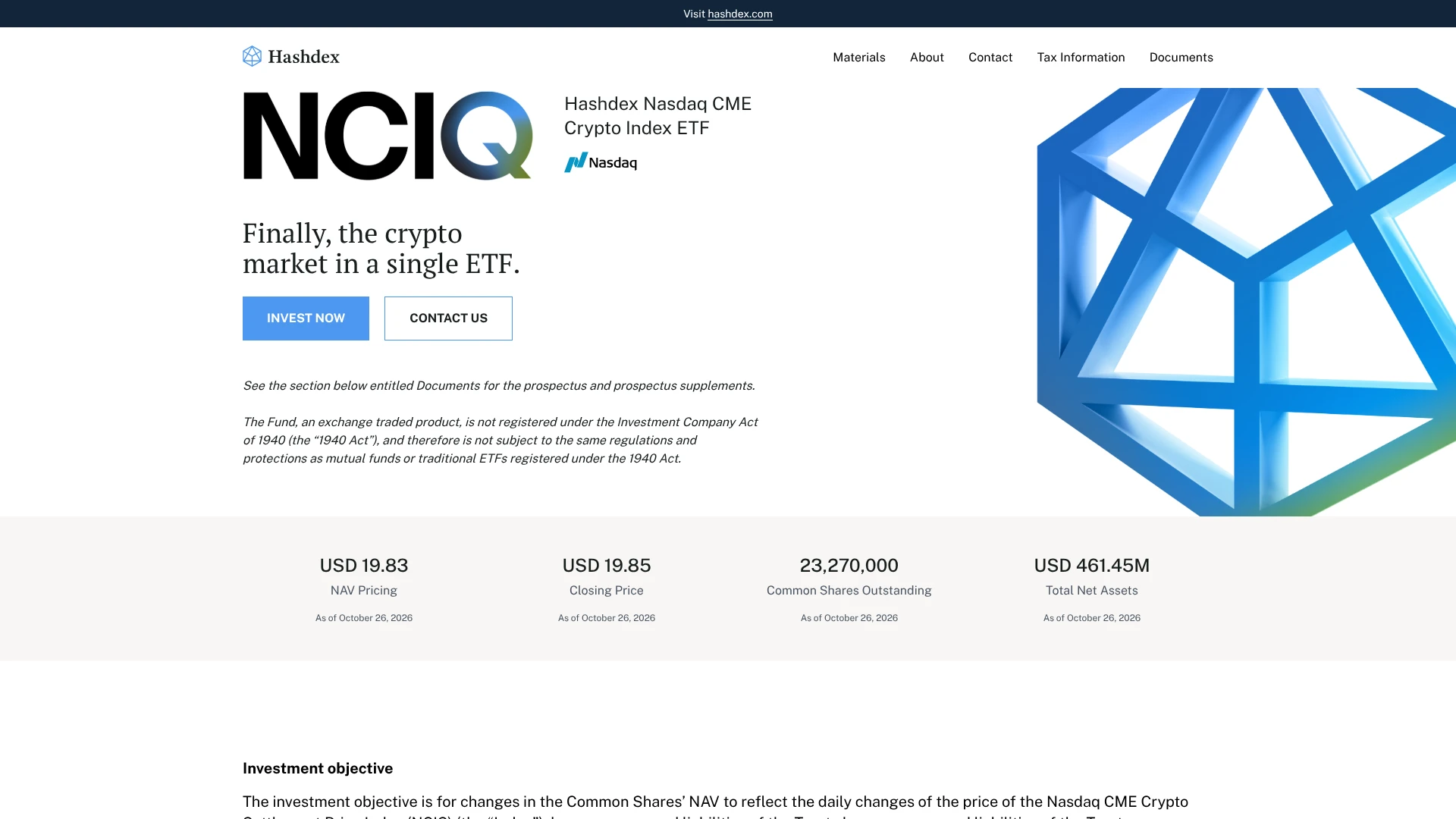
NCIQ tracks the Nasdaq CME Crypto Settlement Price Index and held nine assets as of October 2026, with bitcoin at about 75.6%. It charges 0.25% and had $461.45 million in net assets as of 26 October 2026, according to Hashdex.
It launched on Nasdaq in February 2025 and stakes part of its holdings, 12.92% of net asset value as of October 2026. At a third of BITW’s fee, it is the lower-cost of the two large index funds.
Best for: readers comparing a lower fee on a multi-coin index.
Website: hashdex-etfs.com
How Spot Bitcoin ETF Fees Compare
A sponsor fee is the yearly percentage of net assets a fund charges to run the product. In spot bitcoin ETFs the fees now sit in a narrow range, so custody and issuer can matter as much as price. These are the funds whose fee we could confirm on an issuer page, as of October 2026.
| Bitcoin ETF | Fee | Bitcoin Custodian |
|---|---|---|
| Morgan Stanley (MSBT) | 0.14% | Coinbase and BNY |
| Franklin (EZBC) | 0.19% | Coinbase Custody |
| Bitwise (BITB) | 0.20% | Coinbase Custody |
| VanEck (HODL) | 0.20% | Gemini Trust Company |
| ARK 21Shares (ARKB) | 0.21% | Anchorage, BitGo, Coinbase Custody International |
| iShares (IBIT) | 0.25% | Coinbase Custody |
| Fidelity (FBTC) | 0.25% | Fidelity Digital Assets |
| CoinShares (BRRR) | 0.25% | Coinbase Custody and BitGo |
None of the bitcoin fund pages we could open showed an active fee waiver in October 2026; the launch waivers of 2024 have expired. Waivers still matter in newer products: ETHB’s 0.12% rate and TSOL’s full waiver both have end dates, after which the standard fee applies.
Spot, Staking and Index ETFs: What Is the Difference?
A spot ETF holds the coin directly. A staking ETF is a spot ETF that also locks part of its proof-of-stake coins with validators and passes the rewards to the fund, minus a share kept by the sponsor and its providers. An index ETF holds a basket of coins according to a published index.
The practical differences show up in the details. Staked share varies a lot: TETH, the 21Shares ether fund, had about 51% staked as of 30 September 2026, while BSOL targets 100%. Index fund fees vary widely, from 0.75% for BITW to 0.25% for NCIQ. And the share of staking rewards a sponsor keeps is a second cost on top of the sponsor fee.
Why There Are So Many Crypto ETFs Now
The SEC approved 11 spot bitcoin ETPs on 10 January 2024, and spot ether ETFs began trading on 23 July 2024. The bigger change came in September 2025, when the SEC approved generic listing standards for commodity-based trust shares. Exchanges can now list qualifying products without first submitting a proposed rule change to the SEC for each one.
Spot Solana and XRP funds followed within weeks of each other in late 2025, and Bitwise added Chainlink, Avalanche, Hyperliquid and NEAR funds during 2026. For background on what this means for adoption, see our overview of institutional crypto adoption in 2026.
How Cryptic Helps
Cryptic is a crypto marketing agency headquartered in Dubai, founded in 2020 and a verified Circle Alliance partner. ETF launches put crypto in front of advisers, wealth platforms and institutional allocators, an audience that reads research, compares fees and expects disclosure. Projects and issuers that want that audience need positioning, tier-1 coverage and content that holds up to due diligence.
We have managed more than $10M in crypto marketing budgets and scaled more than 200 Web3 brands, including work with Bybit, Binance, OKX and Canton Network. Our crypto PR agency team handles media and thought leadership for institutional-facing brands, and our guide on how to market a crypto project to institutional investors shows the playbook.
Final Thoughts
The US crypto ETF market in 2026 is no longer a bitcoin-only story. Bitcoin funds are cheap and crowded, with fees between 0.14% and 0.25% among the funds we checked. Ether funds now split into plain and staked versions. Solana, XRP and newer coins have their own spot funds, though most of them are far smaller than IBIT and ETHA. Fees and assets change, so check each figure on the issuer’s page before relying on it.
If you are building a crypto brand that needs to reach institutional investors, book a strategy call with Cryptic.
FAQ
What is the largest crypto ETF in 2026?
BlackRock’s iShares Bitcoin Trust (IBIT) is the largest fund in this comparison, with about $64.7 billion in net assets as of 26 October 2026, according to iShares. The largest ether fund is BlackRock’s iShares Ethereum Trust (ETHA), with about $7.55 billion as of the same date. Both are far larger than any Solana, XRP or index fund.
Which bitcoin ETF has the lowest fee?
Among the funds whose fee we confirmed with the issuer, Morgan Stanley Bitcoin Trust (MSBT) has the lowest sponsor fee at 0.14%, which Morgan Stanley called the lowest bitcoin ETP fee when it launched in April 2026. Franklin’s EZBC charges 0.19%, Bitwise’s BITB and VanEck’s HODL 0.20%, and IBIT and FBTC 0.25%, as of October 2026.
Do any crypto ETFs pay staking rewards?
Yes. Several ether and Solana funds stake part or all of their holdings and pass rewards to the fund. Examples include BlackRock’s ETHB, Bitwise’s BSOL and Fidelity’s FSOL. The sponsor usually keeps a share of the rewards; ETHB’s sponsor and execution agent take 10% of gross staking rewards. Plain funds such as ETHA and ETHW do not stake.
Are there spot Solana and XRP ETFs in the US?
Yes. Bitwise’s BSOL began trading on 28 October 2025, announced as the first US spot Solana ETP, and Canary’s XRPC began trading on 13 November 2025 as the first spot XRP ETF under the 1933 Act structure. As of October 2026, the largest funds we checked are BSOL in Solana, with about $1.07 billion, and the Bitwise XRP ETF in XRP, with about $535.2 million.
What is the difference between a crypto ETF and buying crypto directly?
A spot crypto ETF holds the coin for you through a regulated custodian, and you own shares of the fund in a brokerage account, paying a yearly sponsor fee. Buying directly on an exchange means you own the coin itself and can move it to a wallet, but you handle custody yourself or trust the exchange. Our list of the top crypto exchanges covers that route.
How does Cryptic work with crypto ETF issuers and institutional brands?
Cryptic is a crypto marketing agency founded in 2020 and headquartered in Dubai. It is a verified Circle Alliance partner that has worked with Bybit, Binance, OKX and Canton Network. For institutional-facing brands, Cryptic handles positioning, tier-1 PR, thought leadership and content built to pass due diligence. Cryptic’s ETF comparison is editorial information, not investment advice.