Quick answer
Kalshi is the stronger choice for regulated US trading, and Polymarket is the stronger choice for crypto-native, global access. Kalshi is a CFTC-regulated exchange available in 49 states plus DC, trades in US dollars, and led the market with $31.5 billion in June 2026 volume. Polymarket is onchain, settles in USDC on Polygon, and dominates political and global markets, adding $13.3 billion across its main and US platforms in the same month. Choose Kalshi for compliance and fiat rails. Choose Polymarket for onchain transparency, deep liquidity in politics, and worldwide reach.
Prediction markets stopped being a niche in 2026. In June alone, Kalshi and Polymarket processed a combined $44.8 billion in trading volume, a 75% jump from May, according to The Block. The 2026 FIFA World Cup poured fuel on the fire, with Kalshi’s World Cup Winner market alone drawing more than $832 million in bets.
So when people compare Polymarket vs Kalshi, the real question is no longer “which one is bigger.” Both are now serious platforms. The question is which one fits your goals, your location, and how you want to trade. For crypto projects and marketing teams, it is also about which ecosystem to build around.
This guide breaks down Polymarket vs Kalshi across regulation, fees, markets, liquidity, and US access, so you can pick the right platform in 2026. If you want to look beyond the two leaders, see our guide to the top prediction market platforms in 2026. For a wider view of trading venues, see the top crypto exchanges in 2026.
What Are Prediction Markets, And Why They Boomed In 2026
A prediction market is a platform where people trade on the outcome of real-world events, such as elections, sports, or economic data. Each contract settles at $1 if the event happens and $0 if it does not. As a result, the live price acts as a real-time probability of the outcome.
Two platforms lead the sector. Kalshi is a US-regulated event exchange. Polymarket is a crypto-native protocol. Both surged in 2026 as sports, politics, and macro events pulled in millions of new traders. Naturally, the World Cup became the clearest catalyst, turning casual fans into active market participants.
Polymarket vs Kalshi At A Glance
| Feature | Polymarket | Kalshi |
|---|---|---|
| Type | Onchain, crypto-native protocol | CFTC-regulated event exchange |
| Regulation | US relaunch via acquired QCEX licence | CFTC-designated contract market since 2020 |
| US Access | Via Polymarket US (compliant pathway) | 49 states plus DC |
| Currency | USDC on Polygon (pUSD collateral) | US dollars |
| June 2026 Volume | $13.3 billion (main plus US) | $31.5 billion |
| Fees | Taker fees around 0.75% to 1.8% | Formula-based trading fees |
| Funding | Crypto deposits and withdrawals | ACH, debit, wire, and select crypto |
| Best For | Crypto traders, politics, global users | US traders, compliance, fiat rails |
Polymarket
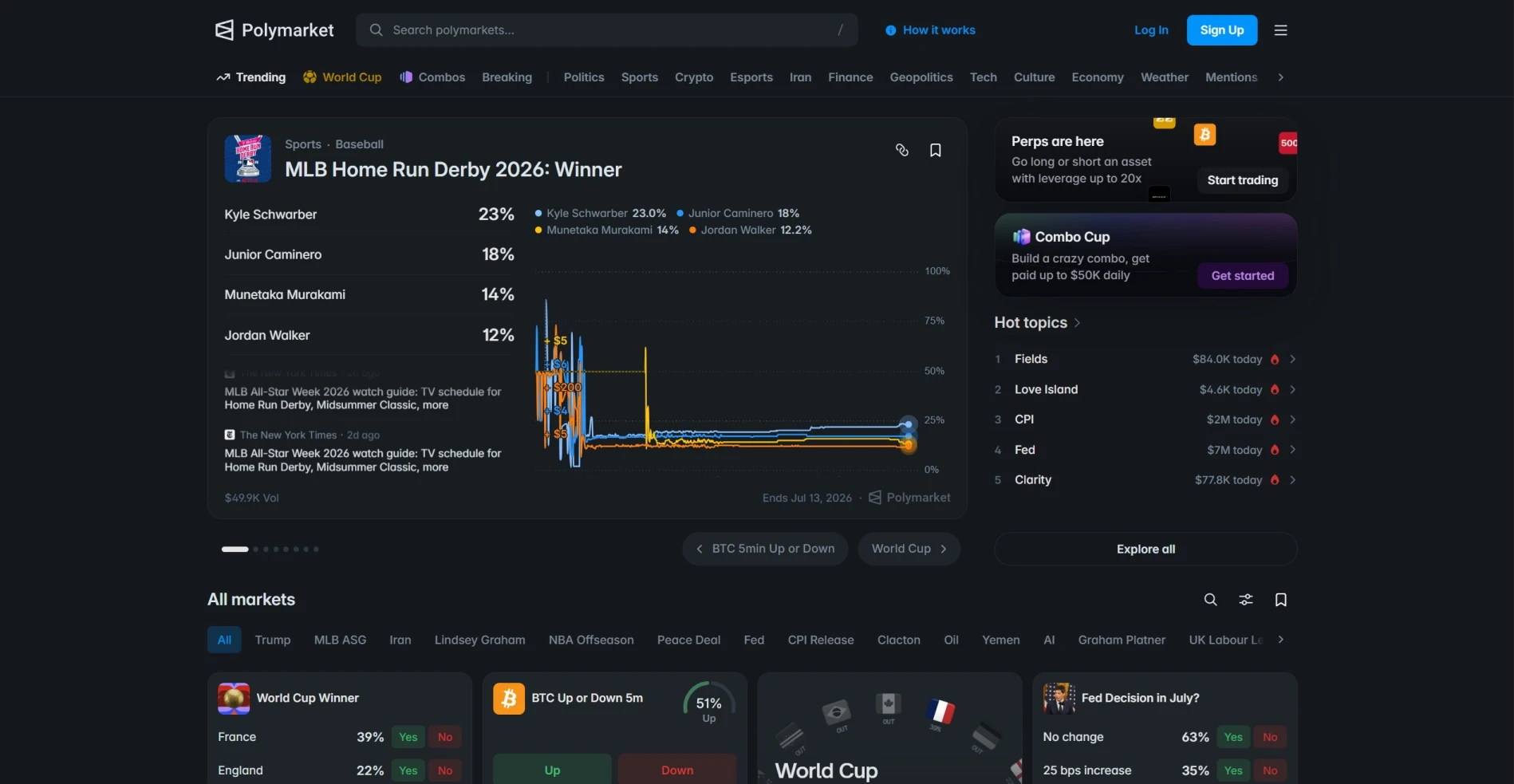
Best for crypto-native, global, and political markets
Polymarket is the largest onchain prediction market in the world. It runs on the Polygon network and settles trades in USDC, which makes it fully crypto-native. Because it is onchain, every position, price, and settlement is transparent and verifiable by anyone.
Its biggest strength is political and global markets. Polymarket built its reputation during major elections, and it remains the deepest venue for politics, geopolitics, and crypto-related events. Meanwhile, its US relaunch through the acquired QCEX licence, branded Polymarket US, opened a compliant path back into the American market. In June 2026, the main platform added $10.26 billion in volume and Polymarket US added a further $3.04 billion.
Key Stats
- Type: Onchain prediction market on Polygon
- Currency: USDC (pUSD collateral, backed 1:1)
- Best For: Politics, crypto markets, global and onchain traders
- Strengths: Deep political liquidity, full onchain transparency, worldwide access, strong brand
Kalshi
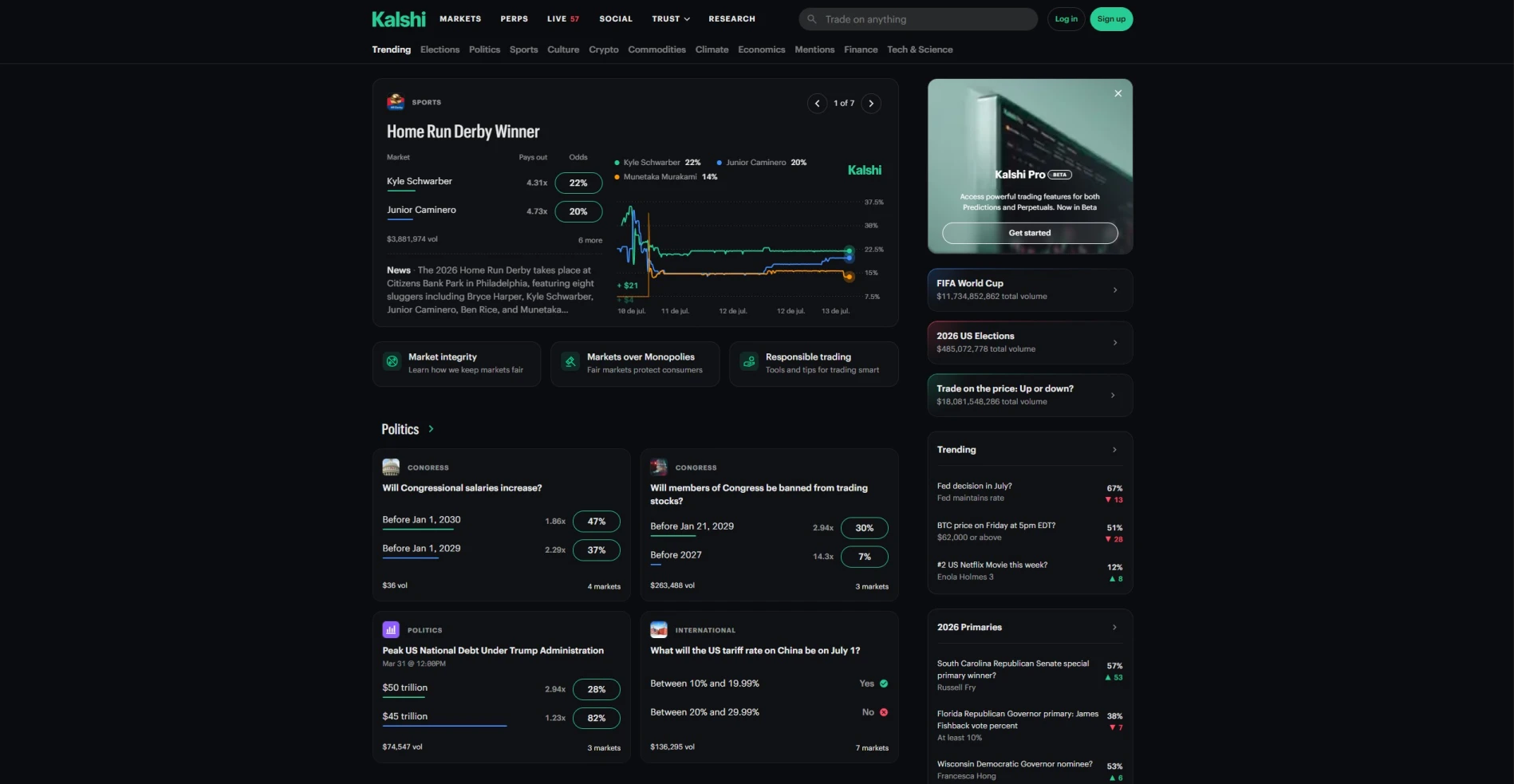
Best for regulated US trading and volume
Kalshi is the volume leader and the most clearly regulated option. It has operated as a CFTC-designated contract market since 2020, and it added its own clearing entity, Kalshi Klear, in 2024. In other words, it works inside the traditional US derivatives framework rather than around it.
For US users, this matters. Kalshi is available in 49 states plus DC, supports fiat funding through ACH, debit cards, and wire, and trades directly in US dollars. As a result, it feels familiar to anyone used to a regulated brokerage. In June 2026, Kalshi posted a record $31.5 billion in volume, up 87.4% month over month, driven heavily by sports and the World Cup.
Key Stats
- Type: CFTC-regulated event exchange
- Currency: US dollars
- Best For: US traders, sports, compliance-first users
- Strengths: Full CFTC regulation, deep US access, fiat rails, record trading volume
Head-To-Head: The Key Differences
Regulation And Trust
Kalshi leads on regulation. It is a CFTC-designated contract market with US clearing, which gives it clear legal standing. Polymarket, by contrast, is crypto-native and settled earlier CFTC charges in 2022, then acquired a licensed entity to relaunch in the US. Therefore, if regulatory certainty is your top priority, Kalshi has the edge.
Fees
Both platforms keep fees competitive. Polymarket charges variable taker fees, roughly 0.75% to 1.8% depending on the market, and no deposit or withdrawal fees. Kalshi uses a formula-based trading fee and does not charge for ACH transfers, though card deposits can carry a small fee. In practice, active traders should compare fees per market rather than assume one is always cheaper.
Markets And Liquidity
This is where the two differ most. Polymarket owns political and global markets, with the deepest liquidity for elections and geopolitics. Kalshi is stronger in sports, economics, and US-centric events. During the World Cup, both benefited, but Kalshi captured the larger share of sports volume.
Access And Funding
Kalshi is easier for US users who prefer traditional banking rails. Polymarket is easier for crypto users who already hold USDC and want onchain control of their funds. Ultimately, your wallet and location often decide the winner here.
Polymarket vs Kalshi: Which Should You Use In 2026?
There is no single winner for everyone. The right platform depends on where you live, how you fund your account, and what you want to trade.
Choose Kalshi if you are a US-based trader who wants a CFTC-regulated exchange, fiat funding, and strong sports and economic markets. Choose Polymarket if you want onchain transparency, USDC settlement, global access, and the deepest liquidity in political markets. For many active traders, using both is the smartest approach, since each platform leads in different categories.
How Cryptic Helps Prediction Markets Grow
Prediction markets did not scale by accident. They scaled through sharp positioning, community building, and well-timed cultural moments like the World Cup. That is exactly the work Cryptic does for Web3 brands.
Cryptic is a crypto marketing agency based in Dubai, founded in 2020, and a verified Circle Alliance Partner. Our clients include Binance, Bybit, Algorand, OKX, Canton, and Polymarket. As a result, we understand how prediction markets, exchanges, and onchain products win attention and convert it into active users. Our teams run KOL marketing and full-funnel crypto growth marketing campaigns that turn moments into momentum. If you are building in this space, book a free strategy call.
Frequently Asked Questions
Is Polymarket or Kalshi better in 2026?
It depends on your needs. Kalshi is better for regulated US trading, fiat funding, and sports markets, and it led with $31.5 billion in June 2026 volume. Polymarket is better for onchain, crypto-native trading, global access, and political markets. Many traders use both, since each leads in different categories.
Is Polymarket legal in the US?
Polymarket returned to the US through Polymarket US, a compliant pathway built on a licensed entity it acquired. The main global platform historically restricted US users after a 2022 CFTC settlement. In 2026, US traders access Polymarket through this regulated route, while Kalshi remains available directly in 49 states plus DC.
What is the difference between Polymarket and Kalshi?
Polymarket is an onchain prediction market that settles in USDC on Polygon and leads in political and global markets. Kalshi is a CFTC-regulated event exchange that trades in US dollars and leads in volume and US sports markets. The core difference is crypto-native versus traditional regulated infrastructure.
How do prediction markets make money?
Prediction markets earn revenue mainly from trading fees. Polymarket charges taker fees of roughly 0.75% to 1.8% per market. Kalshi uses a formula-based fee on each contract. Both platforms grew revenue sharply in 2026 as combined monthly volume passed $44.8 billion, driven by sports and the World Cup.
Final Thoughts On Polymarket vs Kalshi
Polymarket vs Kalshi is not a fight with one winner. It is a split market. Kalshi leads on regulation, US access, and raw volume. Polymarket leads on onchain transparency, global reach, and political liquidity. In 2026, both are proof that prediction markets have moved from the fringe to the mainstream.
For crypto projects, the lesson is bigger than picking a platform. The brands that win this cycle are the ones that combine a strong product with sharp marketing and real community. That is the gap Cryptic closes for Web3 teams building the next wave of onchain products.