Quick answer
Solarious is a Renewable Energy Monetization Platform that went live on September 1, 2026, producing and tokenizing environmental commodities for better earnings. Introducing a new Proof-of-Energy Layer-1 blockchain, its Solar Miner measures and signs solar production data, validates proofs for commodity issuers and the network mints SOLAR tokens from accepted records. The first SOLAR tokens have already been used to settle an invoice on-chain. CertiK completed a security audit of Solarious in July 2026.
The Renewable Energy Monetization Platform that unlocks more value from producing solar energy. The network issues SOLAR tokens and environmental commodities settlement from verified renewable-energy production data and has completed its first on-chain payment.
SAN DIEGO – Solarious announced that its Layer-1 blockchain went live on September 1, 2026, bringing its Proof-of-Energy system into live operation. The network is recording signed solar-generation data, validating energy proofs, issuing SOLAR tokens from accepted production records and processing on-chain transactions.
Solarious has also completed the network’s first payment transaction using SOLAR. The token was transferred on-chain to settle an invoice, demonstrating a practical payment use on the live network alongside its role in renewable-energy verification.
Infrastructure For Trusted Solar Energy Production Data
Distributed solar systems generate measurable electricity, but turning those readings into records that another party can trust requires more than ordinary monitoring. The data must be linked to a real device, authenticated, checked against previous submissions and protected against replay or unrealistic production claims.
Solarious addresses that problem with connected measurement hardware, cryptographic signatures and blockchain validation. Its proprietary DC-connected Solar Miner measures voltage, current and cumulative energy output. Each approved device has its own cryptographic identity and signs production reports before sending them to a relayer service.
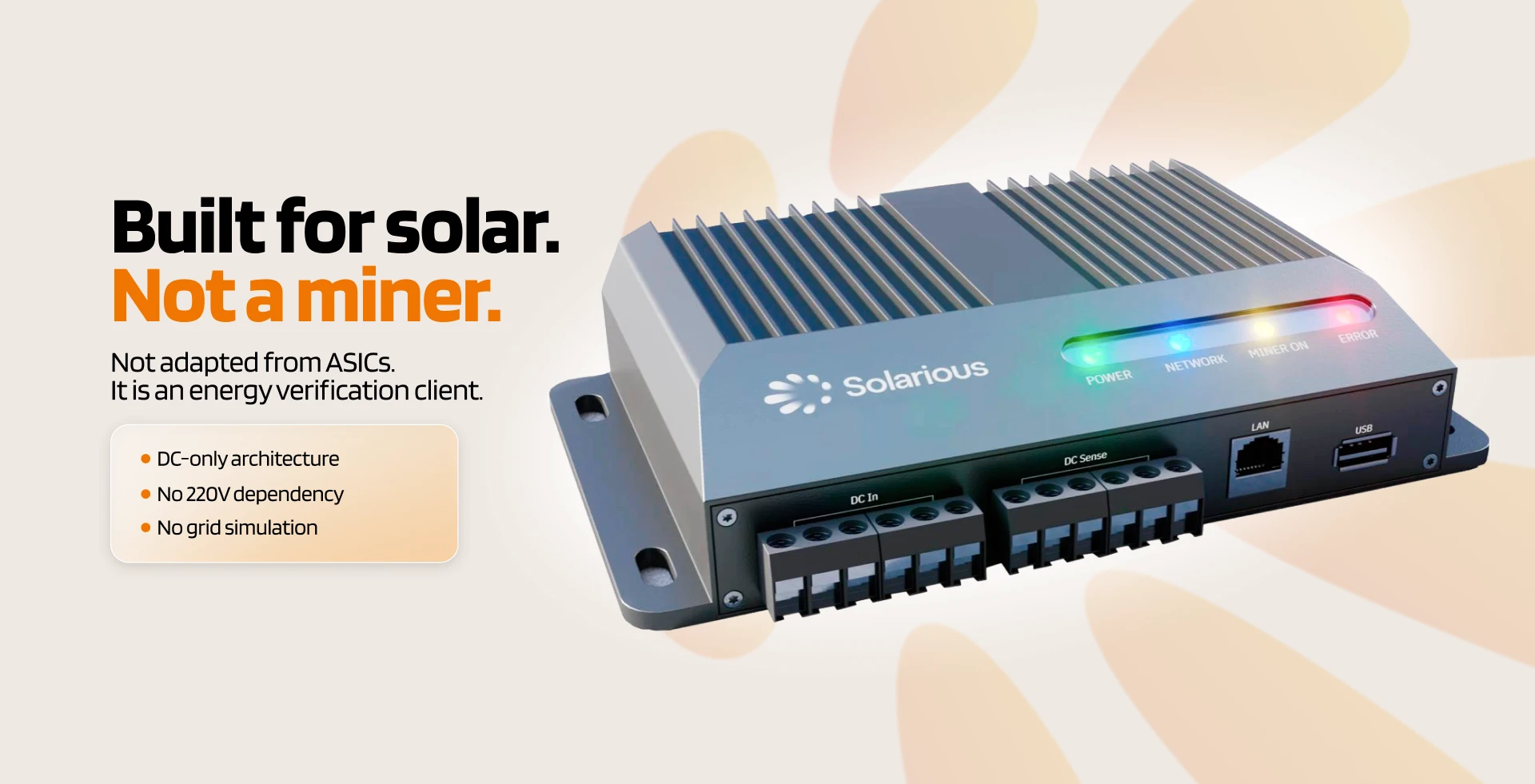
The relayer submits each signed report to the Solarious network. A smart contract checks the device identity and signature, compares the cumulative reading with the last accepted report and applies a registered production-rate limit. Accepted records become traceable on-chain entries. According to Solarious documentation, device registration, production history and related transactions can be queried from the blockchain.
This creates a shared audit trail without treating blockchain as the source of the physical measurement. The electricity is generated and measured off-chain; Solarious records and validates the associated proof on-chain. A blockchain record does not by itself create a Renewable Energy Certificate or determine ownership of an environmental attribute.
Evidence from the live system
The September launch follows earlier operational milestones. Solarious previously announced that its first Solar Miner had generated signed energy proofs on-chain and identified an April 29 Proof-of-Energy demonstration as a step toward production readiness. The live network now extends that workflow from device reporting to token issuance and transaction settlement.
Solarious has developed the blockchain, validator architecture, mining-pool infrastructure, block explorer, developer documentation and the initial Solar Miner verification client. SOLAR functions as the network utility token for transaction fees and other protocol activity. Its demonstrated uses now include issuance from accepted energy proofs and payment of an invoice on-chain.
CertiK completed a security audit of Solarious in July 2026. CertiK’s public record states that the assessment covered 26 code files using static analysis, formal verification and manual review. Eleven findings were resolved and five were acknowledged, while 27 of 27 formal-verification properties passed. The audit applies to the code within its stated scope.
Live today and planned next
Solarious is live as a blockchain network for signed renewable-generation records, token issuance and on-chain transactions. The company’s next stages include broader Solar Miner deployment, expanded validator participation and further producer onboarding.
SREC/REC settlement is expected to progress as the Solarious network expands and more Solar Miners generate sufficient eligible environmental-attribute deposits to support aggregation and trading. Solarious is currently working with several solar farms to integrate the solution. Participation and availability will remain subject to location, metering standards, registry requirements, contractual ownership and applicable regulation per jurisdictions.
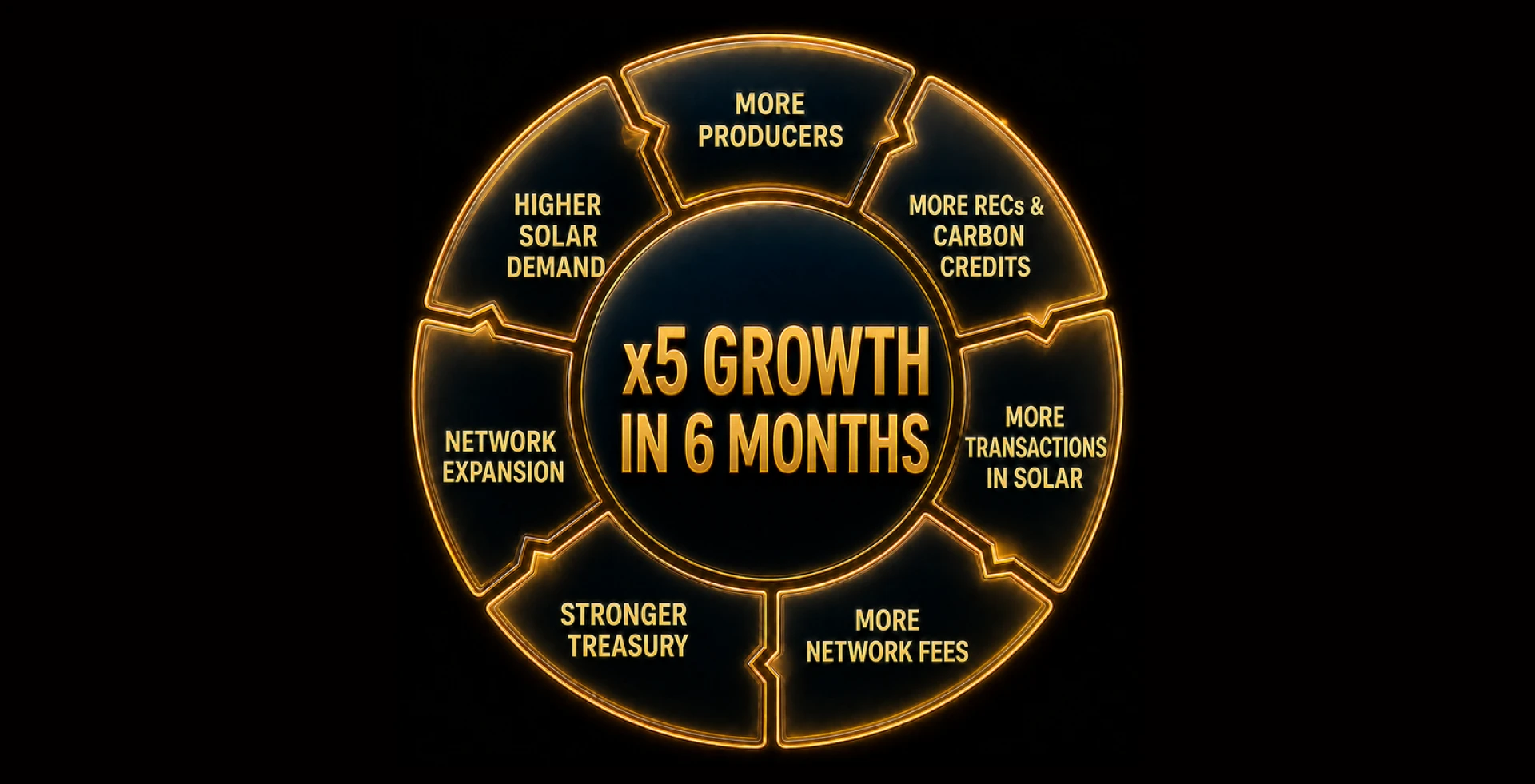
The two economies – crypto and environmental commodities – form a reinforcing cycle, with each stage supporting and strengthening the next.
A network centered on measurable production
“We are not building another blockchain. We are building the missing infrastructure that connects environmental commodities to digital markets.” said Jack Samatov, founder and CEO of Solarious.
The live launch gives that objective a concrete base: signed generation data is being accepted by the network, SOLAR is being issued from verified production records, and the token has been used to complete an on-chain payment.
You can join Solarious early in two ways: earn $SOLAR through the Airdrop Campaign by downloading Verdex Wallet, or buy $SOLAR at a discount directly from the Solarious website.
Frequently Asked Questions
What is Proof-of-Energy?
Proof-of-Energy is a new mining protocol that Solarious uses to connect measured solar production to its blockchain network growth. Connected hardware measures electricity output off-chain and signs a production report, and the network validates that proof on-chain before accepting the record. SOLAR tokens are then issued from accepted production records, which ties token issuance to verified renewable-energy production data.
How does the Solar Miner work?
The Solar Miner is a proprietary DC-connected device developed by Solarious. It measures voltage, current and cumulative energy output, and each approved device has its own cryptographic identity used to sign production reports. A relayer submits the signed reports to the network, where a smart contract checks the device identity and signature, compares the cumulative reading with the last accepted report and applies a registered production-rate limit.
Does a Solarious on-chain record create a Renewable Energy Certificate?
Not by itself. According to Solarious, a blockchain record does not create a Renewable Energy Certificate or determine ownership of an environmental attribute. The electricity is generated and measured off-chain, and Solarious records and validates the associated proof on-chain. SREC and REC settlement is expected to progress as more Solar Miners generate eligible environmental-attribute deposits, subject to location, metering standards, registry requirements, contractual ownership and regulation.
Has Solarious been audited?
Yes. CertiK completed a security audit of Solarious in July 2026. According to CertiK’s public record, the assessment covered 26 code files using static analysis, formal verification and manual review. Eleven findings were resolved and five were acknowledged, while 27 of 27 formal-verification properties passed. The audit applies to the code within its stated scope.
About Solarious
Solarious is the trade name of Crypto Engine LLC. The company operates a Layer-1 network and develops connected hardware for renewable-energy data verification. Its ecosystem includes the Solar Miner device, Proof-of-Energy verification, validator infrastructure and the Verdex Wallet.
Official resources: Website | Technical documentation | Protocol terms | CertiK audit
Risk and eligibility notice
Digital assets involve risk and may lose some or all of their value. SOLAR availability and participation are subject to jurisdictional eligibility, project terms and technical conditions. Nothing in this article is investment advice or an offer, solicitation or recommendation where prohibited. Rewards, utility, liquidity and market value are not guaranteed. Environmental attributes may not be available for every installation.