
Quick answer
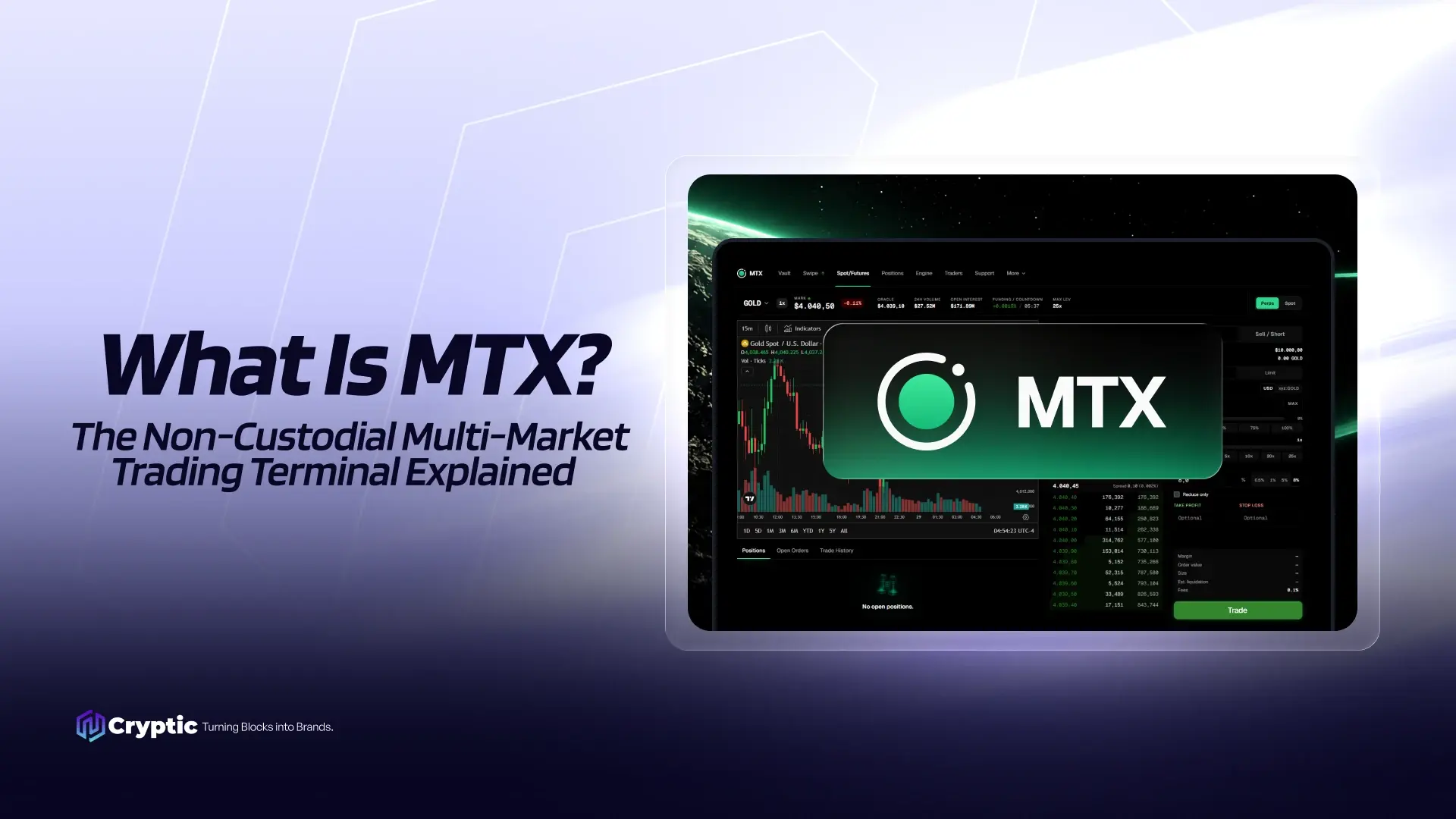
MTX is a non-custodial, multi-market trading terminal designed to let users access different markets, brokers and venues through one unified interface while keeping control of their assets in their own vault or wallet. Its core positioning is built around three ideas: multi-market access, cross-venue connectivity and self-custody. MTX combines these foundations with a mode-based interface that ranges from simplified trading experiences to more advanced terminal, execution, data and automation workflows.
Traditional trading platforms often force users to choose between simplicity and depth, or between centralized custody and direct control over their assets.
MTX is approaching the problem differently.
Instead of positioning itself as another broker or single-market trading app, MTX is designed as an orchestration layer that can sit between traders, markets, brokers, exchanges and wallets.
The idea is simple:
Trade everything, anytime, anywhere from your own vault.
That positioning puts self-custody at the center of the product while combining it with multi-market access and a modular interface designed for different types of trading workflows.
What Is MTX?
MTX is a non-custodial, multi-market trading terminal.
Rather than acting as the custodian of user assets, MTX is designed to connect users with different trading venues while the assets themselves remain inside the user’s own vault or wallet.
This creates a different relationship between the trader and the trading platform.
With a traditional custodial broker, assets are generally held inside an account controlled by the broker. With MTX, the product vision places the user’s own vault at the center and uses MTX as the interface and orchestration layer around it.
The platform is also designed around multi-asset access. The current product positioning includes stocks, futures, options, crypto and FX through connected brokers and decentralized exchanges.
The goal is not simply to create another trading screen.
MTX is attempting to create one environment through which different markets and different trading experiences can be accessed.
The Three Ideas Behind MTX
The MTX proposition can be broken down into three core ideas.
1. Trade Everything
The first pillar is asset agnosticism.
MTX is designed around access to multiple asset classes instead of being tied to a single type of market.
The current product vision includes:
- Stocks
- Futures
- Options
- Crypto
- FX
Access would come through connected brokers, exchanges and decentralized venues rather than requiring MTX itself to become the underlying venue for every asset.
For traders, the value of this model is consolidation.
Instead of switching between separate platforms for different markets, MTX is designed to provide a unified front end across them.
2. Trade Anytime, Anywhere
The second pillar is cross-venue access.
MTX is positioned as a layer that can connect with brokers and other providers in the background while presenting those connections through one interface.
That means the terminal can potentially bring together infrastructure that normally exists across multiple separate platforms.
The important distinction is that MTX does not need to replace every broker or exchange.
It can connect them.
That turns MTX from a traditional trading platform into something closer to a trading operating system that sits above different providers.
3. Trade From Your Own Vault
The third pillar is self-custody.
This is one of the clearest differences between MTX and conventional brokerage platforms.
User assets are intended to remain in the user’s own vault or wallet, with MTX functioning as the orchestration layer rather than the custodian.
The Vault therefore plays a central role in the MTX product architecture.
It is designed as the connection point for wallets, accounts and broker integrations while reinforcing the idea that users remain in control of their assets.
MTX Modes At A Glance
MTX is structured around a collection of specialized product modes rather than one single interface.
| Mode | Role within MTX |
|---|---|
| Agent X | Automation and AI-oriented trading workflows |
| Swipe | Simplified, mobile-first market interaction |
| Smart Money | Market discovery and intelligence |
| Engine | Execution, routing and trading logic |
| Terminal | Information-dense professional trading interface |
| Data and Intel | Analytics, signals and market intelligence |
| Predict | Predictive analytics and forecasting |
| Trade | Core trading execution |
| Vault | Self-custody and account connectivity |
The product report describes these modes as a stack of specialized workflows, allowing MTX to serve different levels of trading complexity without forcing every user into the same interface.
How The MTX Modes Work
Vault
Vault sits at the foundation of the MTX concept.
It is designed as the self-custody core of the platform and the integration hub for wallets, accounts and broker connections.
Instead of starting with a broker account and building outward, MTX starts with the user’s own vault and connects trading infrastructure around it.
That gives the product a crypto-native foundation while still allowing it to connect with more traditional market infrastructure.
Trade
Trade represents the core execution layer.
Its purpose is straightforward: provide trading access across the connected markets and venues inside the MTX environment.
Rather than treating every market as a completely separate experience, Trade is intended to bring execution into the same broader MTX ecosystem.
Terminal
Terminal is the more advanced trading environment.
The product analysis describes it as an information-dense interface closer to the type of workstation experienced traders may recognize from Interactive Brokers or MetaTrader-style platforms.
Charts, order books and multi-asset market information can form part of this experience.
This gives MTX a professional layer without requiring every user to begin with a professional trading interface.
Swipe
Swipe approaches trading from the opposite direction.
It is designed as a simplified, mobile-first interface for faster market discovery and trade decisions.
The idea is to reduce friction for users who do not want to immediately interact with a dense professional terminal.
This creates a potential progression within the platform.
A user can begin with a simpler mode and later move toward Terminal, Engine and other advanced tools as their needs become more sophisticated.
Engine
Engine represents the execution and orchestration core.
The current product analysis associates the mode with areas such as order routing, risk parameters, bots and abstraction between different trading venues.
This layer is important to the wider MTX proposition because connecting multiple venues is only useful if the complexity behind those connections can be simplified for the user.
Smart Money
Smart Money is positioned as a discovery and intelligence layer.
The current concept focuses on surfacing institutional-style flows or structured market signals based around factors such as liquidity, volume and alpha signals.
The objective is to add more context to trading decisions rather than presenting users with raw market access alone.
Data And Intel
Data and Intel represents the analytical side of MTX.
The product analysis connects the mode with analytics, signals and market structure insights, with potential applications around deeper research and testing.
This gives MTX a data layer alongside its execution and custody layers.
Predict
Predict is positioned around predictive analytics.
The current product concept connects it with areas such as price, volatility and probability forecasting.
Together with Agent X and Data and Intel, it forms part of the more data-driven side of the MTX stack.
Agent X
Agent X is positioned as an automation-oriented layer.
The current product analysis describes it as a potential co-pilot that could support order routing, trading playbooks and workflows across connected brokers and venues.
The significance is not simply adding another feature.
It gives MTX a possible interface between the trader and the increasingly complex infrastructure underneath the terminal.
How MTX Differs From Traditional Trading Platforms
MTX is not trying to compete only on the number of markets available.
Its architecture creates several structural differences.
Self-Custody Instead Of Platform Custody
Traditional brokers generally hold client assets within brokerage accounts.
MTX is designed around a different model where the user’s vault remains the center of the experience and MTX acts as the orchestration layer.
Multiple Venues Through One Interface
Most retail trading applications remain closely connected to one broker or one primary back end.
MTX is designed around multi-market and multi-venue abstraction.
That means a user could interact with different infrastructure without requiring a completely separate front end for each provider.
Multiple Interfaces For Different Traders
Many platforms make a trade-off.
Professional terminals offer depth but can be difficult to learn. Retail apps offer simplicity but often remove advanced functionality.
MTX attempts to combine both approaches.
Swipe provides a simpler experience while Terminal and Engine are designed for more advanced workflows.
Instead of choosing between a retail app and a professional terminal, MTX is building both experiences into the same product architecture.
Who Is MTX Built For?
The MTX product analysis identifies advanced retail and prosumer traders as a particularly relevant audience.
These are users who want more control and flexibility than a simple retail app can provide, but who also want a more modern experience than traditional professional trading terminals.
The positioning becomes especially relevant for traders who value three things:
Self-custody.
Multi-market access.
More advanced execution and data tools.
The product strategy specifically recommends positioning MTX toward advanced retail and prosumer traders looking for self-custody, multi-market access and advanced execution on top of connected brokers and venues.
Why The Mode-Based Structure Matters
One of the more important parts of MTX is not any individual mode.
It is the ability to combine them.
A new user does not necessarily need the same interface as an experienced trader.
Someone exploring markets may prefer Swipe.
An active trader may want Terminal.
A more advanced user may require Engine.
A data-focused trader may use Data and Intel or Predict.
A user focused on connectivity and custody begins with Vault.
The recommended product journey even suggests allowing users to progress from Swipe toward Terminal, Engine, Agent X and Predict as they become more advanced.
This gives MTX the potential to grow with the trader rather than forcing every trader into the same experience from day one.
The Bigger MTX Vision
The strongest way to understand MTX is not as another trading application.
It is a unified trading layer.
The platform brings together three elements that are usually separated across different products:
Vault: where control and connectivity begin.
Modes: how users interact with markets.
Intelligence: how data, analytics and automation can support those workflows.
The MTX product strategy identifies Vault, Modes and AI-oriented functionality as the three pillars that can differentiate the platform from classic terminals and retail trading apps.
The result is a product designed to connect markets without taking control away from the trader.
Frequently Asked Questions
What Is MTX?
MTX is a non-custodial, multi-market trading terminal designed to connect users with different markets, brokers and trading venues through one interface while allowing assets to remain inside the user’s own vault or wallet.
Is MTX A Broker?
MTX is positioned as an orchestration layer rather than a traditional custodial broker. The product is designed to connect with brokers and other venues while presenting those services through a unified front end.
What Markets Does MTX Target?
The current product positioning includes stocks, futures, options, crypto and FX through connected brokers and decentralized exchanges.
What Is The MTX Vault?
Vault is the self-custody core of MTX. It is designed as an integration hub for wallets, accounts and broker connections while keeping the user’s own vault central to the trading experience.
What Are MTX Modes?
Modes are specialized interfaces and workflows within the MTX platform. The current stack includes Agent X, Swipe, Smart Money, Engine, Terminal, Data and Intel, Predict, Trade and Vault.
Is MTX Designed Only For Professional Traders?
No. The mode-based structure is intended to bridge different user levels. Swipe provides a simpler interface while Terminal and Engine represent more advanced workflows. The product strategy particularly identifies advanced retail and prosumer traders as a key audience.
What Makes MTX Different From MetaTrader-Style Platforms?
MTX combines a mode-based architecture with an explicit self-custody vault and a broader multi-asset positioning. Its product concept also puts data, predictive tools and automation-oriented modes more prominently into the platform architecture.
The Bottom Line
MTX is building around a simple but ambitious proposition:
Trade everything, anytime, anywhere from your own vault.
The platform combines self-custody, multi-market access and specialized trading modes inside one environment.
Vault gives users control over their assets and connections.
Trade and Terminal provide access and execution.
Swipe makes the experience more approachable.
Engine adds deeper orchestration.
Data and Intel, Predict and Agent X extend the platform toward more advanced data and automated workflows.
What ties everything together is the architecture.
Instead of building another broker, another exchange or another isolated trading terminal, MTX is designed to become the layer through which traders connect all of them.
One terminal. Multiple markets. Your vault.