
Quick answer
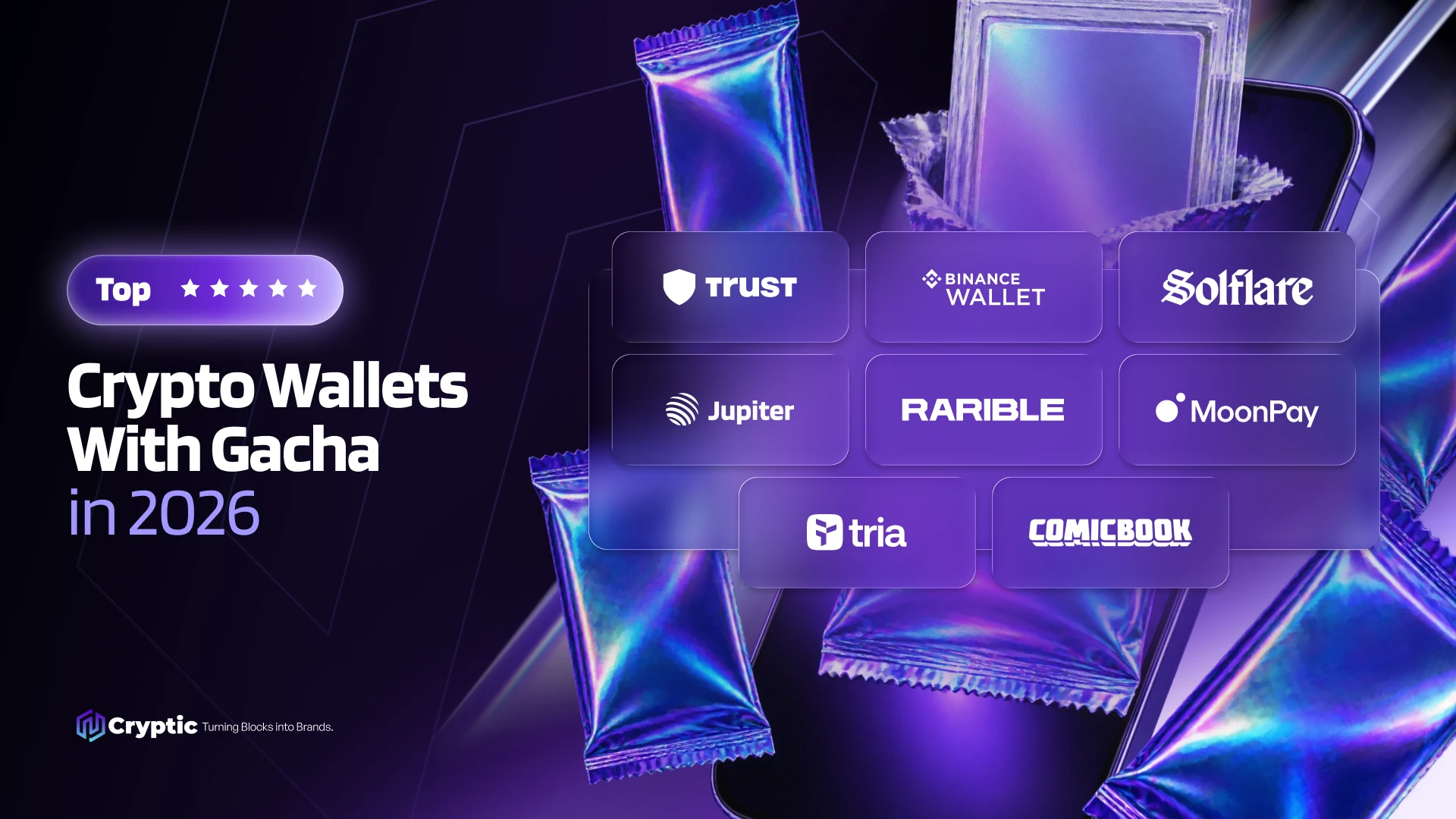
Crypto wallets with gacha now include Trust Wallet, Binance Wallet, Solflare and Tria, plus apps like Jupiter, Rarible, ComicBook.com and MoonPay PayBox. However, almost none of them run the packs themselves. Collector Crypt powers six of the eight platforms on this list, Renaiss powers Binance Wallet, and Tria has not named its provider. So this page tracks who distributes onchain gacha and who sits behind each one.
Onchain gacha is a pack opening product: you pay a fixed price in stablecoins, a random draw picks a real graded collectible from a vault, and you receive a token that represents that item. You can then keep it, sell it back to the provider at a set rate, or have the physical card shipped.
The category is no longer small. For example, the five largest platforms processed $284.3 million of gross gacha activity in July 2026 and returned $249.4 million of it to users through buybacks, according to Blockworks Research.
But the bigger shift is where people open packs. On November 25, 2026, Trust Wallet and Binance Wallet both switched on gacha inside their apps, each with a different provider behind it. This list covers every wallet and app we could verify with a primary source, in order of most recent launch. It is a map rather than a ranking, and it is not financial advice. We update it when a new integration goes live.
Gacha Wallets and Apps at a Glance
| Platform | Type | Powered by | Chain and payment | Live since |
|---|---|---|---|---|
| Trust Wallet | Wallet (mobile) | Collector Crypt | Solana, USDC | November 25, 2026 |
| Binance Wallet | Wallet (in the Binance app) | Renaiss | BNB Smart Chain, USDT | November 25, 2026 |
| Tria | Wallet and card app | Not disclosed | Not disclosed, paid from Tria Wallet | November 4, 2026 |
| MoonPay PayBox | AI payment vault | Collector Crypt | Solana | 2026 |
| Jupiter Gacha | DEX aggregator | Collector Crypt and Phygitals | Solana, USDC | July 13, 2026 (beta) |
| Rarible Gacha Station | NFT marketplace | Collector Crypt | Solana | June 22, 2026 |
| Solflare Packs | Wallet | Collector Crypt | Solana, USDC | June 11, 2026 |
| ComicBook.com | Media site | Collector Crypt | Not stated | May 2026 |
1. Trust Wallet
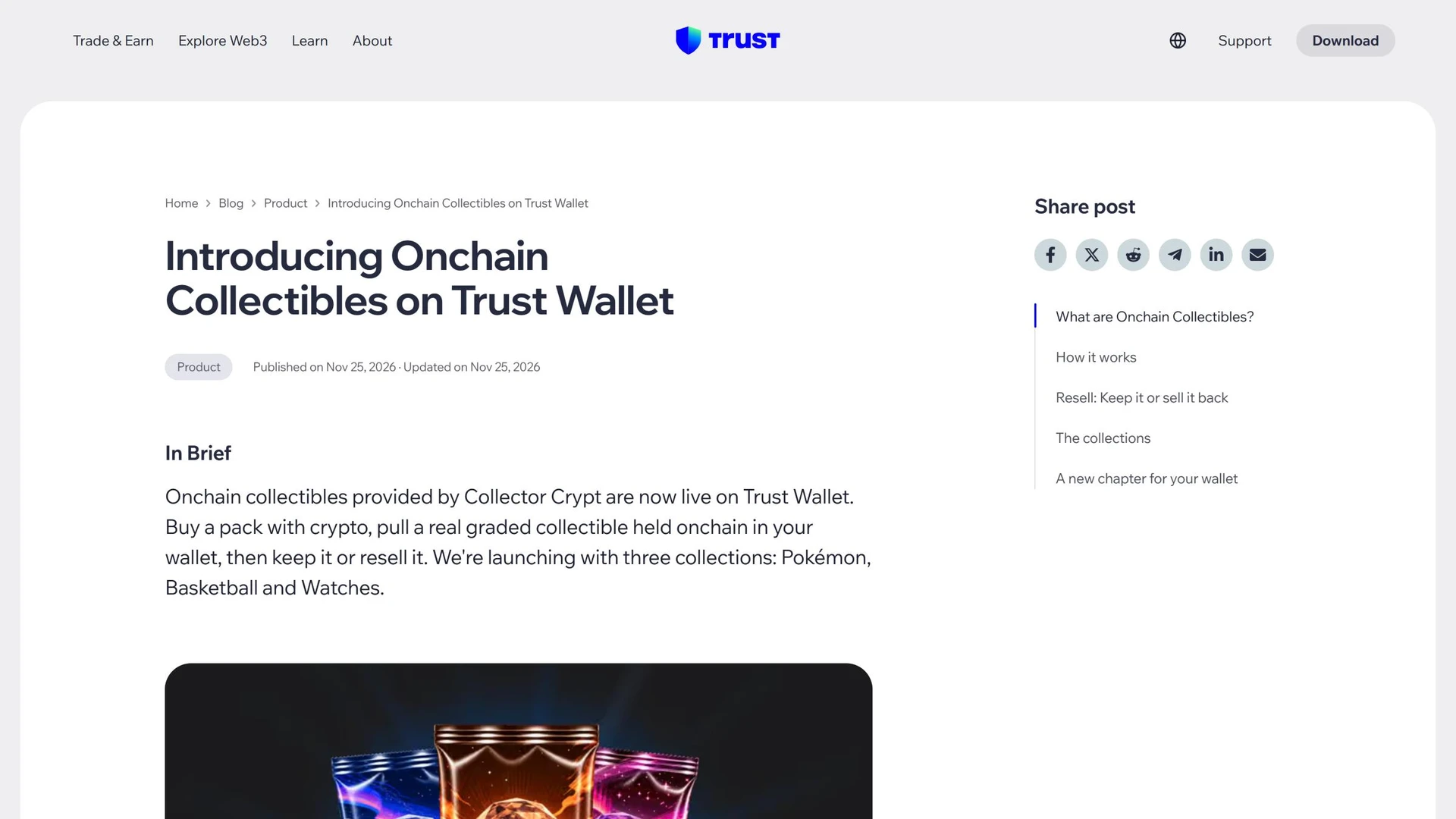
Trust Wallet added collectible packs to its mobile app on November 25, 2026. The launch post states that Collector Crypt provides and operates the collectibles, while Trust Wallet is the distribution platform.
Users pay for packs in USDC on Solana, and each pull is also a token on Solana. At launch the menu runs from a 25 USDC Pokémon starter pack to a 5,000 USDC grail pack, with watch and basketball packs alongside. In addition, every pulled card carries a resell offer for 72 hours. The feature is mobile only and available in certain jurisdictions.
Best for: Seeing how a mainstream multi-chain wallet packages gacha for users who never visited a collectibles site.
Website: trustwallet.com
2. Binance Wallet
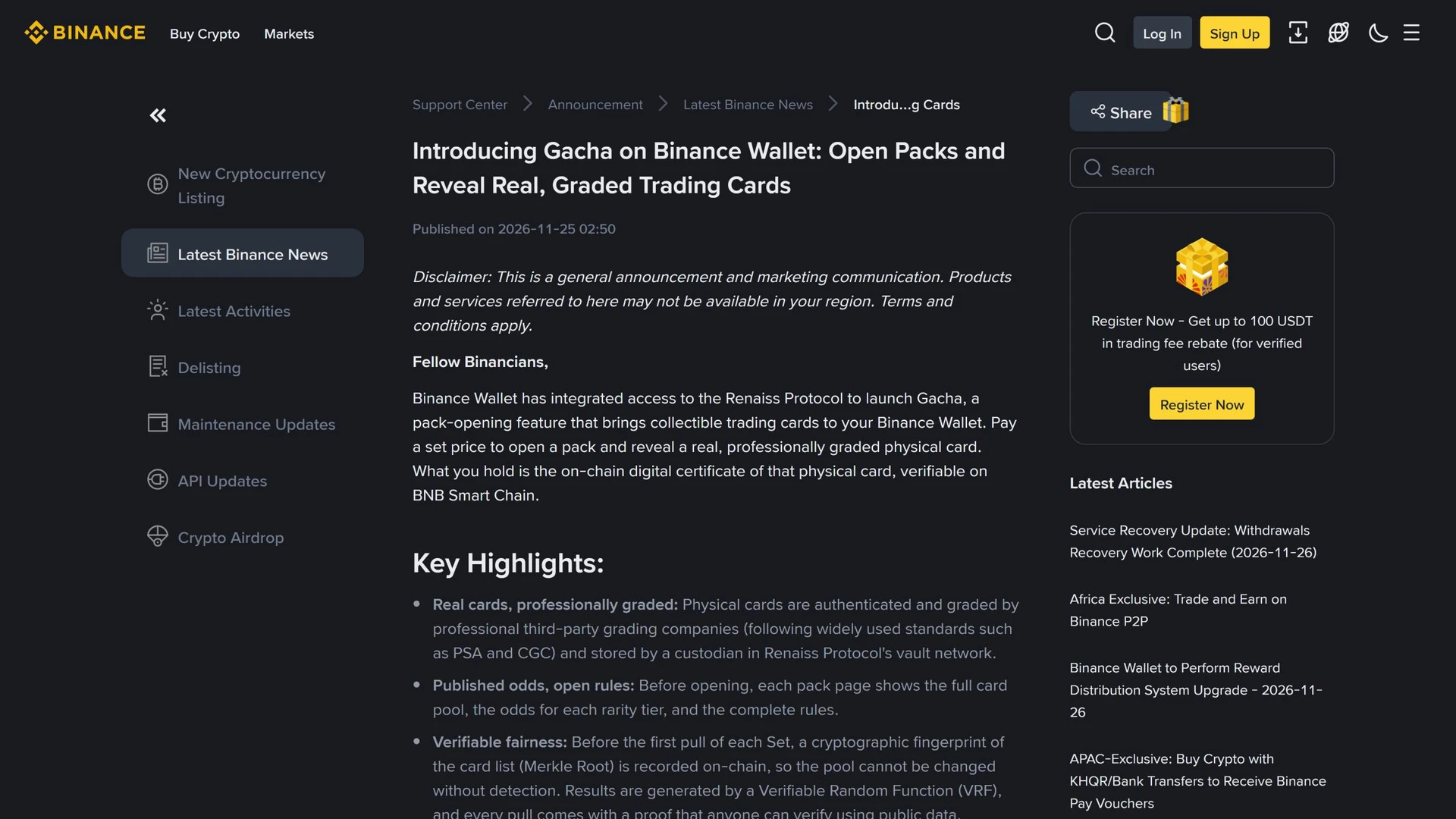
Binance Wallet launched Gacha on the same day, November 25, 2026. The official announcement describes it as a third-party service operated by Renaiss, while Binance Wallet provides access through its interface.
It runs on BNB Smart Chain, and users pay for packs with USDT from the wallet balance. Users can open up to 10 packs at once, and each pack page shows the card pool and the odds for each rarity tier before purchase. Results then come from a verifiable random function. Users can also sell a card back within 72 hours. However, physical redemption is not available at launch.
Best for: Tracking the first large wallet that chose a provider other than Collector Crypt.
Website: binance.com
3. Tria
Tria, a self-custodial finance app that reports more than 600,000 users, opened Tria Gacha to the public on November 4, 2026. According to its press release, users buy packs through Tria Wallet and reveal real graded Pokémon and One Piece cards that they can keep, sell back in the app or have delivered where supported.
Still, the release does not name the company that sources and vaults the cards, and it does not say which chain the tokens live on. As a result, Tria is the one entry on this map where the engine is unknown.
Best for: A look at gacha bundled with a spending card and rewards program.
Website: tria.so
4. MoonPay PayBox
PayBox is the payment vault MoonPay built for AI assistants. It added Collector Crypt as its first collectibles plugin, which lets an AI assistant buy packs for a collector on Solana.
The collector picks one of two modes. In Always Ask mode, every pack needs a passkey approval before the purchase. In Autonomous mode, the collector sets a spending limit and the AI then opens packs within it. It is the first case we found of gacha distributed through an AI agent instead of a screen.
Best for: Teams studying agent-driven purchases as a new distribution channel.
Website: moonpay.com
5. Jupiter Gacha
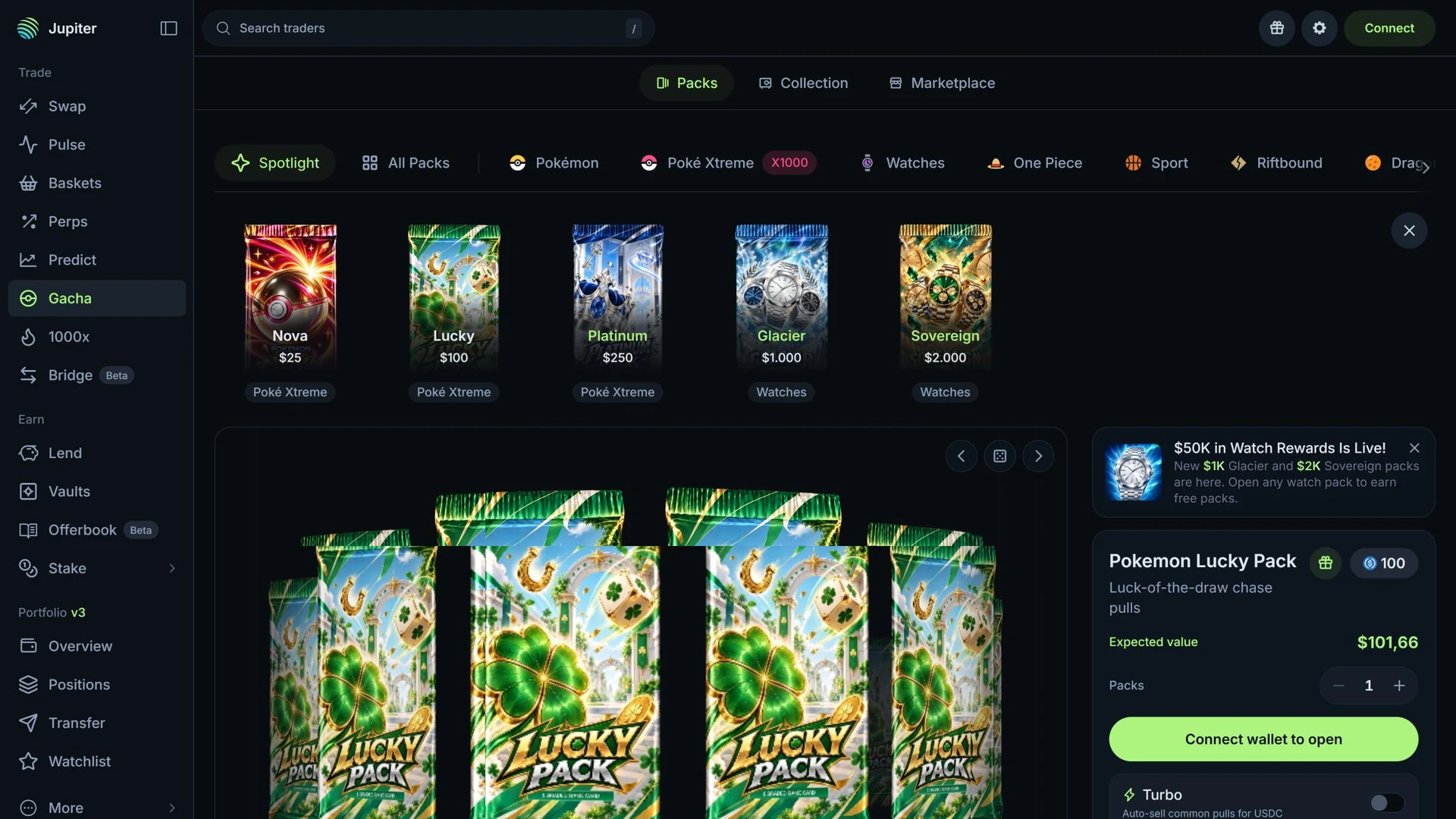
Jupiter, the Solana DEX aggregator, opened Jupiter Gacha in beta on July 13, 2026. It is also the only entry here that runs on two providers. The Jupiter documentation lists Collector Crypt and Phygitals, and each pack belongs to one or the other.
Jupiter prices packs in USDC. The buyback window differs, though: 3 days on Collector Crypt packs and 7 days on Phygitals packs. Phygitals packs follow that company’s restricted jurisdictions policy, while that policy does not affect Collector Crypt packs. Holders can also list a Collector Crypt card on the marketplace or use it as loan collateral on Jupiter Offerbook.
Best for: Comparing two providers side by side inside one interface.
Website: jup.ag/gacha
6. Rarible Gacha Station
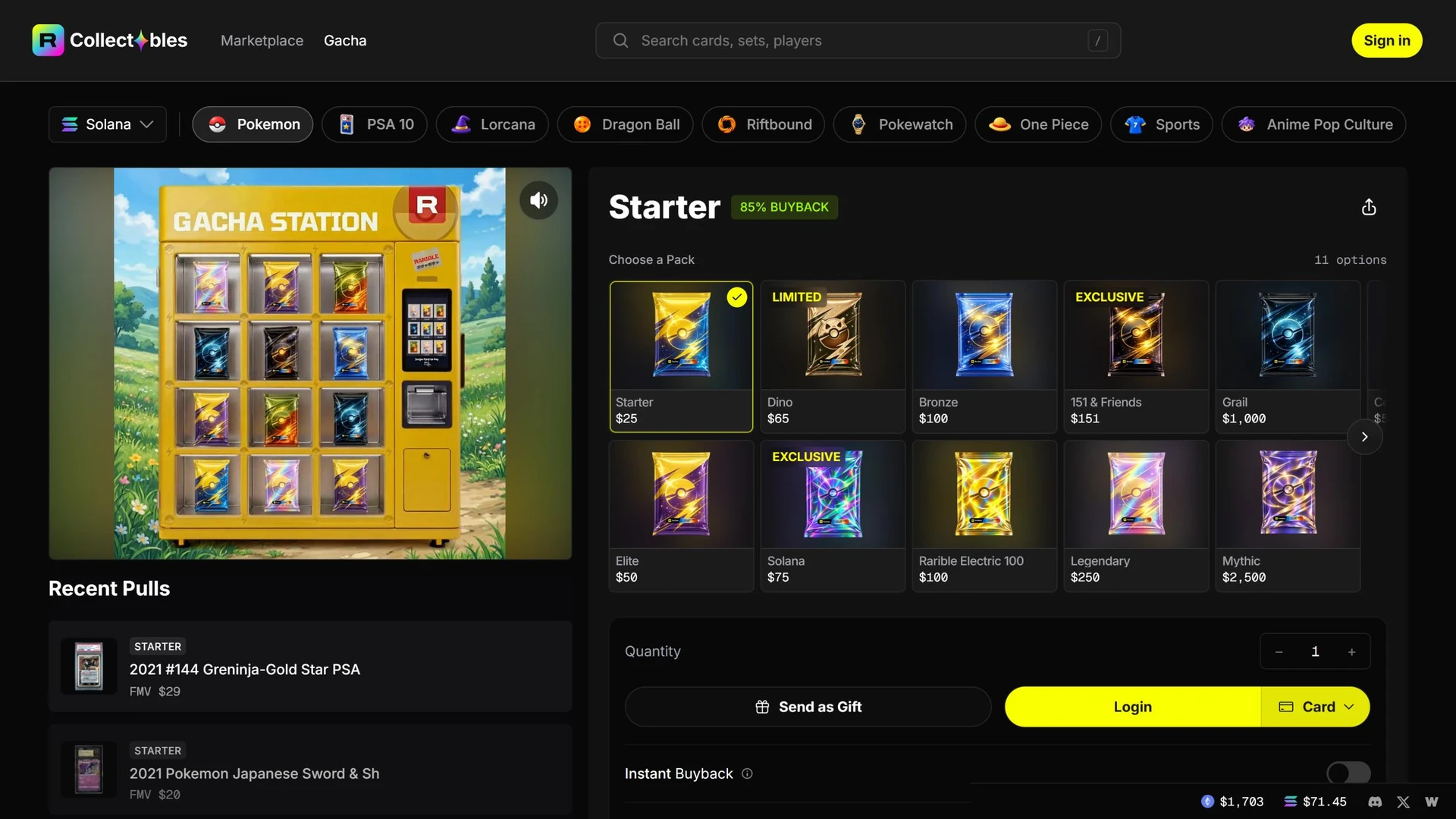
Rarible launched Gacha Station on Solana on June 22, 2026, running on Collector Crypt, as reported by Solana Compass. Collector Crypt handles grading, vault storage, token minting and buyback liquidity, while Rarible supplies the storefront and its collector community.
Rarible later confirmed the partnership with Collector Crypt on its own blog in July 2026.
Best for: A case of an NFT marketplace adding physical collectibles through a provider.
Website: rarible.com
7. Solflare Packs
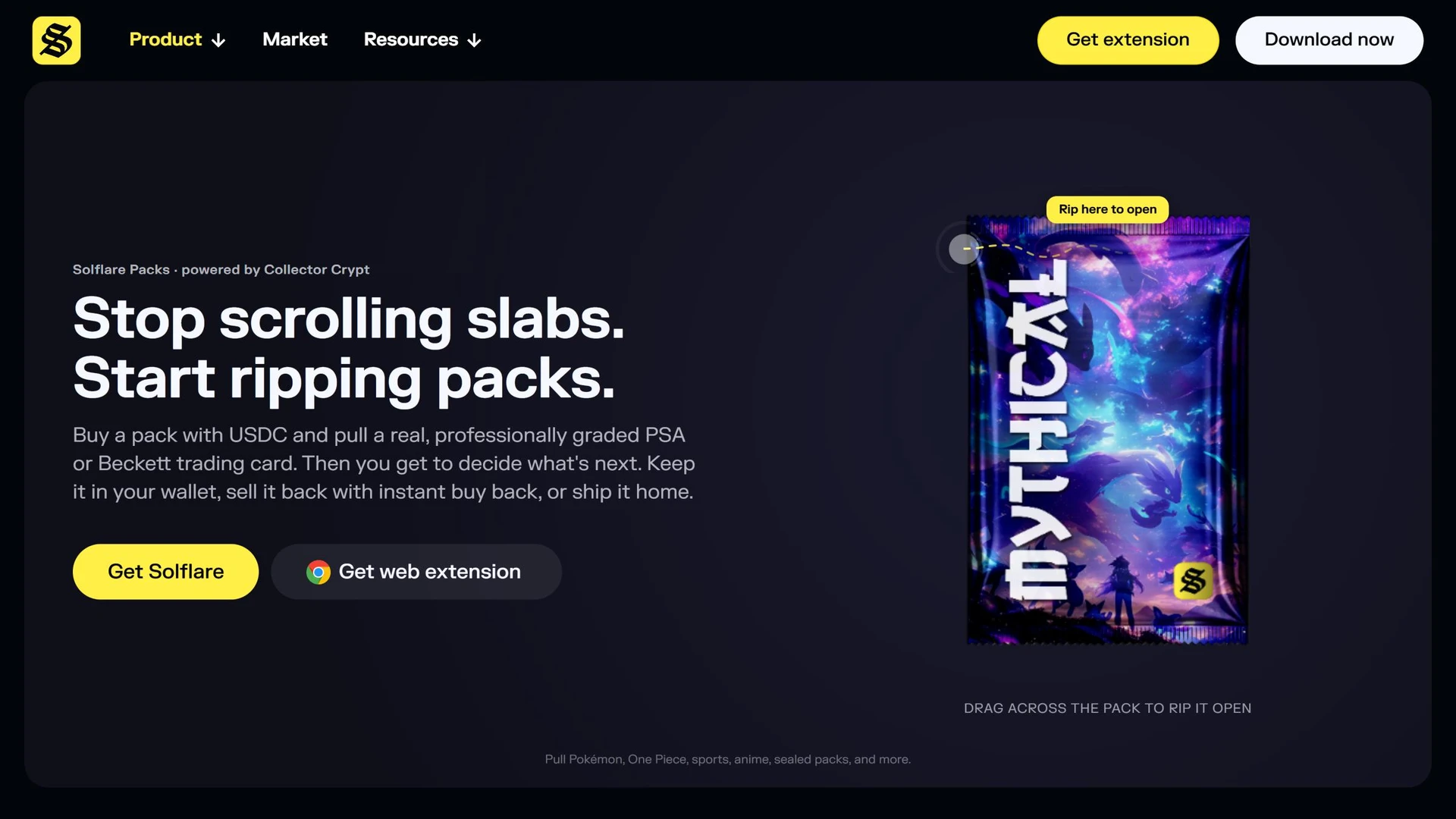
Solflare was the first wallet on this map. It announced Solflare Packs on June 11, 2026 as a native in-wallet experience powered by Collector Crypt. In the announcement Solflare reports over 4 million monthly active users.
Users buy packs in USDC, from 25 USDC to 2,500 USDC, and every card carries a 72-hour buyback window from Collector Crypt. Solflare shows the odds before purchase, limits availability by region and requires buyers to be 18 or older. Solflare did $6.3 million in pack openings in June, including $3.3 million in its first full week, according to the Blockworks second quarter report on Collector Crypt.
Best for: The clearest public numbers on what a wallet integration adds in its first weeks.
Website: solflare.com/packs
8. ComicBook.com
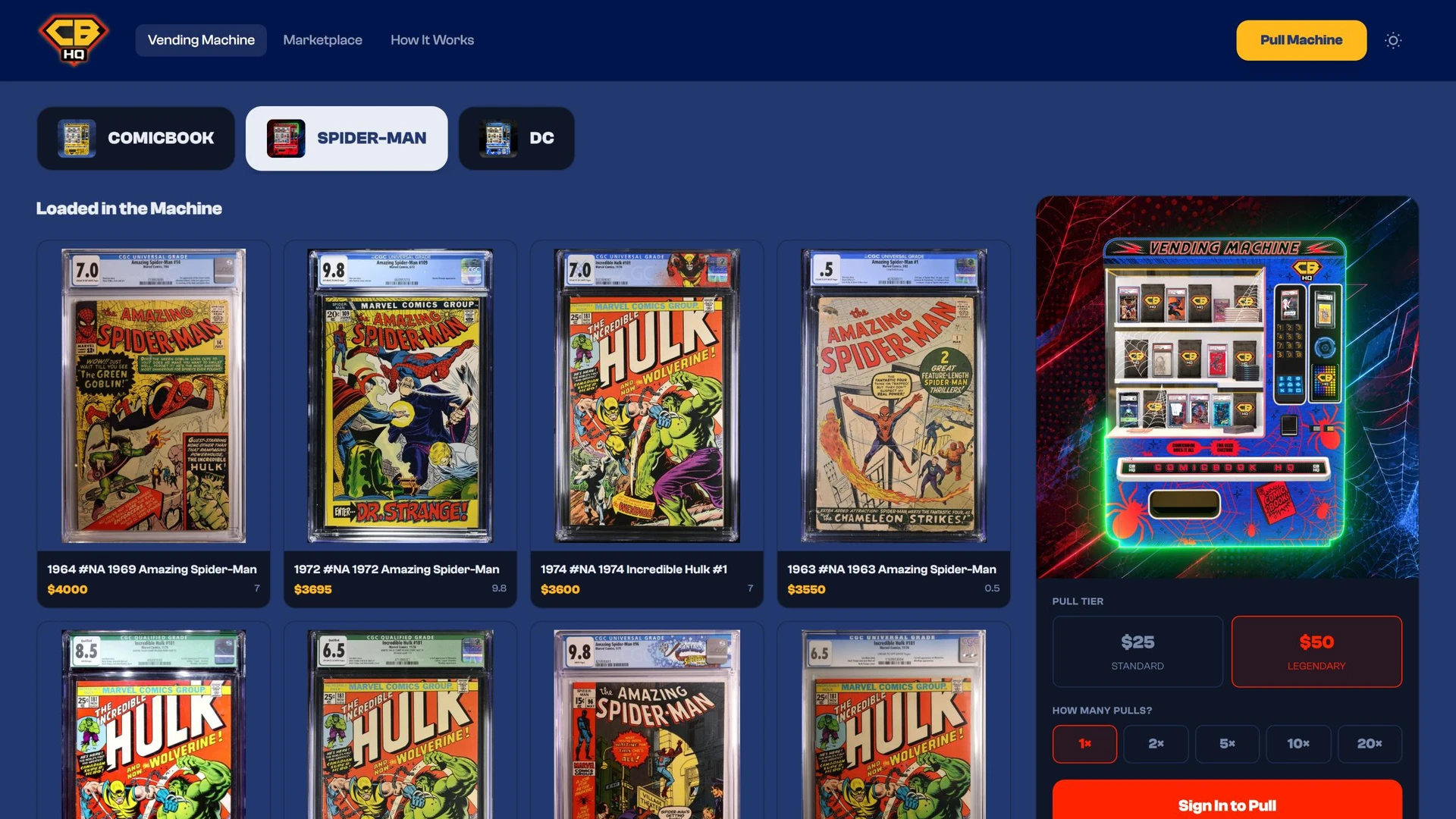
Not every distributor is a crypto product. For example, in May 2026 Collector Crypt announced a Comic Book Gacha machine hosted on ComicBook.com, a media site it says reaches 40 million users. The machine sits on the publisher’s own domain and runs on Collector Crypt’s white-label API.
In the announcement, Collector Crypt said partners can tap into more than $20 million of its inventory with no monetary requirement from the partner. That is the offer that explains why so many fronts use the same engine.
Best for: Understanding gacha as a white-label product for media and community sites.
Website: comicbookvending.com
Who Powers the Packs
A gacha provider is the company that buys, grades and vaults the physical cards, mints the tokens, runs the random draw and pays the buybacks. In contrast, the wallet or app is the storefront. Three providers appear on this map.
Collector Crypt is a Solana platform for tokenized graded cards and the engine behind six of the eight entries. It also runs on Base and Robinhood Chain, according to DefiLlama. Its own share of trading card platform volume was 51.2% in the second quarter of 2026, per the Blockworks report.
Renaiss runs on BNB Chain. It raised $1.5 million in June 2026 in a round led by YZi Labs and reported more than $20 million in revenue and more than 260,000 users at that time, according to its funding announcement. Those figures come from the company itself, so treat them as self-reported.
Phygitals is a Solana platform that supplies part of the Jupiter packs. It took a different road to distribution in April 2026, when it opened a storefront on Fanatics Collect, a traditional trading card marketplace, so tokenized cards appear next to regular listings.
What the Numbers Say About Wallet Distribution
Partner channels are still a small slice. For example, partner pack openings were $14.1 million in the second quarter of 2026, or 3.6% of Collector Crypt’s $395.1 million in gacha spend, according to the Blockworks report. But the curve is steep: $1.0 million in April, $2.5 million in May and $10.7 million in June, the month Solflare went live.
The same report also shows who the buyers are. Wallets that spent more than $100,000 are 3.7% of users and 87% of lifetime spend. Also in June, 57% of monthly users were active on a single day. Twelve months after a first purchase, 9.8% of Collector Crypt users were still active. A wallet integration brings reach, but the revenue still depends on finding and keeping a small group of heavy buyers.
For any Web3 team, the pattern is therefore worth copying. The provider keeps the hard part, which is inventory and logistics, and gives distribution partners a ready product. As a result, growth comes from sitting where users already hold a balance.
How Cryptic Helps
Cryptic is a crypto marketing agency founded in 2020 and headquartered in Dubai, with offices in London, Amsterdam and Riyadh. We are not a gacha platform, so we do not appear on this map. Instead, our work starts after the partners sign the integration: making sure the right users know the product exists and come back to it.
For collectibles platforms, wallets and consumer crypto apps, that usually means creator campaigns with a network of 2K+ KOLs, PR around launches and partnerships, and user acquisition measured in sign-ups and deposits. Cryptic is trusted by Binance, Bybit, OKX and Algorand, and has scaled 200+ Web3 brands. See how we run crypto KOL marketing or read our guide to RWA tokenization platforms for the wider market.
Final Thoughts
At the start of 2026 onchain gacha lived on a handful of specialist sites. Today, however, it sits inside wallets with millions of users, a DEX, an NFT marketplace, a comic book site and an AI payment tool. The interesting contest is no longer which platform has the best packs. Instead, it is which provider sits in the most places, and which distributors turn a first pull into a returning user.
If you are launching a wallet feature, a collectibles product or any consumer crypto app and want a plan to reach users who stay, book a strategy call with Cryptic.
FAQ
Which crypto wallets have gacha built in?
As of November 2026, four wallets have gacha inside the app: Trust Wallet, Binance Wallet, Solflare and Tria. Trust Wallet and Solflare use Collector Crypt as the provider, Binance Wallet uses Renaiss, and Tria has not named its provider. Outside wallets, Jupiter, Rarible, ComicBook.com and MoonPay PayBox also offer packs through third-party providers.
Who powers gacha on Trust Wallet and Binance Wallet?
Trust Wallet says Collector Crypt provides and operates its collectibles, with packs paid in USDC on Solana. Binance Wallet says its Gacha is a third-party service operated by Renaiss on BNB Smart Chain, with packs paid in USDT. Both launched on November 25, 2026, and both give a 72-hour window to sell a card back.
What is onchain gacha?
Onchain gacha is a pack opening product where you pay a fixed price, usually in a stablecoin, and a random draw selects a real graded collectible held in a vault. You receive a token that represents ownership of that item. You can keep the token, sell it back to the provider at a set rate within a time window, or redeem the physical item where shipping is supported.
Can you redeem the physical card from a wallet gacha pull?
It depends on the wallet and the provider. Solflare Packs and Jupiter Gacha let users ship the physical card to a home address. Binance Wallet states that physical redemption is not available at launch and is planned for a future release. Tria offers delivery where supported. Always check the terms on the pack page, because shipping also has country limits.
Is onchain gacha gambling?
There is no single answer, because the rules depend on the country and regulators are still looking at paid random products. Wallets on this list limit access by region and some require buyers to be 18 or older. Packs are not an investment product. A buyback sets a floor on the value of a pull, not a profit, so most of the outcome depends on the draw.
How can a Web3 project get distribution through wallets?
The gacha providers show one model: build the product once, open an API and let wallets and apps embed it under their own brand. Distribution alone is not enough, since most users in this category buy once and leave. Cryptic, a crypto marketing agency based in Dubai, helps projects pair wallet and partner integrations with KOL campaigns, PR and user acquisition so new users return.